“We replaced three people with AI” is the kind of sentence that sounds great in a board deck and falls apart under a CFO’s questions. So let’s do the version that survives those questions.
This is the story of an invoice-processing agent that took over the work of roughly three full-time roles and the actual economics behind that claim. Not the demo math. The real math: what it costs to build, what it costs to run, what humans still do, and where the payback genuinely comes from. If you’re weighing operational AI for finance, this is the accounting you should demand before signing anything.
Results at a glance
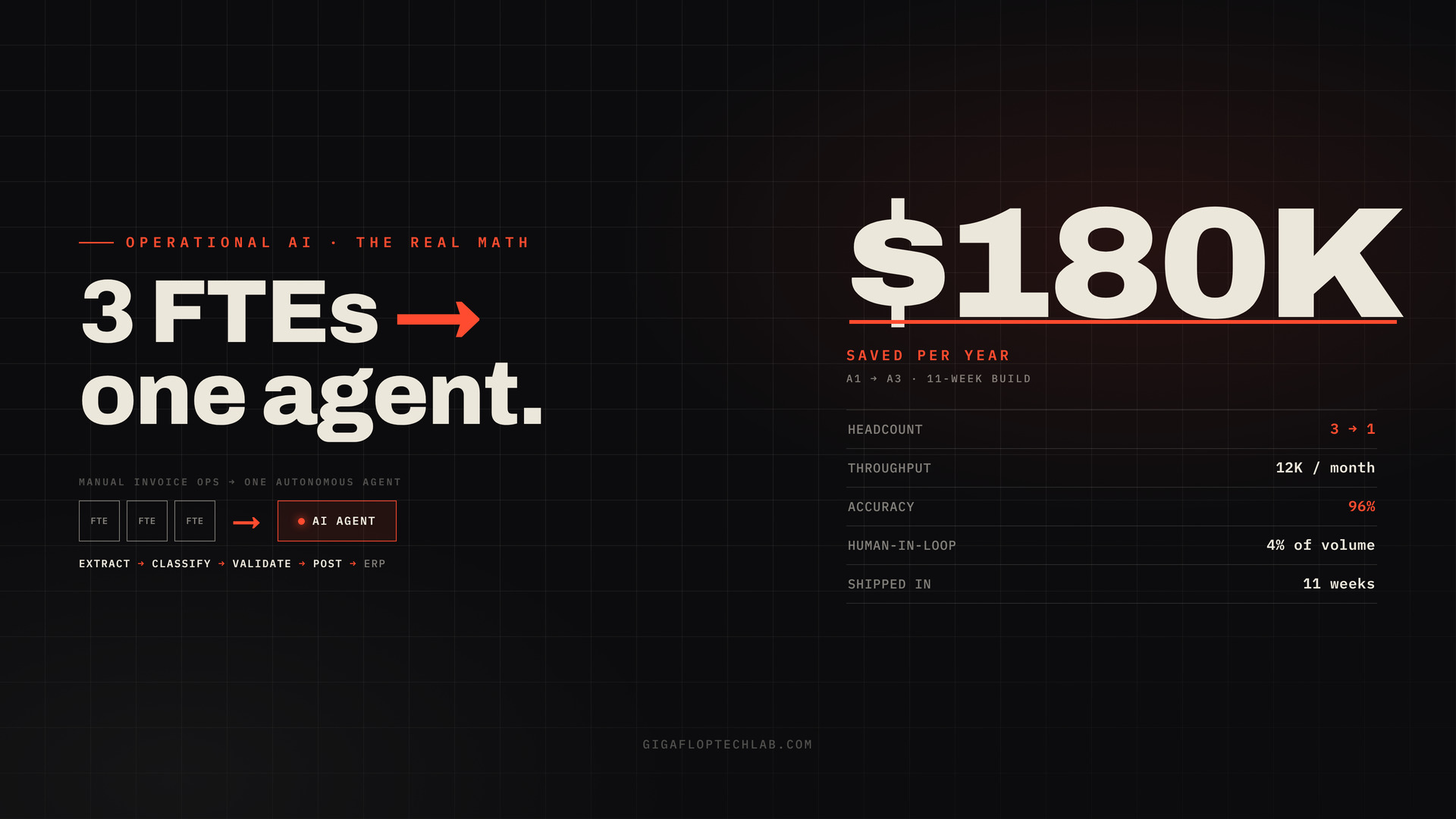
| Manual workload before | ~3 FTEs on invoice processing |
| Agent accuracy | 96% |
| Volume handled | ~12,000 invoices / month |
| Human role after | Exception review + oversight (not elimination) |
| What made it production-safe | Eval pipeline + human-in-the-loop gating |
Engagement metrics from the Gigaflop record; dollar figures below are illustrative ranges, not from this client’s books. [[EDITOR: confirm CS-INVOICE figures 96% / ~12K-per-month / ~3 FTEs and naming/anonymization approval.]]
The context
The starting point was an accounts-payable function doing what AP functions everywhere do: receiving invoices in every format imaginable — PDFs, scans, email bodies, the occasional spreadsheet — and keying them into an ERP by hand. At roughly 12,000 invoices a month, that work occupied about three full-time people. Capable people, doing careful work, on a task that was high-volume, repetitive, and almost entirely rule-shaped with a messy edge.
That last part is the whole story. Invoice processing looks like a clean automation target and isn’t because maybe 80% of invoices are routine and the other 20% are exceptions: a missing PO number, a line item that doesn’t reconcile, a vendor who formats things differently every time. Pure rule-based automation chokes on that 20%. It’s exactly the “messy middle” where reasoning earns its place.
The challenge
The business goal was simple to state and hard to do safely: take the manual keying off people’s plates without introducing errors into the financial system. In AP, a wrong number isn’t a typo it’s a mispayment, a duplicate, or a reconciliation headache that costs more to clean up than the automation saved.
So the bar wasn’t “can an AI read an invoice?” (yes, easily). The bar was: can it process invoices at production volume, at an accuracy the finance team trusts, without a human checking every single one and can we prove it? That word “prove” is where most operational-AI projects quietly fail.
Our approach
We built the agent as a pipeline of four stages, each doing one job well, rather than one model trying to do everything:
- Extraction — pull the fields off any invoice format (vendor, amount, line items, dates, PO).
- Classification — route by type, vendor, and approval path.
- Validation — check the extracted data against the system of record and business rules (does the PO match? does it reconcile? is it a duplicate?).
- ERP posting — write the validated invoice into the financial system.
Two things wrapped around that pipeline are the reason it shipped to production instead of staying a demo:
- An eval pipeline. Continuous measurement of accuracy across invoice types, so the team could prove the 96% and catch regressions before they reached the books. An agent you can’t measure isn’t an asset; it’s an unaudited liability.
- Human-in-the-loop confidence gating. The agent doesn’t act on everything blindly. High-confidence invoices flow through automatically; low-confidence or anomalous ones get routed to a person. The humans didn’t disappear their job moved from keying every invoice to reviewing the exceptions that actually need judgment.
The results
At ~12,000 invoices a month and 96% accuracy, the agent absorbed the bulk of the routine processing that had occupied three FTEs. The humans shifted to exception handling and oversight a smaller, higher-value workload than manual keying. The financial system stayed clean because validation and human-in-the-loop gating caught what the agent wasn’t sure about.
Worth being precise about what “replaced 3 FTEs” means here: the manual processing work equivalent to ~3 roles was automated. Good operational-AI programs typically redeploy those people to higher-value work rather than simply cutting headcount and that framing matters for both morale and the honest ROI story.
The real math (the part the headline hides)
Here’s the accounting a CFO actually needs. The operational metrics above are from the engagement; the dollar figures below are illustrative ranges to show you the structure of the math plug in your own numbers.
The cost being offset. A fully-loaded AP clerk in the US runs meaningfully more than base salary once you add benefits, overhead, software seats, and management. Base salaries for AP clerks cluster around $44K–$56K across major salary trackers (2025–2026); fully loaded, a realistic planning range is roughly $55K–$75K per FTE per year. Three of those is a recurring ~$165K–$225K/year workload.
What you spend to offset it. Two buckets, and ignoring either is how vendors lie with ROI:
- Build (one-time): scoping, the four-stage pipeline, ERP integration, the eval harness, and testing. A production-grade not demo build is a real project, not a weekend prompt.
- Run (recurring): model/inference costs, the platform, monitoring, and critically the human exception-review time that never goes to zero. A 96% agent means ~4% still needs eyes. At 12K/month that’s ~480 invoices needing review. That human cost is part of the TCO, not an asterisk.
The honest payback framing. Real ROI = (annual loaded cost of offset work) − (annual run cost incl. exception review) − (amortized build cost). The headline “3 FTEs” overstates the gain if you forget the run + review costs; it understates it if you forget that the freed-up people produce value elsewhere and that error-reduction has its own dollar value. The point isn’t a single magic number — it’s that the math holds up when you include every line, which most pitches don’t.
📊 Graph suggestion: Stacked bar “Manual cost/yr” (one tall bar) vs. “Agent cost/yr” (build amortized + run + exception review), with the gap labeled “net annual benefit.” Caption: plug in your loaded FTE cost and volume.
| Line item | Manual (3 FTEs) | Invoice agent |
| Recurring labor | ~$165K–$225K/yr (illustrative, loaded) | Exception review only [[your number]] |
| Build (one-time) | — | Amortized over useful life [[your number]] |
| Run / infra | minimal | Model + platform + monitoring [[your number]] |
| Error/rework risk | higher (manual keying) | lower (validation + evals) |
| Net | baseline | benefit = manual − (build amortized + run + review) |
Common mistakes in operational-AI ROI
- Counting the FTEs saved, ignoring the costs added. Build, run, and ongoing exception review are real. A 96% agent is not a 0%-human agent.
- Pricing the FTE at base salary. Use fully loaded cost or you’ll understate the benefit and misjudge payback.
- Skipping the eval pipeline to save money. Then you can’t prove accuracy, can’t catch drift, and the finance team never trusts it. False economy.
- Automating before measuring. If you can’t state today’s volume, error rate, and per-invoice handling time, you can’t compute ROI — you’re guessing.
Could this work for your operation?
The pattern transfers to any high-volume, semi-structured document workflow with a messy edge: AP/AR, claims, onboarding paperwork, order processing. The questions to ask before you scope one:
- What’s our true monthly volume, and what does a fully-loaded person on this task cost?
- What’s the cost of an error in this process? (High-error-cost workflows justify more validation.)
- Can we verify the agent’s output to build evals? (If not, fix that first.)
- Are we prepared to keep humans on exceptions and redeploy the freed-up time well?
If those answers are solid, the math usually is too.
Conclusion
“One agent replaced three people” is a headline. The real story is quieter and more durable: a four-stage pipeline absorbed the routine 80%, an eval harness made its accuracy provable, and human-in-the-loop gating kept the 20% and the financial system safe. The ROI is real precisely because the math includes the costs the headline leaves out.
That’s the difference between operational AI that survives a CFO’s questions and a demo that doesn’t. Demand the full accounting. The good projects welcome it.
CTA
Curious what the real math looks like for one of your workflows? Bring your volume and a fully-loaded cost-per-person, and the payback picture takes about one conversation to sketch.
Scope Your Own AI Agent → we’ll map a high-volume workflow, design the pipeline + eval + human-in-the-loop layer, and give you the honest ROI math before you commit a dollar.
FAQs
It can absorb the manual processing workload equivalent to roughly three roles, as in this engagement (~12K invoices/month at 96% accuracy). But “replace” is imprecise humans shift to exception review and oversight rather than disappearing, and strong programs redeploy freed-up people to higher-value work.
The remaining ~4% isn’t lost it’s routed to a human through confidence gating. At 12,000 invoices a month, that’s roughly 480 invoices needing review. That human exception-handling time is a real, ongoing cost and belongs in any honest ROI calculation.
Take the fully-loaded annual cost of the work being offset, then subtract the agent’s recurring run cost (including human exception review) and the amortized one-time build cost. Pricing the people at base salary or ignoring run costs are the two most common ways ROI gets overstated.
Rule-based RPA handles cleanly structured invoices but breaks on the ~20% with missing fields, odd formats, or reconciliation issues. An agent reasons through that messy middle and escalates only genuine edge cases which is where most of the manual hours actually hide.
It depends on invoice variety, ERP integration complexity, and accuracy bar. A production-grade build with validation, eval pipeline, and human-in-the-loop is a real project, not a quick prompt. Scoping your volume and exception rate sets the timeline.
Largely, yes. ROI scales with volume and with the cost of errors. At a few hundred invoices a month, the build may not pay back; at 12,000, it does. The selection question is this workflow high-volume and verifiable matters more than the technology.