Most companies are still treating AI agents as a tool category. They’re about to discover it’s an org chart.
The tell is already in the data. In 2025, roughly a quarter of organizations had appointed a Chief AI Officer. One year later, IBM’s Institute for Business Value put that figure at 76% a survey of around 2,000 CEOs across 33 countries (IBM, 2026). A C-suite role went from curiosity to near-default in twelve months. That kind of move doesn’t happen for a piece of software. It happens when leaders realize a capability now touches every part of how work gets done and someone has to own it.
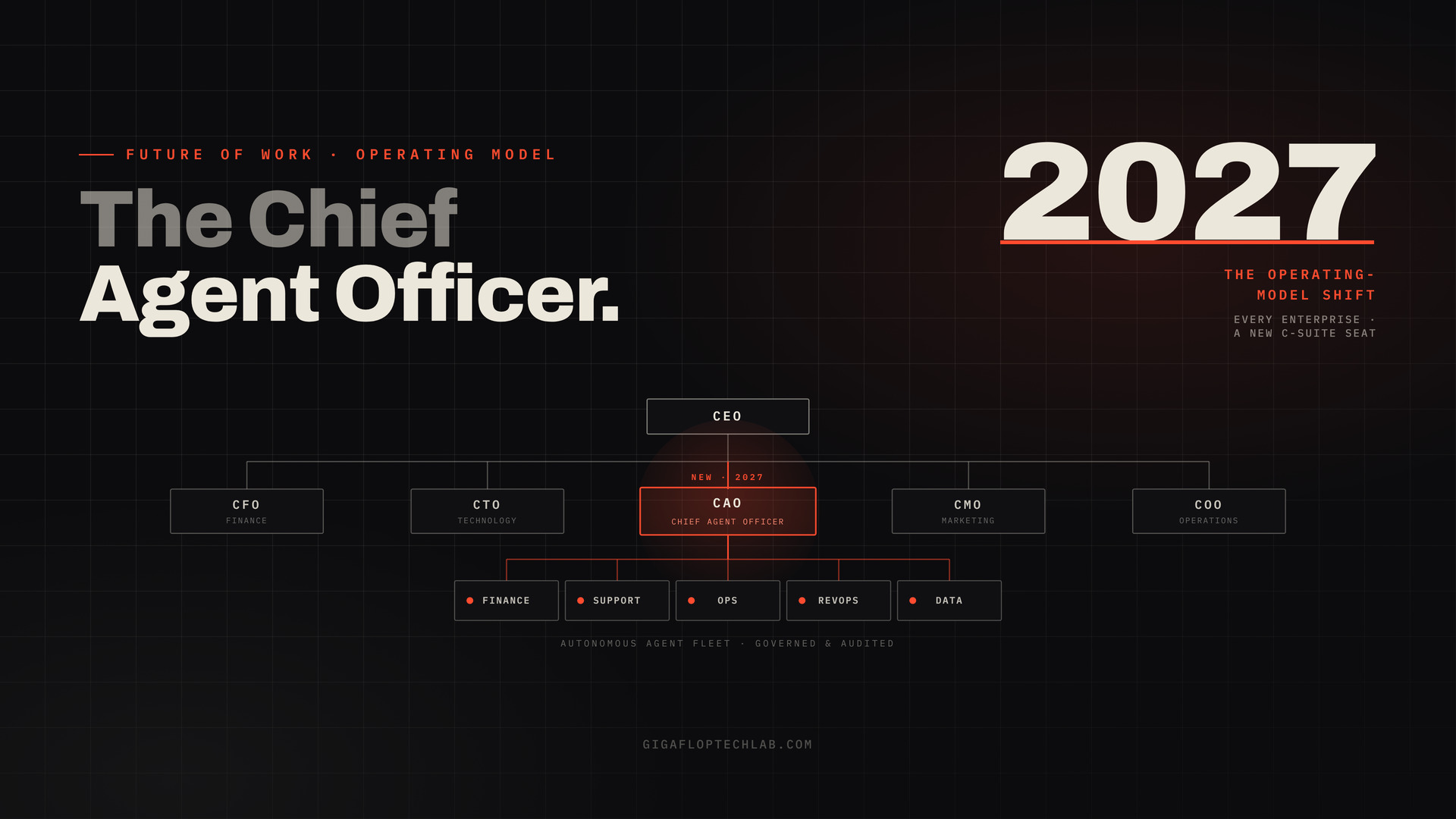
But here’s the prediction most of those boards haven’t reached yet: the Chief AI Officer is the on-ramp, not the destination. By 2027, the companies that actually scale agents past the pilot stage will have split that role in two and the half no one has hired for yet is the one that runs the agents. Call it the Chief Agent Officer.
This isn’t a title prediction. It’s an operating-model prediction. Let me lay out why the role becomes inevitable, and what the model around it looks like.
Why now: agents stopped being a feature and started making decisions
The thing that forces a new operating model isn’t capability it’s autonomy. A tool waits to be used. An agent decides and acts.
Gartner expects that by 2028, at least 15% of day-to-day work decisions will be made autonomously through agentic AI, up from effectively zero in 2024, and that around a third of enterprise software applications will include agentic AI by then (Gartner, 2025). Read that as an operations statement, not a tech one: a meaningful share of the decisions your business runs on will be made by software that doesn’t sit in a seat, attend a standup, or answer to a manager unless you build one.
The moment software makes decisions on your behalf, three questions appear that no tool ever raised: Who is accountable when it’s wrong? What’s its budget? And how do we know it’s still doing its job a month from now? Those are management questions. Management questions need a manager.
The four shifts that create the role
1. The CAIO mandate splits strategy separates from operations
The Chief AI Officer role exists to set AI strategy, drive adoption, and move organizations from pilots to production. IBM’s research is blunt about why it pays off: companies with a CAIO reported meaningfully higher returns on AI investment and scaled more projects than peers (IBM, 2026). That’s real. But “set the strategy and drive adoption” is a different job from “run forty agents in production and own what they do on Tuesday.”
As agent fleets grow, those two jobs pull apart the same way “head of digital strategy” and “head of engineering” did a decade ago. The CAIO keeps the vision and the board narrative. A Chief Agent Officer takes the operational P&L: which agents run, what they cost, what they’re allowed to decide, and who gets called when one drifts.
What to do now: in your next org review, separate AI strategy from agent operations on paper, even if one person holds both today. Naming the seam is how you avoid the gap later.
2. Agents get budgets, owners, and performance reviews
You don’t manage a hybrid workforce of humans and agents with a dashboard. You manage it the way you manage people: each agent has an owner, a cost line, a defined scope of authority, and a way to measure whether it’s still performing.
The “performance review” for an agent is an eval pipeline continuous tests across regression, adversarial, and drift suites. This is the unglamorous core of the new role. Agents don’t fail loudly; they regress quietly, and the first sign is usually a customer complaint or a finance surprise, not an alert. The Chief Agent Officer owns the layer that catches it before either happens.
What to do now: before you scale any agent, stand up observability and an eval gateway. If you can’t measure an agent’s accuracy this week versus last week, you don’t have an agent in production you have a liability with good PR.
3. The 40% cancellation wave forces accountability into existence
Here’s the sobering number. Gartner predicts that over 40% of agentic AI projects will be cancelled by the end of 2027 — not because the technology fails, but because of escalating costs, unclear business value, and inadequate risk controls (Gartner, 2025). Much of today’s market is what Gartner calls “agent washing”: existing chatbots and automation rebranded as agents.
That cull is the event that creates the role. The organizations on the surviving side of it will be the ones that put accountable ownership, cost discipline, and risk controls around agents before scaling which is the Chief Agent Officer’s entire job description. The cancellation wave doesn’t kill agentic AI. It kills agentic AI without an owner.
What to do now: treat every agent like a hire, not a download. Define success criteria, a budget ceiling, an escalation path, an audit log, and a kill switch before it goes live. If a proposed agent can’t clear that bar, it’s a demo, not a deployment.
4. The org chart inverts toward oversight
When agents outnumber people at routine work, the human job changes shape. Gartner expects AI agents to outnumber human sellers by roughly tenfold by 2028 while cautioning that fewer than 40% of sellers will say the agents actually improved their productivity (Gartner, 2025). The lesson there is sharp: more agents is not more value. Past a point, piling tools onto people just creates noise and burnout.
So the winning model doesn’t replace the team with agents it moves the team up the stack, from doing the work to supervising it. Human-in-the-loop stops being a safety net and becomes a management layer: people handle exceptions, set policy, and review the cases agents route to them by confidence. Headcount shifts from execution to judgment. That’s an organizational design choice, and it’s the CHRO’s problem as much as the CTO’s which is exactly why this role sits in the C-suite and not in IT.
What to do now: map which of your workflows are high-volume and verifiable (good agent candidates) versus high-judgment and ambiguous (keep humans, route exceptions). Design the human roles around that split deliberately, before attrition or hype designs them for you.
What this actually means for your business
Strip away the title and the operating model is the real takeaway. By 2027, an “AI-first” enterprise won’t mean one that uses a lot of AI. It’ll mean one organized around a managed agent workforce, with three things most companies don’t have yet:
- An accountable owner for agent operations, distinct from AI strategy.
- A production-grade assurance layer evals, observability, audit logs, kill switches that treats agents as systems that must keep earning trust, not as features that ship once.
- A redesigned human layer built around oversight and exception-handling, not just cost-cutting.
Notice that none of this is about buying a better model. The hard part of the 2027 operating model is organizational and operational, not technical. The companies that struggle won’t be the ones with worse AI. They’ll be the ones who bought capable agents and never decided who runs them.
The Gigaflop view
From the audits and agent builds we run for Series A–C teams, the pattern is already visible at smaller scale: the deployments that survive contact with real traffic are the ones with an eval gateway, a human-in-the-loop confidence-routing design, and an audit log in place before launch not bolted on after the first incident. The teams that skip that layer tend to show up later, usually after an agent has quietly drifted or a cost line has quietly tripled. The Chief Agent Officer is just that discipline, given a seat at the table and a budget to enforce it.
You don’t need to hire the title in 2026. You do need to start building the function because the org chart shifts whether or not you’ve named the box.
Conclusion
The Chief AI Officer answered the question “what’s our AI strategy?” The Chief Agent Officer answers the harder one coming right behind it: “who runs the agents, and how do we know they’re still trustworthy?” The data says autonomous decisions, agent fleets, and a brutal cancellation cull all land inside the same two-year window. The enterprises that treat agents as a workforce to be managed with ownership, evals, and oversight will be on the right side of that cull. The ones that treat them as a tool to be installed won’t.
The role is coming. The only real choice is whether you design the operating model on purpose, or inherit one by accident.
CTA
Want the contrarian, production-grade read on where AI, agents, and data are actually heading minus the hype? Subscribe to The Gigaflop Brief → for the leadership essays and operating-model breakdowns we send founders and boards.
Already standing up agents and want a sober look at your readiness? Book a strategy call → no pitch, just a clear view of what’s production-ready and what isn’t.
FAQs
Not widely it’s a forecast. But its predecessor, the Chief AI Officer, went from about 26% of organizations in 2025 to 76% in 2026 (IBM). As agents move from strategy to large-scale operations, expect the operational half of that role to formalize into a distinct seat by 2027.
The Chief AI Officer sets strategy and drives adoption across the business. A Chief Agent Officer owns agent operations: which agents run in production, what they cost, what they’re authorized to decide, and the evals and controls that keep them trustworthy. Strategy versus running the workforce.
Partly, yes. Gartner expects over 40% of agentic AI projects to be cancelled by the end of 2027 due to cost, unclear value, and weak risk controls (2025). That cull is real but it rewards companies with accountable ownership and controls, which is exactly the case for the role.
The title is an enterprise phenomenon; the function scales down. A Series B company won’t hire a Chief Agent Officer, but it still needs one accountable owner, an eval pipeline, and a kill switch before scaling agents. The discipline matters more than the org chart at your size.
The evidence points to redesign, not wholesale replacement. Gartner notes agents will vastly outnumber human sellers by 2028, yet most sellers won’t report productivity gains meaning value comes from moving people to oversight and exception-handling, not from removing them.
Before scaling any agent, give it an owner, success criteria, a budget ceiling, an audit log, and a kill switch and stand up evals so you can measure its performance over time. If a proposed agent can’t clear that bar, it isn’t ready for production.