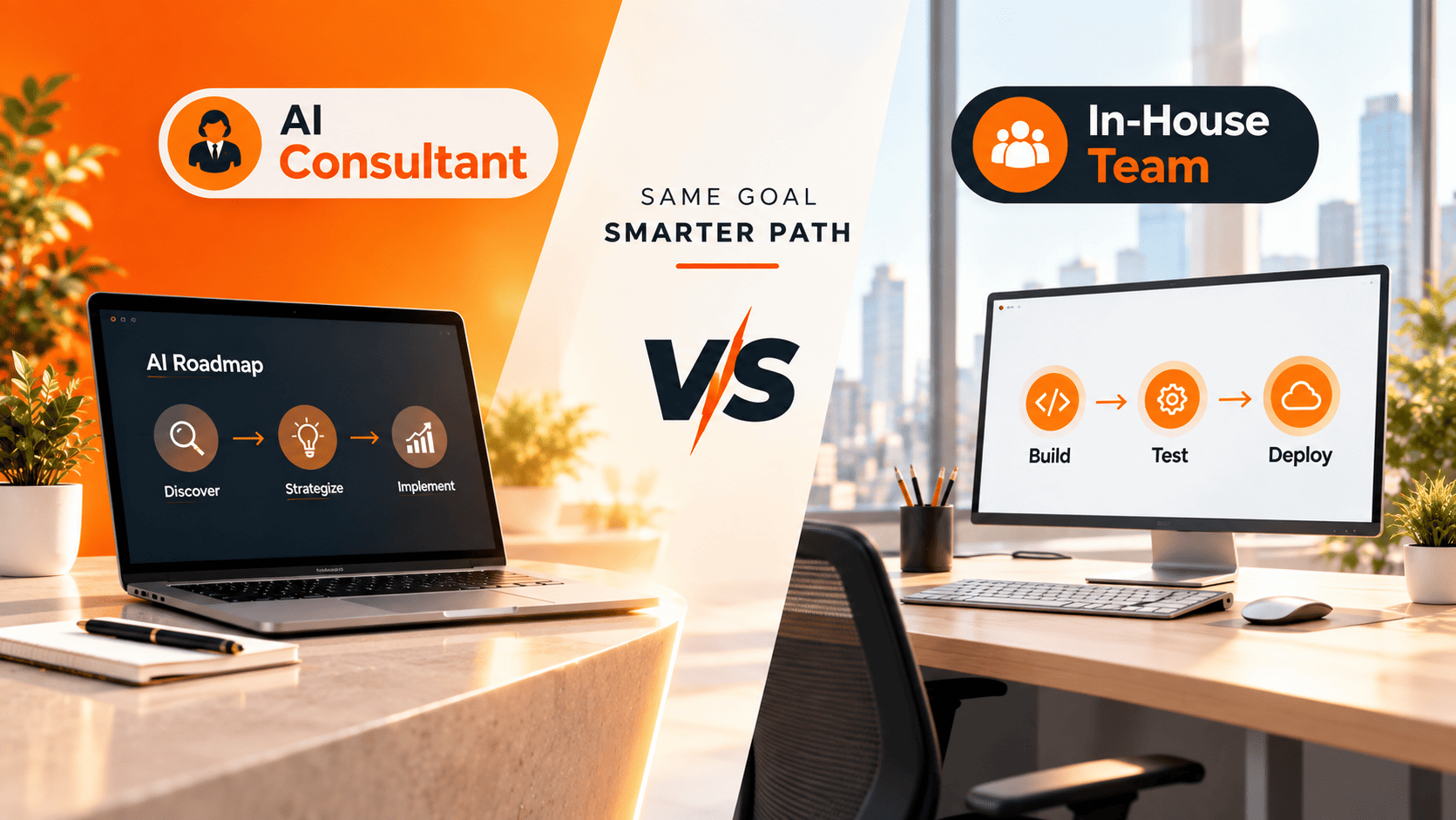
When embarking on an AI project, one of the initial considerations is whether to enlist the services of external AI consultants or hire people in-house.
The question is not just one concerning the payments involved.
In the case of a specific AI project, consultants provide you with specialized know-how while avoiding the need to hire new full-time staff. Hiring in-house employees may be preferable when AI solutions become an ongoing capability requiring long-term investment.
There is also a third variant of working with AI, a hybrid model where you have a dedicated unit of employees that can handle business aspects of the process while external consultants are dealing with the implementation of their AI expertise.
“You can build a very rich agentic world, defined by a tapestry of AI agents, which can act on our behalf across our work and life, across teams, business processes, as well as organisations.”
– Satya Nadella, Chairman & CEO, Microsoft
To sum things up, AI consultants are the most preferable choice when you have a clearly defined project in mind, require relevant know-how, or still have to learn the basics of using AI. Hiring in-house specialists may be the right solution when the activities of the unit are continuous and of strategic importance.
AI Consultants vs. In-House Teams: What Is the Difference?
Before comparing costs, it helps to understand what you are actually buying.
| Factor | AI Consultants | In-House AI Team |
| Initial commitment | Usually lower | Higher |
| Recruitment | Not normally required | Required |
| Specialist expertise | Available as needed | Must hire or develop |
| Time to start | Often faster | Recruitment and onboarding first |
| Flexibility | High | Depends on team capacity |
| Business knowledge | Must be transferred | Builds internally |
| Long-term ownership | Needs clear handover | Strong internal ownership |
| Scaling expertise | Easier to add specialists | Requires additional hiring |
| Idle capacity | Lower risk | Higher risk between projects |
| Best fit | Defined or variable AI workload | Continuous AI workload |
AI consultants can support much more than development. Artificial intelligence consulting can include AI opportunity assessment, strategy, roadmap development, solution architecture, implementation, integration, and optimization.
For example, Gigaflop TechLab’s AI consulting approach covers opportunity assessment through implementation and optimization. AI Strategy & Consulting Services
Artificial Intelligence Consultant – What is the importance of role?
It is crucial for a reliable AI consultant to guide you in responding to business queries prior to taking any step in technology.
Some examples include
- Which process would be our priority for automation?
- Where may AI bring some measurable gain?
- What data and technology will be required?
- Should we create a new system from scratch, integrate or use some third-party solutions?
- To what actions should AI be granted rights?
- Where will there be a need for people to intervene?
- What method of assessment of success should be used?
There is a certain step-by-step algorithm of operations starting from revealing opportunities to setting up priorities, creating strategy, solving the problem of solution development, implementing it and optimizing it.
It is worth mentioning that picking an unsuitable AI use case may be more expensive than picking the unsuitable technology.
💡 Not sure where to start with AI?
Before building a permanent team, identify which workflows are worth automating and what level of AI expertise you actually need
How Much Does It Cost to Have an AI Team In-House?
The salary comes only as a partial cost.
According to the U.S. Bureau of Labor Statistics, the average salary of software developers was $135,980 in May 2025. Computer and information systems managers earned $175,140 on average.
However, these numbers don’t show the total cost of developing AI capabilities.
You also need to think about such cost as:
- Recruitment
- Wages and other compensation
- Management costs
- Software and AI tools
- Cloud system infrastructure
- Training costs
- Compliance and security measures
- Monitoring and testing costs
- Internal stakeholders’ time
- Costs of wasted capability
The following formula can be used
Real in-house cost = salary + compensation + recruitment + management + tools + systems + training + wasted capability
For instance, having one developer at a company does not mean the company has all the capabilities necessary for the production of AI-based projects, as depending on the nature of the project various specialists may be needed.
How to Determine When Each Model is Appropriate Based on Cost Analysis
Focus on workload and not just the terminology.
Scenario 1: Small AI projects
If you only have one major automation project with minimal further AI projects, then creating a permanent team may lead you to pay for effort, which you will not be using.
Consultant model: project engagement with specialist skills.
In-house model: salary, management, tools, and education even when the project is finished
Scenario 2: Ongoing AI development
If you are doing several AI projects annually with frequent optimizations and AI expected to help into the core product or operations, having a permanent local capacity becomes more appealing.
In-house model: better ownership and institutional knowledge.
Consultant model: sufficient flexibility, yet repeated engagement with professionals may become less effective over time.
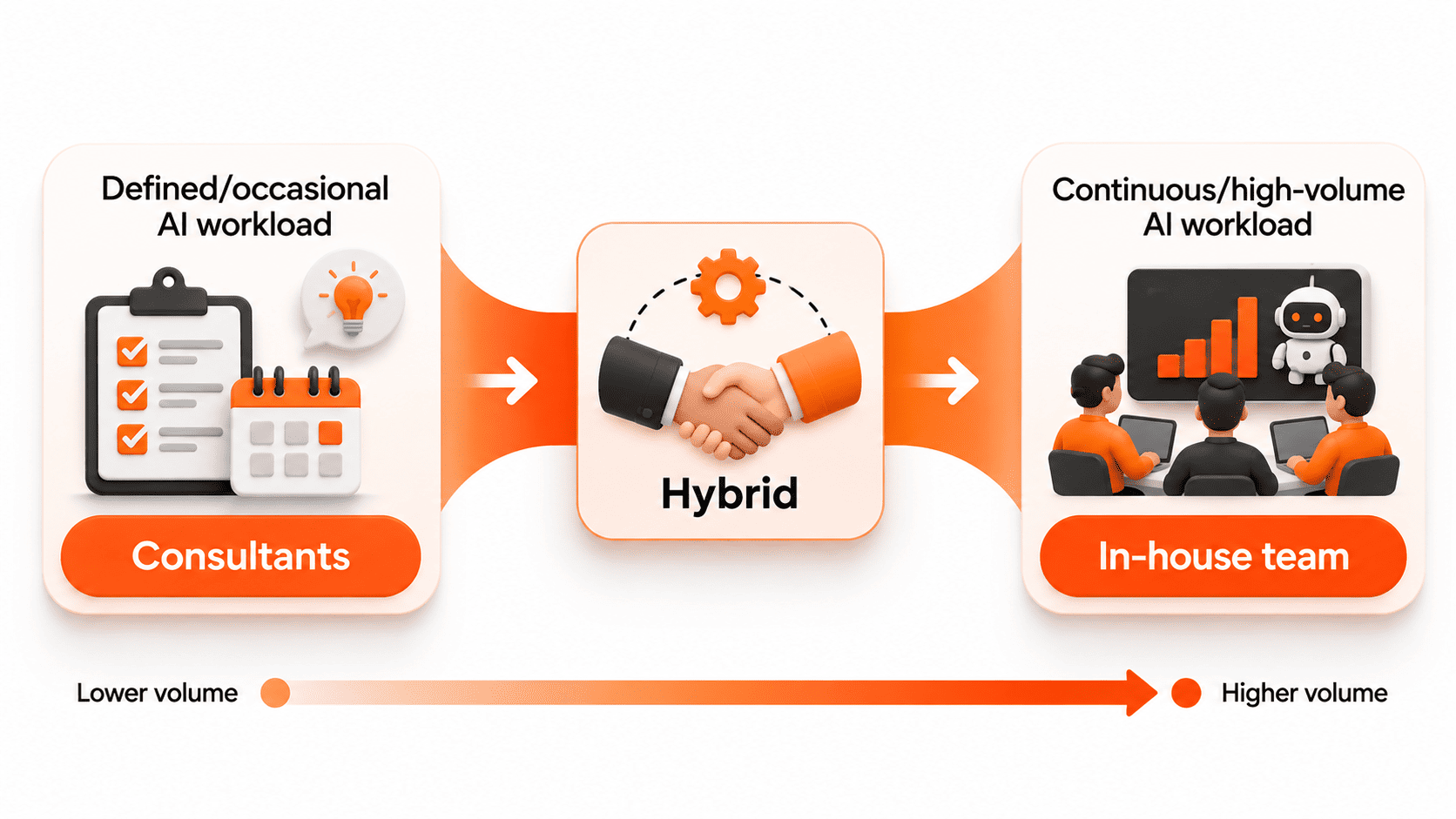
Scenario 3: You need both models
Here is where a hybrid model can be applied.
The internal team deals with business requirements, data, product processes, and long-term ownership.
External AI consultants help with strategies, architecture, complicated development, integrations, or particular operational projects.
Which Costs are Not Obvious?
It is relatively easy to identify obvious expenses. However, hidden costs are often the reason behind poor decisions.
Hidden costs associated with hiring in-house staff
Recruitment – Hiring professionals with the necessary combination of AI and software knowledge, data skills, and business experience can take a while.
Idle capacity – An employee who is on payroll is being paid even if his/her job responsibilities do not require much work.
Management – Someone has to plan work; review results; ensure that the work follows the timelines.
Skill Updates – The situation in the field of AI technology is changing quite rapidly, so in-house staff should receive continuous training.
Hidden costs associated with hiring consultants
Knowledge transfer – Your employees need the documentation. Otherwise, they will not be able to act correctly without a vendor’s help.
Internal stakeholder time – Employees that have to approve the project need to devote their time to providing input.
Support – Maintenance and improvement must be defined before implementation.
Vendor dependence – Lack of good documentation can lead to issues with future changes to the project.
We need to define the documentation, access, security, support, and handover procedures beforehand.
At What Point Would You Consider Building An In-House AI Team
In-house teams are more compelling when
- AI is a fundamental part of your product.
- There are multiple ongoing AI projects.
- You need something in-house on a permanent basis.
- Your data and processes require a lot of specialization.
- You seek continuous optimization.
- You already have a strong technical management
- Your team can add value to more than one project.
The most important question is
Can an AI team stay busy for a long time?
If you can answer this positively, the economics of hiring an AI team is favorable.
Why A Hybrid Model May be Optimal?
You do not necessarily have to choose between consultants and employees.
The hybrid model allows distributing responsibilities logically depending on where each side has the highest value.
The in-house team will take care of
- Business requirements
- Product decisions
- Data access
- Internal processes
- Stakeholder relationships
- Long-term ownership
AI consultants will do
- AI strategy
- Architecture
- Rapid prototyping
- Complex AI development
- System integration
- Evaluation
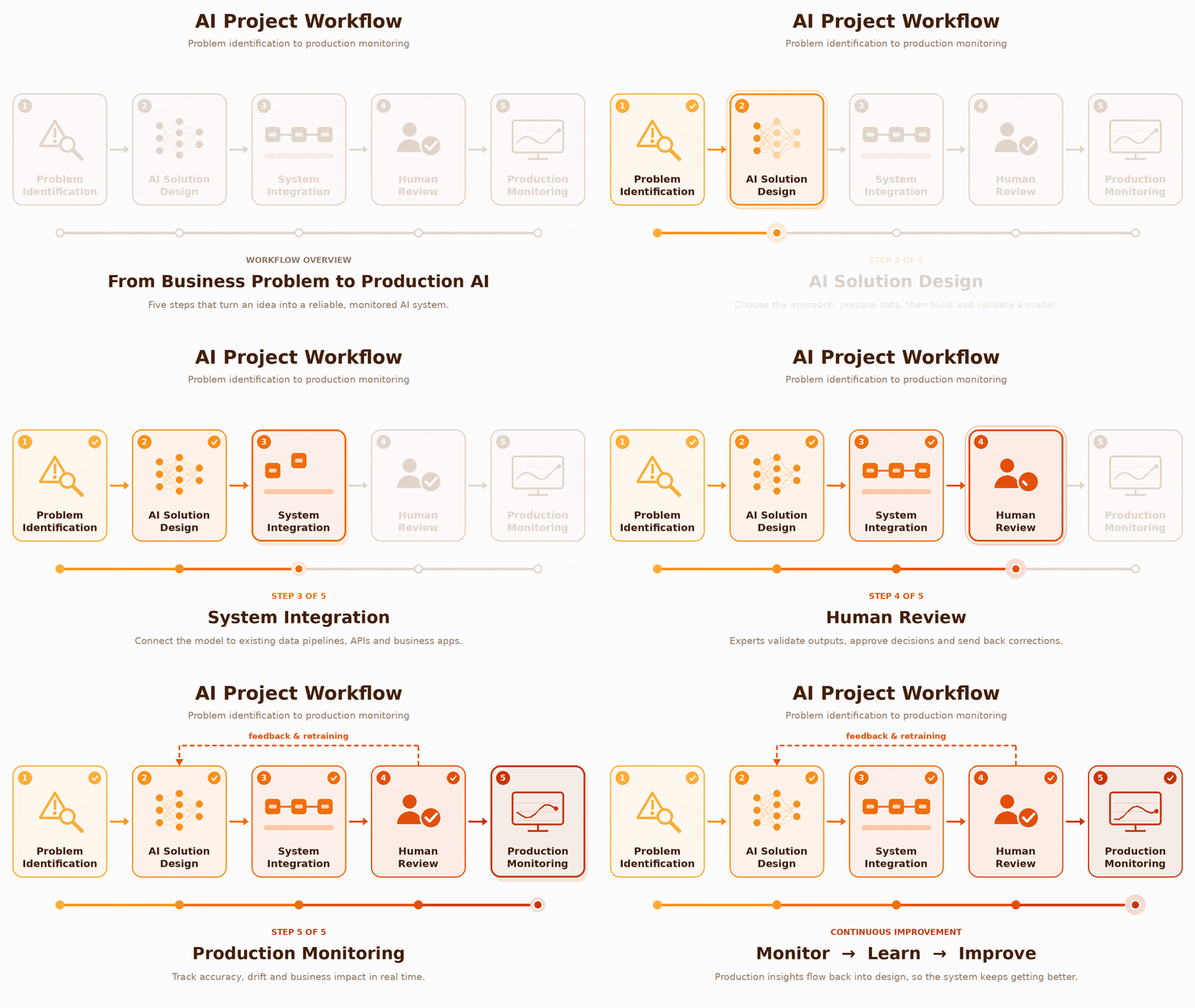
A 5-Step Decision-Making Framework
Prior to choosing between AI consultants and forming an internal team, answer the following five questions
1. What is the estimated volume of AI tasks that need to be accomplished?
1 or 2 projects is not like having to constantly develop AI.
2. What is the level of specialization needed?
Should certain skills be required that cannot be obtained with relative ease, the consultancy market becomes the better choice.
3. What is the urgency in the need for results?
If time is of the essence, then the hiring process makes you dependent on something outside your control.
4. Who owns the solution after launching?
Make sure to define that first before starting work on development.
5. What will happen after the initial project?
Don’t forget about support, optimization, and other possible applications, as well as future staffing after the initial project is finished.
The essence can be summarized as follows
If you have defined workload, go for consultants; for ongoing work you need to go in-house. In case of combined workload consider a hybrid approach.
What Does This Look Like in a Real AI Project?
Real project economics are more useful than generic promises.
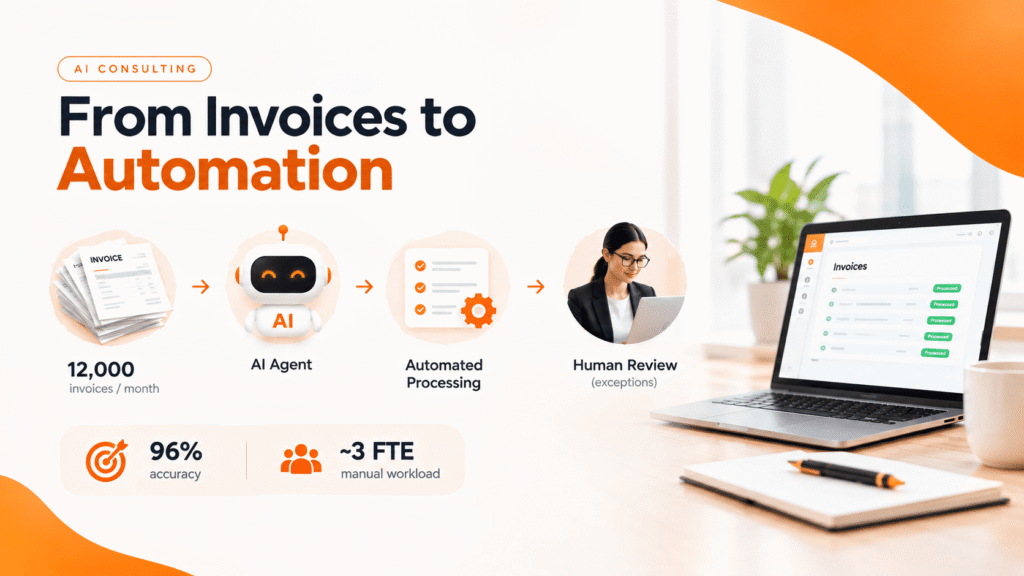
Gigaflop TechLab’s invoice-agent case study describes a workflow processing approximately 12,000 invoices per month, with a manual workload equivalent to about three FTEs. The AI agent achieved 96% accuracy, while people remained responsible for exception review and oversight. Read the Invoice Agent ROI Case Study
Real Project Snapshot
| Metric | Result |
| Monthly invoices | ~12,000 |
| Manual workload | ~3 FTE equivalent |
| Agent accuracy | 96% |
| Human role | Exception review + oversight |
The important lesson is not simply that AI can replace manual work.
It is that the right AI system can move people away from repetitive processing and toward exception handling, oversight, and higher-value work.
That is the type of business case you should evaluate before deciding whether you need permanent AI employees, external specialists, or both.
When you are in a dilemma of hiring AI consultants or in-house employees, there is no clear victor.
- Select AI consultants in situations that require expert knowledge, when the specific work has been determined or when more flexibility is required, or when AI is still being tested to understand how to apply it positively.
- Select an in-house AI team if AI needs to be developed continuously on a long-term basis, when the amount of work is stable, and when ownership is important.
- Choose a hybrid solution when it is necessary to retain ownership over the project internally but to use external expertise for a certain segment of AI initiatives.
- The correct choice should stem from the analysis of the main task to be solved, not from the analysis of the team’s structure.
Frequently Asked Questions (FAQs)
Not necessarily. Consultants may optimize payroll expenses and hiring efforts for individual projects, while internal teams may be less costly in the event that there is a continuous flow of work in experimental AI.
AI consultancy should be used when there is a clear AI project, expertise is needed, use cases need verification, or speed of implementation needs to be higher than the hiring process allows.
Building an internal team is more appropriate if AI is strategically important, projects are continuous, and the team can be used productively over time.
AI consultancy may include AI strategy, readiness assessment, use case discovery, solution design, implementation, automation, integration, governance, and optimization.
Absolutely. The hybrid approach combines insider knowledge and long-term ownership with the capabilities of external specialists needed for specific AI projects.
Ready to Choose the Right AI Model?
You do not need to build a large AI team before understanding where AI can create value.
Start by identifying your highest-value workflows, estimating the required workload, and deciding which capabilities need permanent ownership.