Engaging an artificial intelligence consulting partner may bring substantial benefits in terms of efficiency and new digital revenue sources for your organization. However, wrong interpretation of complex technical jargon at the vendors assessment stage frequently results in expectations mismatch, excessive budgets for software purchase, and delays in implementation.
When business leaders hire AI consulting firms, the miscommunication primarily occurs because of the confusion between high-priced experimental technology associated with research and the effective and profitable business software solutions.
As Nvidia CEO Jensen Huang noted when describing the shift toward practical enterprise integration:
“The future of software is about moving from simple conversational prompts to autonomous enterprise systems. Every company will eventually run on digital intelligence, but the biggest mistake leaders make today is confusing the core model with the underlying business logic.”
According to market research conducted by Gartner on the value of Enterprise AI, it was found that 60% of enterprise AI projects fail to reach fruition due to improper scope and insufficient data preparedness. To safeguard your financial investment, you must familiarise yourself with the terminology used in business consulting.
This article explains most of the most commonly confounded terminologies in business consulting, explains what these terms mean for your financials, and provides guidance on how to evaluate your partners effectively.
The True Cost of Terminology Confusion in Enterprise Tech
To understand how professional artificial intelligence consulting drives business value, executives must first separate modern probabilistic software from legacy rule-based automation.
| Feature Category | Rule-Based Software | Generative AI Models | Agentic & Hybrid AI Architectures |
| Logic Basis | Fixed if/then decision trees | Probabilistic pattern matching | Goal-driven feedback & tool execution |
| Data Requirement | Clean, structured tables | Large unstructured pre-training data | Real-time private data connectors |
| Operational Focus | Standard task automation | Content & text generation | Complex multi-system execution |
| Cost Profile | Predictable, low maintenance | Variable token & API costs | High upfront design, high long-term ROI |
Misinterpreting these layers leads directly to budget waste. Below are the primary technical distinction errors buyers make during contract negotiations.
4 Essential Technical Concepts Every Executive Should Understand
1. Artificial Intelligence vs. Machine Learning vs. Deep Learning
- Artificial Intelligence (AI) – A wide-reaching concept of machines working like people determined by human thinking or decisions.
- Machine Learning (ML) – A particular subset of AI that enables computer software to analyze past data. In other words, through the use of algorithms it is possible to find previous patterns in the past information and predict future events without defining these processes.
- Deep Learning (DL) – A specific branch of ML that is based on deep artificial neural networks and is capable of performing extremely complicated tasks such as voice translation in real-time mode, autonomous driving, and complicated processing of image data.
Business Implications: If there is a need for a specific Deep Learning network, while the actual constraint leads the operation to a simple regression model or just a software with certain rule sets, such requests cause an increase in the duration of developing process and hosting in the cloud.
2. Generative AI vs. Predictive AI
Because of the popularity of generative tools, stakeholders tend to think that the basis of contemporary AI is its mastery of generating text or images.
- Predictive AI – Makes use of structured historical information to make predictions about trends, evaluate credit risks or uncover fraud. The key question here is: “What can be expected to happen in the future taking into account past data?”
- Generative AI – Employs large amounts of unstructured data and complex models to produce entirely new text and images, complete software programs, or even synthetic data. The relevant question is: “Can the AI create human-like text or image according to the set request?”
Knowing the difference allows you to select AI consultants with the specific domain experience required for your industry context.
3. Model Training vs. Fine-Tuning vs. Retrieval-Augmented Generation (RAG)
In most cases where an AI consultancy firm prepares a proposal related to enterprise architecture, it offers any of the three deployment models
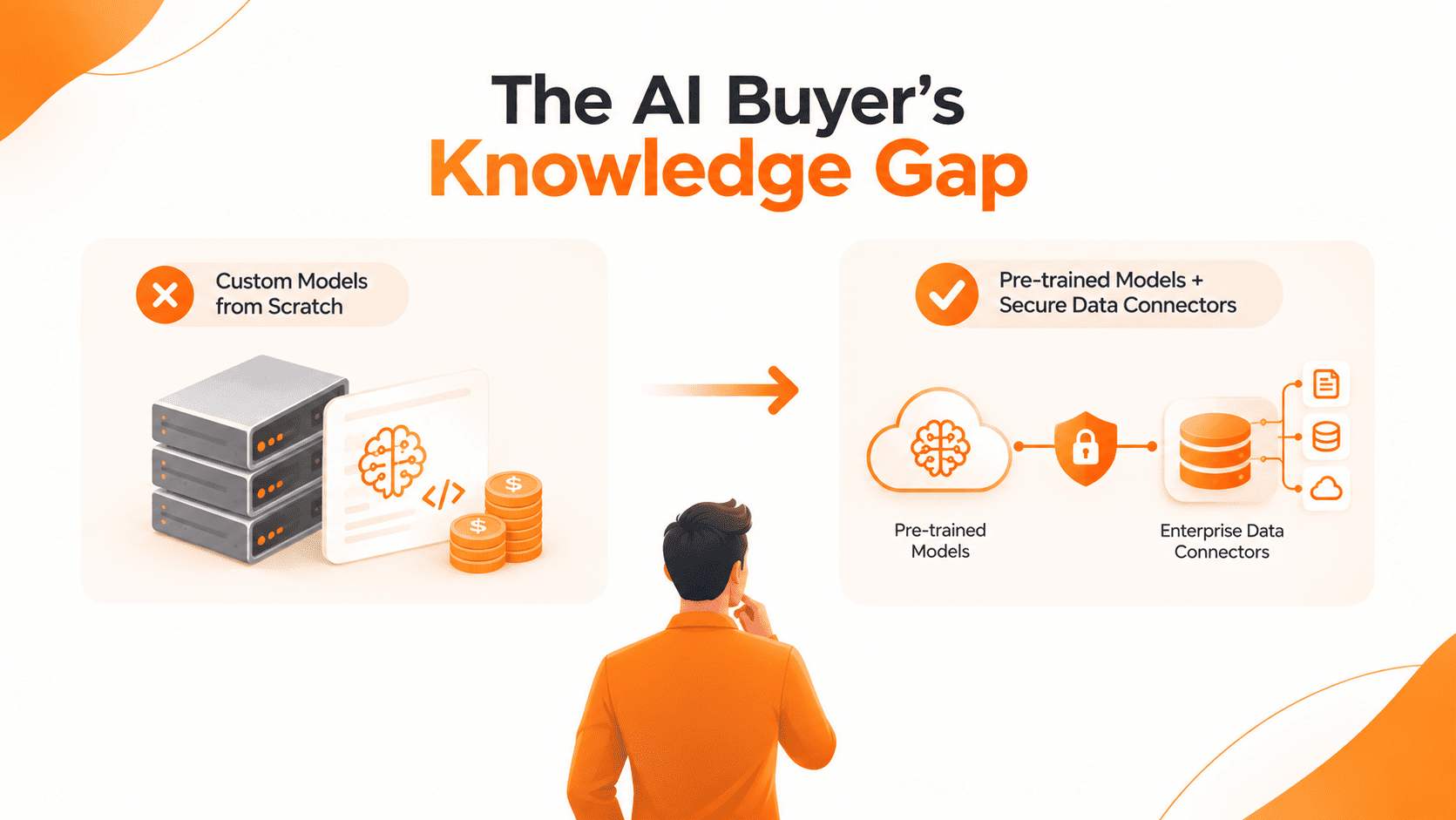
- Training from Scratch – Creating a custom basic model from the ground up. This is an expensive undertaking that involves spending millions of dollars on GPU computing capabilities and using a big internal data engineering team.
- Fine-Tuning – Using an already developed pre-trained model and retraining its internal settings on your data set to change its tone, formatting, or terminology applicable to your domain.
- Retrieval-Augmented Generation (RAG) – Connecting an available low-cost basis model to your enterprise databases (CRMs, ERPs, knowledge bases), with no change to the internal workings of the underlying model.
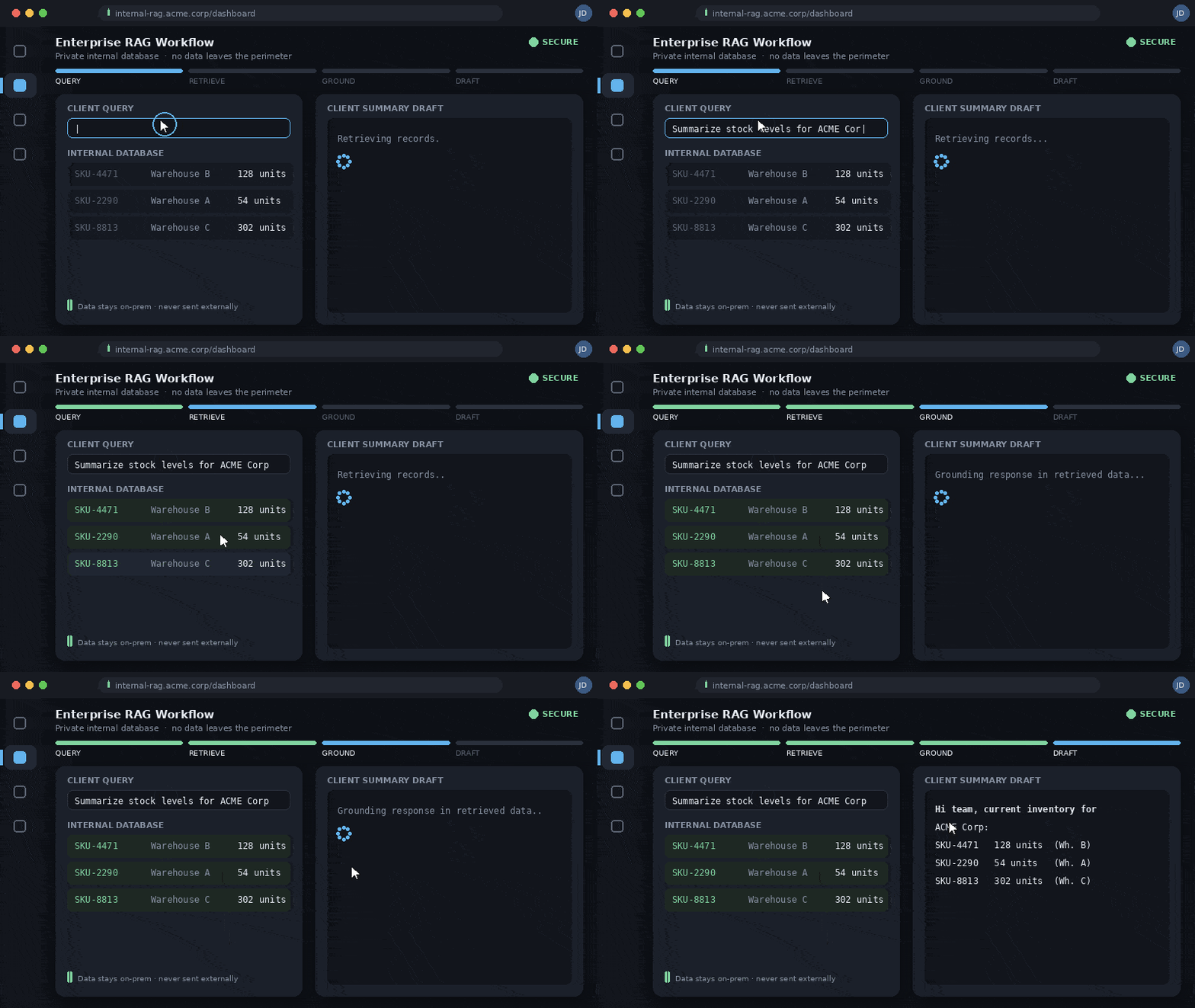
When we helped an online retailer boost customer conversion rates by 28%, we utilized a lightweight RAG integration rather than an expensive custom model build. This delivered hyper-personalized product recommendations while protecting margin budgets.
4. Outputs that Are Deterministic vs. Probabilistic
- Traditional enterprise software is deterministic – when you provide input X whether it’s a number entered into an equation or a request submitted to a database you will receive output Y with 100% certainty, regardless of the circumstances.
- In contrast, modern AI models operate probabilistically – based on input X, the system derives its most statistically probable output. To prevent operational risk associated with expecting fully deterministic results from sophisticated probabilistic systems, competent AI experts add validation mechanisms, controls over outputs, and checkpoints for human involvement in the auditing process.
💡 Is your technology stack ready for secure AI deployment?
Avoid committing capital to vague technical proposals. Book a Free AI Strategy Call with our lead advisory team to evaluate your current data pipelines and identify high-ROI operational workflows.
The Non-Technical Leader’s Guide to Hiring AI Consultants
Selecting the right partner requires assessing their strategic business acumen alongside their engineering skills.
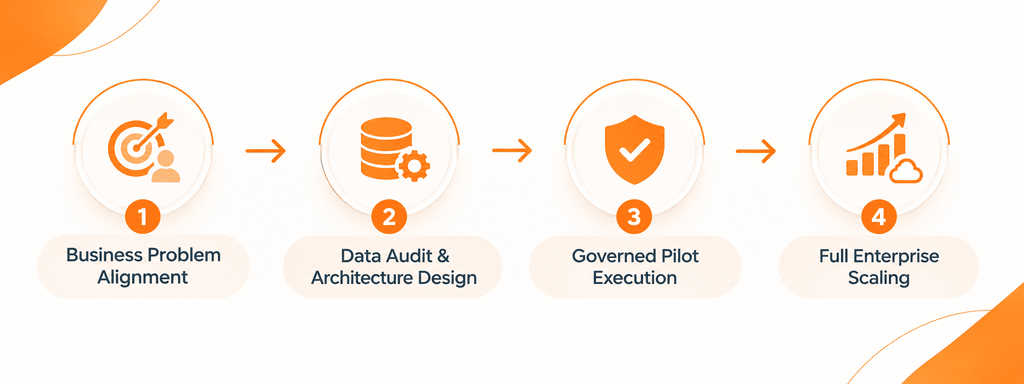
Step 1: Analyze Mindset: Problem-First Vs Technology-First
Inexperienced companies attempt to employ fashionable technological solutions to a problem. Young consultants identify existing problems first, like manual invoicing delays, excessive customer support turnover, or incorrect inventory distribution, before choosing a particular IT solution.
Step 2: Audit Your Information Infrastructure
AI algorithms will be effective to the extent that necessary data is fed to them. Experienced consultants will analyze the quality of your data, its storage format, and its confidentiality policy before they start scripting the solution. Should your internal data be dispersed across different software generations, any sophisticated AI program will have faulty outputs.
Step 3: Evaluate Security and Compliance Systems
For enterprises to be successful, they must have strict requirements for access to roles, encryption protocols for data, and clear standards for retention of data. You should check if the advisor adheres to relevant recommendations, like the NIST AI Risk Management Framework.
Step 4: Ask for Clear Return-on-investment and Pilot Projects
Avoid signing any open-ended research contracts. Instead, seek to establish agreements for a proof of concept (PoC) for periods ranging from 60 to 90 days or for any other specific duration based on measurable KPIs. You can find out more about our enterprise AI transformation solutions by having a look at our phased advisory service which helps the client to comply with the deadlines.
Frequently Asked Questions (FAQs)
The artificial intelligence consulting company assists organizations in realizing the efficiency of AI possibilities, determining the readiness of their data, choosing or developing the right model, creating custom integrations and implementing scalable solutions which lead to significant financial results.
AI consulting focuses on developing the right models to solve strategic issues. Meanwhile, a standard software engineer usually works on the development of deterministic application logic and user interface without having in-depth knowledge in statistical machine learning techniques.
Costs depend on the complexity of the project. Initial planning and analysis services usually cost $10000-$30000, whereas end-to-end implementation can go from $50000 and exceed $250000 depending on the complexity of the data pipeline and integration requirements.
Most AI projects fail because of inconsistent terminology used in technology areas, overengineering simple automation by means of a more advanced model, poor preparation of data infrastructure, and treating probabilistic results like deterministic outcomes.
Ready to Streamline Your AI Strategy?
Navigating the AI landscape doesn’t have to be confusing or risky. Partner with experienced advisors who translate complex technical architecture into practical business results.
Book a Free AI Strategy Call today to review your roadmap and discover how to maximize your AI ROI.