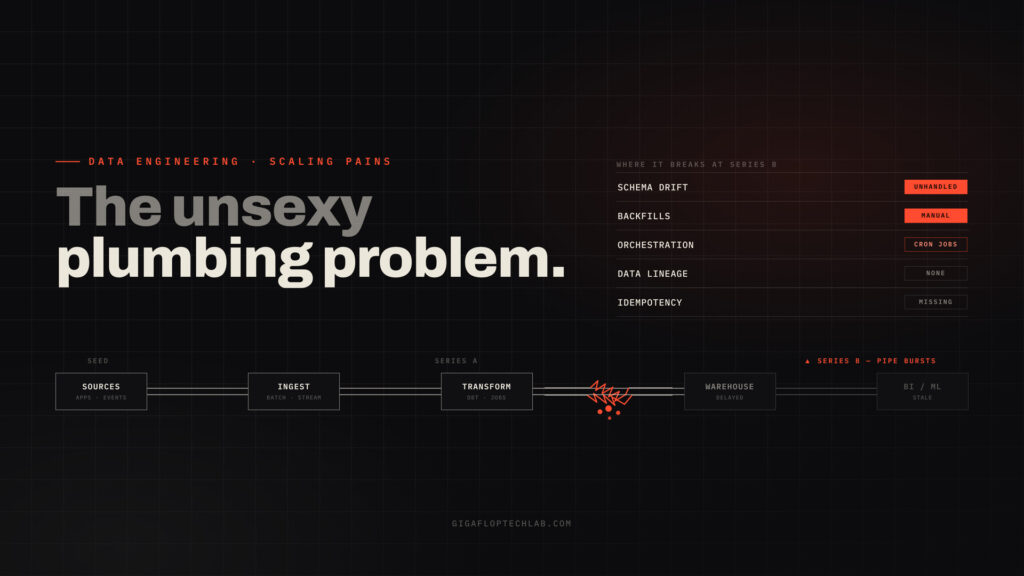
There’s a rite of passage for early-stage data teams that nobody should be performing. A founder or first data hire reads that the “modern data stack” is Fivetran + Snowflake + dbt + Hightouch + Census + an orchestrator, dutifully signs up for all of them, and then spends six weeks wiring tools together and still can’t run a basic query. We hear a version of this story constantly.
The modern data stack was a genuinely good idea that metastasized. Best-of-breed composability a specialized tool for each layer turned into what one widely-shared 2026 analysis called “death by a thousand tools.” The signal that the era is ending is hard to miss: in late 2025, Fivetran and dbt Labs two of the stack’s flagship companies, once valued at $5.6B and $4.2B merged, with commentators openly calling the modern data stack “dead.” When the poster children consolidate, the “assemble five vendors” advice deserves a hard second look.
This piece is the lean alternative for sub-Series-C teams: an architecture that ships in about six weeks, costs a fraction of the full stack, and scales cleanly to Series C plus an honest account of when you actually graduate to the heavier tools.
The core principle: the least-specialized stack that meets the requirement
The bloat doesn’t come from any individual tool being bad. Fivetran, dbt, Snowflake, Hightouch all excellent at what they do. The bloat comes from adopting all of them before you have a clear use case for each. As the most credible 2026 guidance puts it: the real cost driver isn’t the tools, it’s how many you adopt before you need them so start simple and add complexity only when a specific pain demands it.
That’s the same principle behind not buying a dedicated vector database in week one, or rebuilding a pipeline you only needed to instrument: use the least-specialized stack that meets the requirement, and let real pain — not a reference architecture pull you up to the next tier. Every tool you add is a permanent operational and cost tax, not a one-time setup.
The five layers (and how few tools you actually need)
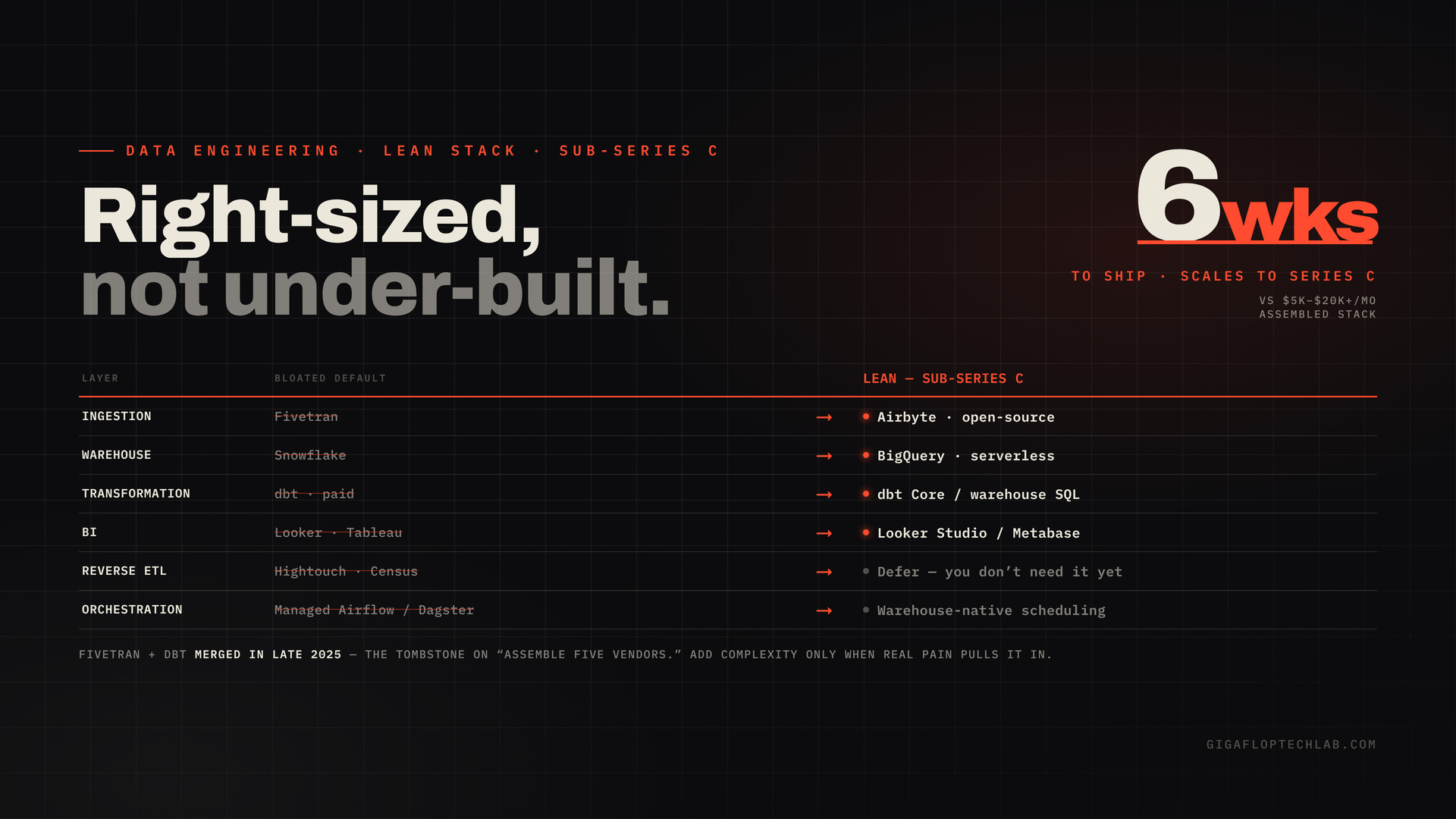
The modern data stack is really five layers: ingestion, warehouse, transformation, BI, and orchestration — with reverse ETL and a metrics layer as emerging slots. The bloated version buys a separate specialized vendor for each. The lean version collapses or defers most of them.
| Layer | Bloated default | Lean sub-Series-C choice | When you actually need the heavy tool |
| Ingestion | Fivetran | Airbyte (open-source / self-host or cloud) | When connector reliability/coverage matters more than cost — typically growth/scale stage |
| Warehouse | Snowflake | BigQuery (serverless, generous free tier, pay-per-query) | When you have heavy concurrent workloads or deep ecosystem/security needs |
| Transformation | dbt (paid) | dbt Core (open-source) or warehouse SQL | When transformation complexity and team size justify the managed tier |
| BI | Looker / Tableau | Looker Studio / Metabase (free / low-cost) | When governance, embedding, or scale demand it |
| Reverse ETL | Hightouch / Census | Defer entirely | When you genuinely need to sync modeled data back to operational tools — most early teams don’t, yet |
| Orchestration | Managed Airflow/Dagster | Lightweight scheduler / warehouse-native | When pipeline complexity outgrows simple scheduling |
Read down the “lean” column and notice what’s not there: no reverse-ETL tools, no managed-everything, no five separate bills. For a sub-Series-C team, that’s not under-building it’s right-sizing.
The recommended lean architecture
A concrete, defensible starting stack for most sub-Series-C SaaS teams:
- Warehouse: BigQuery. Serverless (no infrastructure to manage), a genuinely useful free tier for prototyping, pay-per-query pricing that’s predictable at low volume, and native integration if you’re already on Google Cloud / GA4 / Ads. (If you’re heavily on AWS or need heavy concurrency, Snowflake is the reasonable alternative see the honest caveat below.)
- Ingestion: Airbyte. Open-source, broad connector catalog, self-host to control cost or use cloud. The trade-off is more operational care on edge cases than Fivetran — acceptable at this stage, and a common pattern is to start on Airbyte and migrate only your highest-volume connectors to a managed tool later.
- Transformation: dbt Core (open-source) or plain warehouse SQL. Get version control, testing, and documentation without the paid tier until team size and complexity justify it. Build in three layers staging → intermediate → marts and add data-quality tests from day one (trust is easy to lose, hard to rebuild).
- BI: Looker Studio (or Metabase). Free / low-cost, good enough for the dashboards a sub-Series-C team actually needs.
- Reverse ETL, metrics layer, managed orchestration: deferred. Add each only when a named pain appears.
That stack ships in roughly six weeks instead of stalling for months, costs a small fraction of the $5K–$20K+/month an assembled enterprise stack runs (where the surrounding tools often cost more than the warehouse), and — critically — scales to Series C without a rip-and-replace.
The honest caveats (because a prescription without trade-offs is a sales pitch)
Intellectual honesty matters here, because reasonable experts disagree on specifics:
- Snowflake is a defensible default too. One credible 2026 view argues Snowflake is the right choice for ~80% of companies starting fresh easiest to operate, broadest BI integration, predictable compute/storage separation. The lean point isn’t “never Snowflake”; it’s “don’t buy the whole constellation of tools around it before you need them.” BigQuery is the lower-risk default for most sub-Series-C teams with no strong constraint; Snowflake wins on heavy concurrency or AWS/enterprise needs.
- “Lean” is a starting point, not a destination. The goal is a stack that scales up cleanly, not one you’ll outgrow in a quarter. Each tool in the table has a real “graduate now” trigger adopt it then, deliberately, not preemptively.
- Bet on open standards. Whatever you pick, favor open formats (SQL, Parquet, Iceberg) and avoid lock-in, so graduating a layer later is a swap, not a migration.
- The all-in-one option exists. Integrated platforms now handle ingestion → warehouse → BI in one system for $0–$250/mo. For the smallest teams that may beat even the lean assembled stack worth evaluating, with lock-in as the trade-off.
Common mistakes
- Buying the full reference architecture on day one. The single most common (and expensive) early-stage data mistake. You’re assembling a Rube Goldberg machine before you have a question to answer.
- Adopting reverse ETL before you need it. Hightouch/Census are great and premature for most sub-Series-C teams. Defer.
- Paying for managed everything. Open-source tiers (Airbyte, dbt Core, Metabase) cover most early needs. Pay for managed only when ops burden or scale justifies it.
- Optimizing for a scale you don’t have. Building for Series D traffic at seed stage is how six-week projects become six-month ones.
- Ignoring open standards. Lock-in turns every future graduation into a painful migration. Bet on open formats now.
Conclusion
The modern data stack didn’t fail because the tools were bad it failed because the advice was “buy all of them,” and sub-Series-C teams took it literally, drowning in cost and integration before they could answer a single business question. The Fivetran–dbt merger is the tombstone on the “assemble five vendors” era.
The lean alternative isn’t a compromise; it’s the discipline that the best teams apply at every stage the least-specialized stack that meets the requirement, with complexity added only when a specific pain pulls it in. A managed warehouse, open-source ingestion, and free BI will take most teams cleanly from seed to Series C. Start there. Graduate deliberately. And keep your data spend pointed at answering questions, not at operating a tool collection.
CTA
Standing up analytics for the first time — or already drowning in a five-vendor stack you assembled too early? The right starting architecture is a one-conversation decision, and getting it right saves months.
Scope a Lean Pipeline Build → we’ll design a right-sized stack for your stage that ships in weeks and scales to Series C, tell you honestly which tools you actually need now versus later, and bet on open standards so graduating a layer is a swap, not a migration. Right-sized, not under-built.
FAQs
Will a lean data stack scale, or will we have to rebuild later? A well-chosen lean stack scales to Series C without a rebuild, provided you bet on open standards (SQL, Parquet, Iceberg) and pick tools with clean graduation paths. The goal isn’t the smallest possible stack — it’s the right-sized one that grows by swapping or upgrading individual layers when pain demands, rather than a full re-platform.
The modern data stack is the best-of-breed approach of buying a specialized tool for each data layer ingestion (Fivetran), warehouse (Snowflake), transformation (dbt), BI (Looker), reverse ETL (Hightouch/Census), orchestration. It became bloated because teams adopt all of them before having a clear use case for each, running $5K–$20K+/month and spending weeks integrating tools before they can answer a business question.
A defensible starting stack is a serverless warehouse (BigQuery), open-source ingestion (Airbyte), open-source or SQL transformation (dbt Core), and free BI (Looker Studio or Metabase) deferring reverse ETL, a metrics layer, and managed orchestration until a specific pain appears. It ships in roughly six weeks, costs a fraction of the full stack, and scales to Series C.
For most sub-Series-C teams with no strong constraint, BigQuery is the lower-risk default serverless, generous free tier, predictable pay-per-query, native Google ecosystem integration. Snowflake is the better pick for heavy concurrent workloads, complex enterprise security, or AWS-centric stacks. Both are sound; the bloat comes from the constellation of tools you buy around the warehouse, not the warehouse choice.
You can usually start cheaper. Airbyte (open-source) covers ingestion at lower cost with more operational care; dbt Core gives you version-controlled, tested transformations without the paid tier. Graduate to managed Fivetran or dbt Cloud when connector reliability, team size, or complexity genuinely justify it notably, Fivetran and dbt merged in late 2025, a signal of how much the assemble-everything model has consolidated.
When you genuinely need to sync modeled warehouse data back into operational tools (Salesforce, HubSpot, ad platforms) a real and growing pattern, but one most sub-Series-C teams don’t need yet. Adding reverse ETL before that need exists is a common early-stage over-build. Defer it until a specific operational use case appears.
A well-chosen lean stack scales to Series C without a rebuild, provided you bet on open standards (SQL, Parquet, Iceberg) and pick tools with clean graduation paths. The goal isn’t the smallest possible stack it’s the right-sized one that grows by swapping or upgrading individual layers when pain demands, rather than a full re-platform.