Choosing whether to build custom AI agents or buy off-the-shelf software is the highest-stakes call mid-market leaders will make in 2026. Get it right, and you scale operations massively. Get it wrong, and you’re either burning millions on engineering overhead or trapping your business inside a rigid vendor ecosystem.
Custom builds give you total data control and tailored workflows, but they demand constant upkeep for databases, orchestration, and security. Buying SaaS gets you running fast, but leaves you stuck inside a platform you can’t customize.
Gartner projects that companies using a hybrid decision framework hit positive ROI 2.5x faster than those building strictly in-house.
This guide provides a practical framework to help you weigh engineering trade-offs, map out total cost of ownership, and pick the right path forward.
Build vs. Buy vs. Hybrid: The Trade-Off Matrix
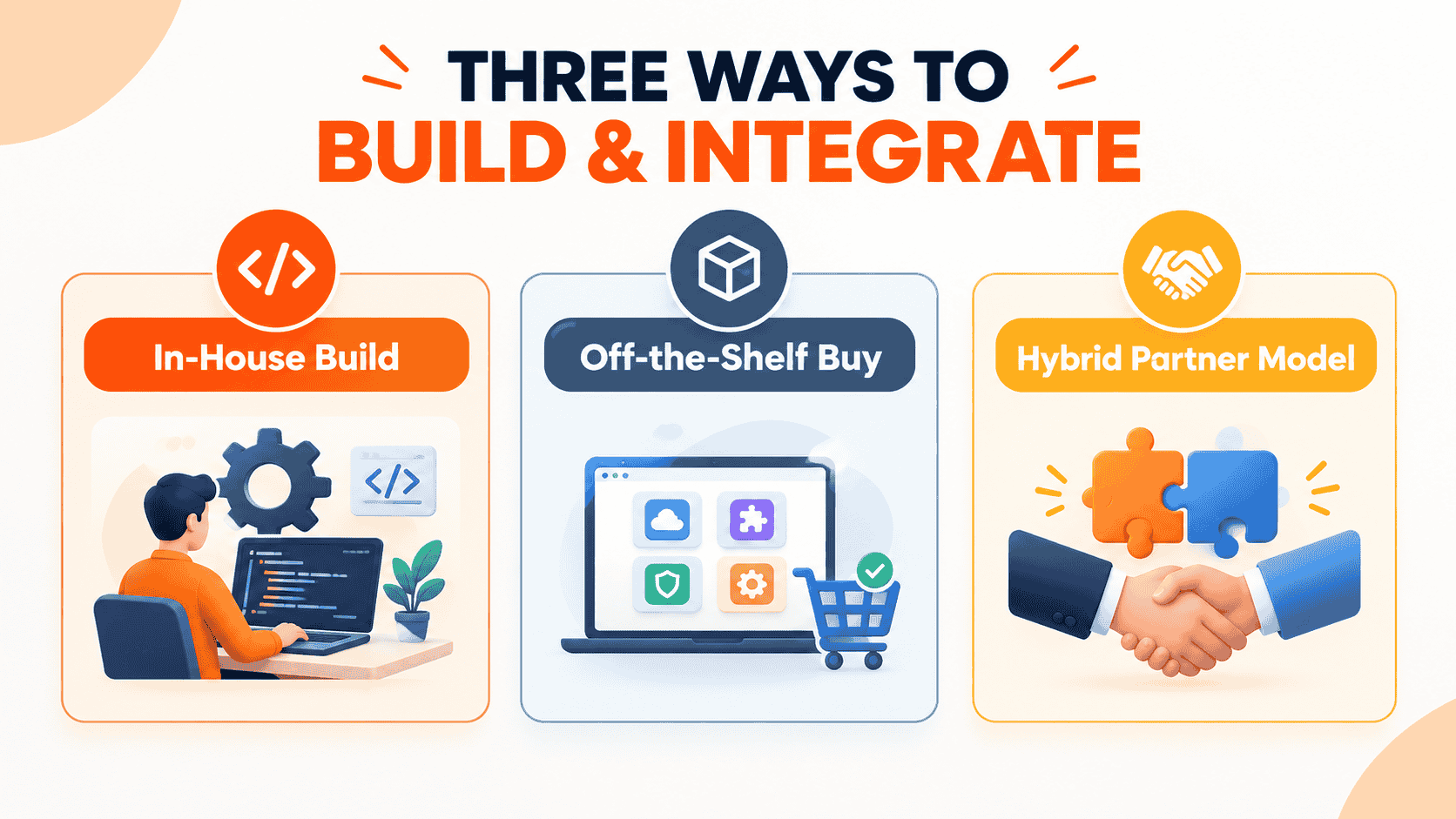
To determine the right strategy for your organization, compare the three primary deployment paths across key business criteria.
| Operational Criteria | Internal Custom Build | Off-the-Shelf SaaS Buy | Managed Hybrid Partner |
| Time-to-Market | Slow (6–12 months) | Fast (1–3 weeks) | Moderate (4–8 weeks) |
| Upfront Capital Cost | High ($150k–$300k+) | Low (Monthly SaaS subscription) | Moderate ($30k–$75k setup) |
| Workflow Customization | Unlimited | Restricted to native platform limits | Tailored to complex enterprise stack |
| Data & Model Ownership | Full IP ownership | Shared vendor infrastructure | Full tenant IP ownership |
| Maintenance Burden | Heavy (Internal engineering team) | Minimal (Handled by vendor) | Low (Managed by partner) |
Selecting the best approach depends on whether the underlying process provides a core competitive moat or merely serves standard operational support:
- Core Competitive Workflows: Proprietary pricing models, custom supply chain forecasting, or unique financial underwriting warrant custom builds or managed hybrid frameworks to protect intellectual property.
- Standard Operational Tasks: Meeting scheduling, basic email routing, or generic HR FAQ answers are best handled by purchasing pre-built SaaS agents.
The 4 Pillars of the Build vs. Buy Call
Before committing budget to any AI agent project, run it through these four reality checks:
- Strategic Edge: Does this workflow actually give you a leg up on competitors, or is it just basic back-office admin you need to get off your plate?
- System Complexity: How many old ERPs, custom SQL databases, and random APIs does this agent need to juggle all at once?
- In-House Tech Bandwidth: Do you have senior devs free to handle model drift, pipeline orchestration, and vector DB maintenance long term?
- Security & Compliance: Are you stuck with strict rules around on-prem data isolation, custom logs, or HIPAA/SOC 2 compliance?
💡 Unsure which path fits your current technical infrastructure?
Don’t waste months arguing over build versus buy trade-offs in boardrooms. Book a Free 15-Minute Technical AI Audit with our systems architects to evaluate your technical stack and build a roadmap.
Real-World Deployment Patterns Across Teams
Looking at common business cases makes it clear when to buy off-the-shelf versus when to build a custom setup:
Customer Support & Escalations (Buy or Hybrid)
For standard store support, off-the-shelf agents hooked into platforms like Shopify do the trick. But if you’re handling complex B2B support that needs live inventory lookups in SAP, you’ll want a tailored hybrid build.
Finance & Audit Reconciliations (Build or Hybrid)
Matching invoices to POs means navigating complex, company-specific rules. Mid-market finance teams rely on custom-scoped agents to cross-check line items without leaking sensitive financial data to public SaaS platforms.
Sales Ops & Lead Enrichment (Buy)
For pulling public web data to enrich incoming leads and booking sales calls, stick with ready-made tools like HubSpot or Salesforce agent modules.
When our team engineered unified operational frameworks for mid-market clients, we helped a mid-market enterprise cut manual invoice processing costs by 59% while maintaining full data control across legacy backend systems.
The Executive Strategic Roadmap for AI Agent Deployment
Executing a successful implementation requires balancing operational speed with technical risk management.
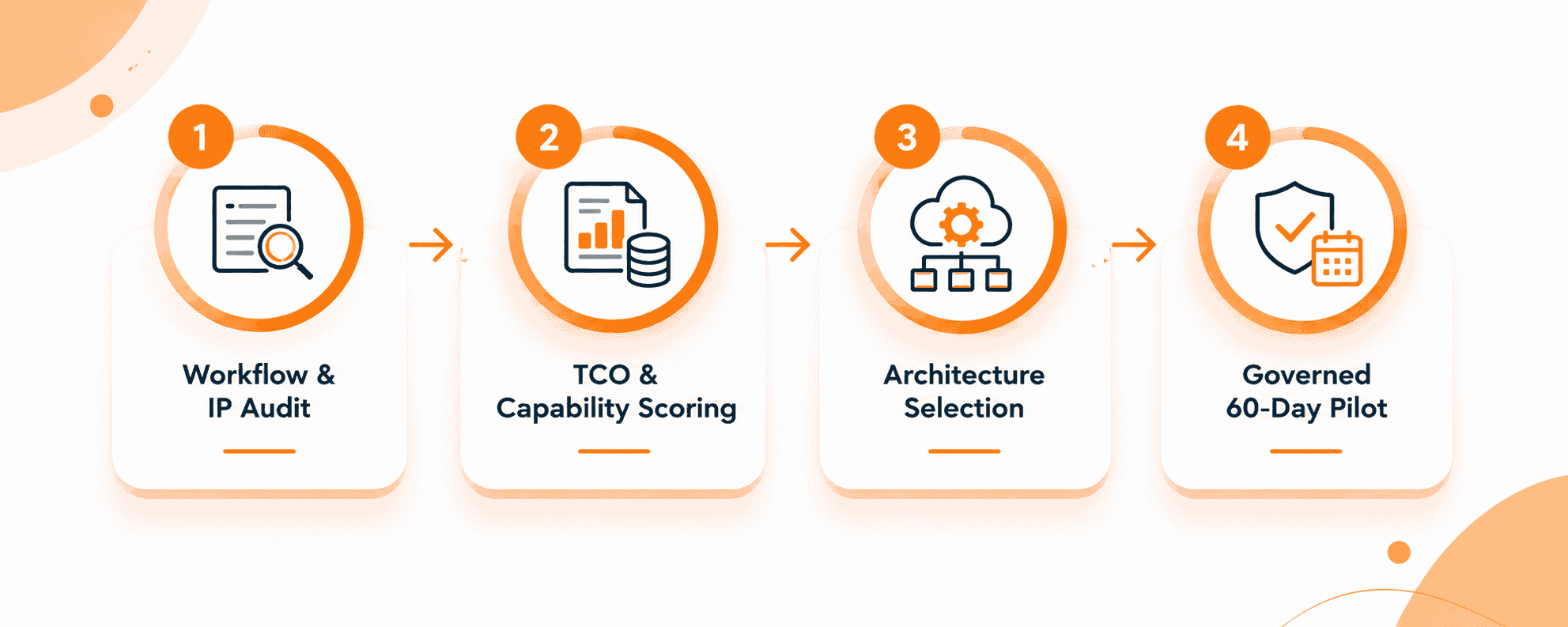
Phase 1: Audit Your Enterprise Workflows
Catalog prospective processes. Distinguish between commoditized admin tasks and proprietary workflows that handle trade secrets or custom business logic.
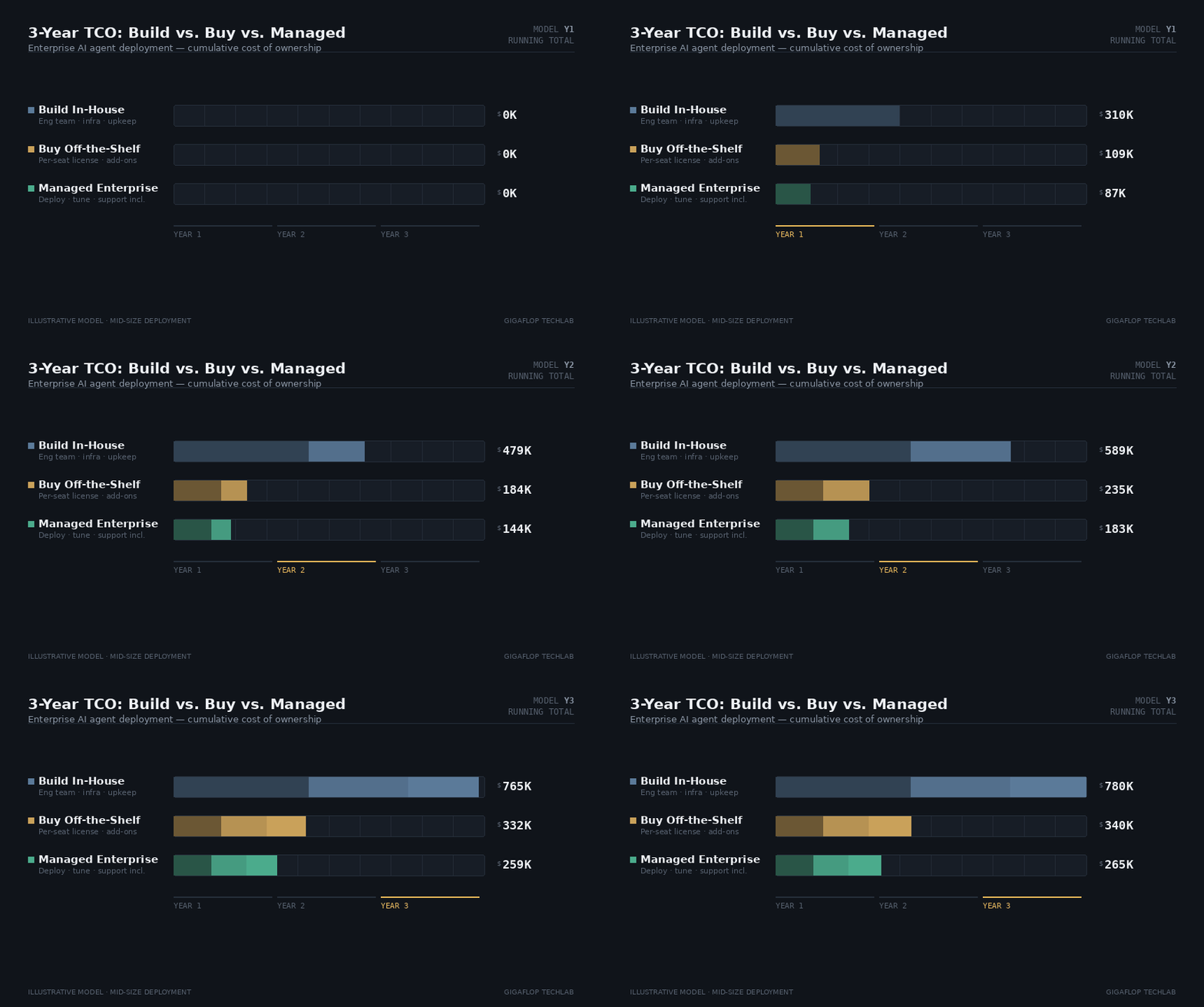
Phase 2: Calculate 3-Year Total Cost of Ownership (TCO)
Factor in developer salaries, token consumption costs, API maintenance, vector store hosting, and ongoing model evaluations alongside software subscription fees.
Phase 3: Choose Your Architectural Strategy
- Off-the-Shelf SaaS: Deploy immediately for standard front-office software tools.
- In-House Custom Build: Commit internal engineering resources only if the workflow represents a core technical moat.
- Managed Partner Deployment: Collaborate with specialized engineering partners for rapid custom integration without long-term hiring overhead. Learn more in our guide on scoping your first enterprise AI project.
Phase 4: Execute a Governed 60-Day Pilot
Deploy your chosen strategy in a bounded sandbox environment. Track cycle times, error rates, token expenses, and human handoff frequency before rolling out across departments.
🚀 Accelerate Your Business Agent Strategy
Ready to deploy secure, high-ROI agentic workflows tailored to your operational stack?
Mitigating Risk: Security, Maintenance, and ROI Tracking
Whichever path your leadership team selects, address these core operational risk factors early:
- Brittle Maintenance Pipelines: LLM APIs, vector stores, and third-party software endpoints update frequently. Ensure a dedicated team is assigned to maintain API connectors.
- Role-Based Access Control (RBAC): Ensure AI agents for business operate under strict least-privilege credentials, preventing unauthorized reads or edits across core enterprise databases.
- Performance Telemetry: According to recent MIT Technology Review insights, enterprise automation projects fail when organizations neglect baseline metrics. Track cost-per-transaction and human intervention rates continuously.
Frequently Asked Questions (FAQs)
The largest hidden expense is long-term maintenance. Beyond initial engineering, teams must continuously maintain API schema connections, optimize vector search pipelines, update system prompts, and manage security updates as LLM models evolve.
Buy off-the-shelf solutions when the workflow is standardized across industries (e.g., scheduling meetings, basic customer live-chat support) and lives entirely within a single SaaS ecosystem like Salesforce or HubSpot.
A managed hybrid approach combines the customization and data ownership of a custom build with the execution speed of off-the-shelf tools. An external specialized engineering team builds and maintains tailored agents on your private cloud infrastructure.
Off-the-shelf agents are safe only if the vendor explicitly guarantees zero data retention for model training, enforces SOC2/HIPAA compliance, and provides dedicated single-tenant data isolation.
Make the Right Strategic AI Choice for Your Business
Choosing between building, buying, or partnering for AI agents for business comes down to balancing process uniqueness, execution speed, and long-term technical control. By analyzing workflows against a structured decision framework, mid-market leaders avoid unnecessary costs and deploy automation that scales.
Ready to clarify your strategy and build a production-grade deployment roadmap?