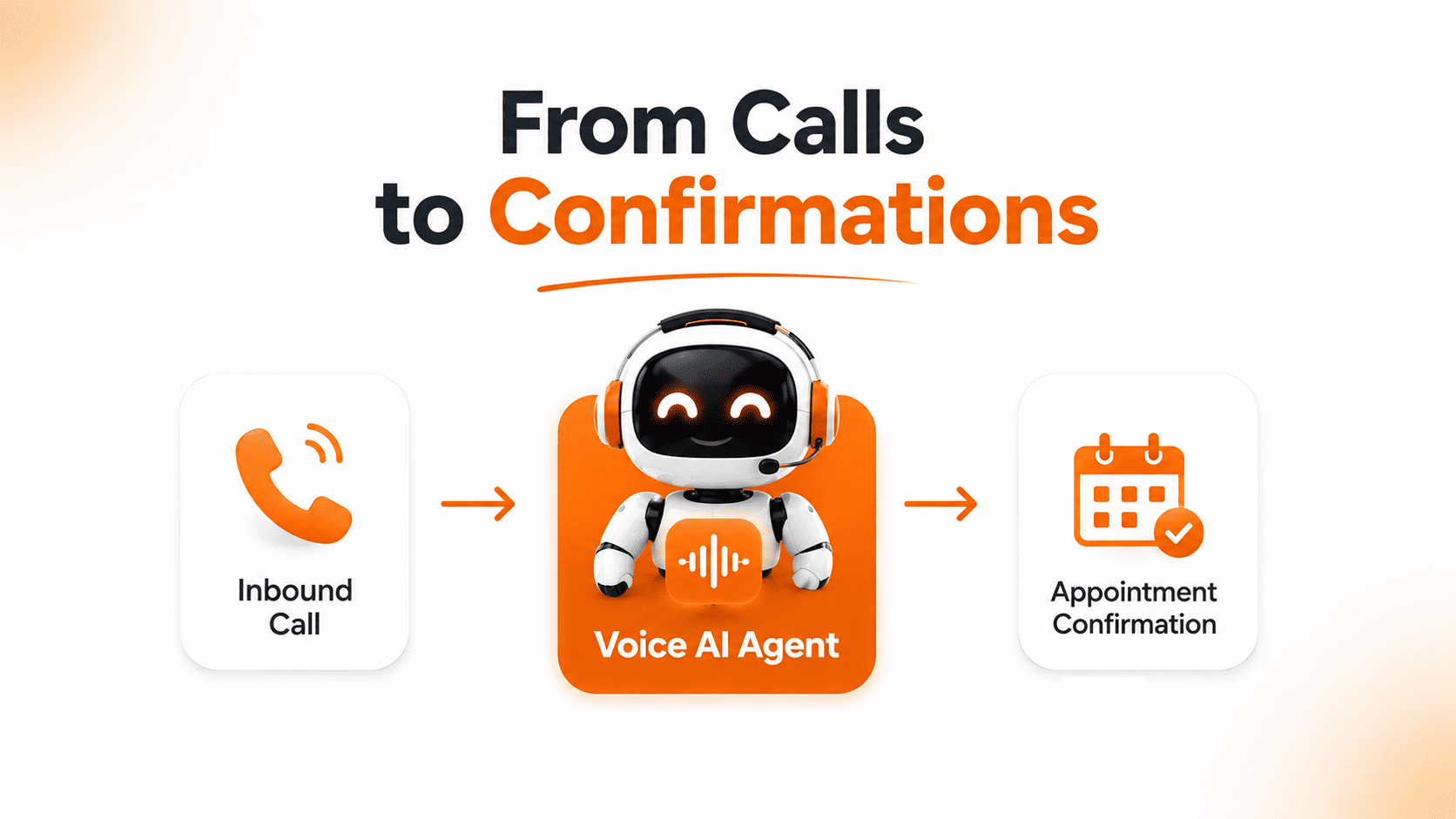
Missed phone calls mean lost revenue. For high-volume service businesses, handling incoming calls during busy hours while keeping operating costs low is an ongoing challenge. Traditional call centers are expensive, while standard IVR menu systems can frustrate callers and often fail to handle complex questions.
When a multi-location dental practice approached our AI agent development company to remove phone queues and automate appointment scheduling, we designed and deployed a custom, autonomous voice AI agent.
This case study explains how we built an AI receptionist that can handle more than 400 complex phone interactions every week with sub-second latency and natural conversation flows.
Measurable Results and Business Impact
Within 30 days of full deployment across all three clinic locations, the custom voice AI agent completely transformed the client’s front-desk operations.
We tracked key operational metrics before and after deployment:
| Operational Metric | Before AI Agent Deployment | After AI Agent Deployment | Total Improvement |
| Weekly Calls Handled | ~400 (Human Desk) | 412 (Handled by AI Agent) | 100% Automated Capacity |
| Average Hold Time | 3 minutes 45 seconds | < 2 seconds | 98.2% Reduction |
| Call Abandonment Rate | 32% | 1.8% | 30.2% Absolute Decrease |
| After-Hours Bookings | 0 (Voicemail) | 87 bookings / week | New Revenue Stream Generated |
| Front-Desk Hours Saved | 0 hours | 22 hours / week | Redirected to Patient Care |
When we implemented a similar automated voice agent solution for another regional partner, we helped a healthcare clinic cut missed appointments by 45% while scaling intake volume. Explore Our Case Studies in Detail
The Client Challenge – High Call Volume & Missed Calls
The client had three busy clinic locations handling more than 600 incoming calls every week. With so many calls coming in, staff were often overwhelmed, resulting in missed appointments and day-to-day operational issues
- Too Many Missed Calls – During busy morning hours, 32% of incoming calls went to voicemail or were abandoned because patients had to wait too long.
- Increasing Staff Workload – Staff spent more than 25 hours every week answering common questions about business hours, location, and service pricing, as well as handling simple calendar bookings.
- Limited After-Hours Support – Patients calling outside regular business hours had no way to schedule an appointment or confirm an existing booking.
The client needed an enterprise-grade solution that could answer calls instantly, sound natural, and connect directly with their central practice management software.
The Solution: A Dedicated AI Receptionist Built for Voice
Instead of using ready-made menu systems, we built a custom voice AI agent around the client’s specific workflows and appointment scheduling process.
Core Architecture & Key Capabilities
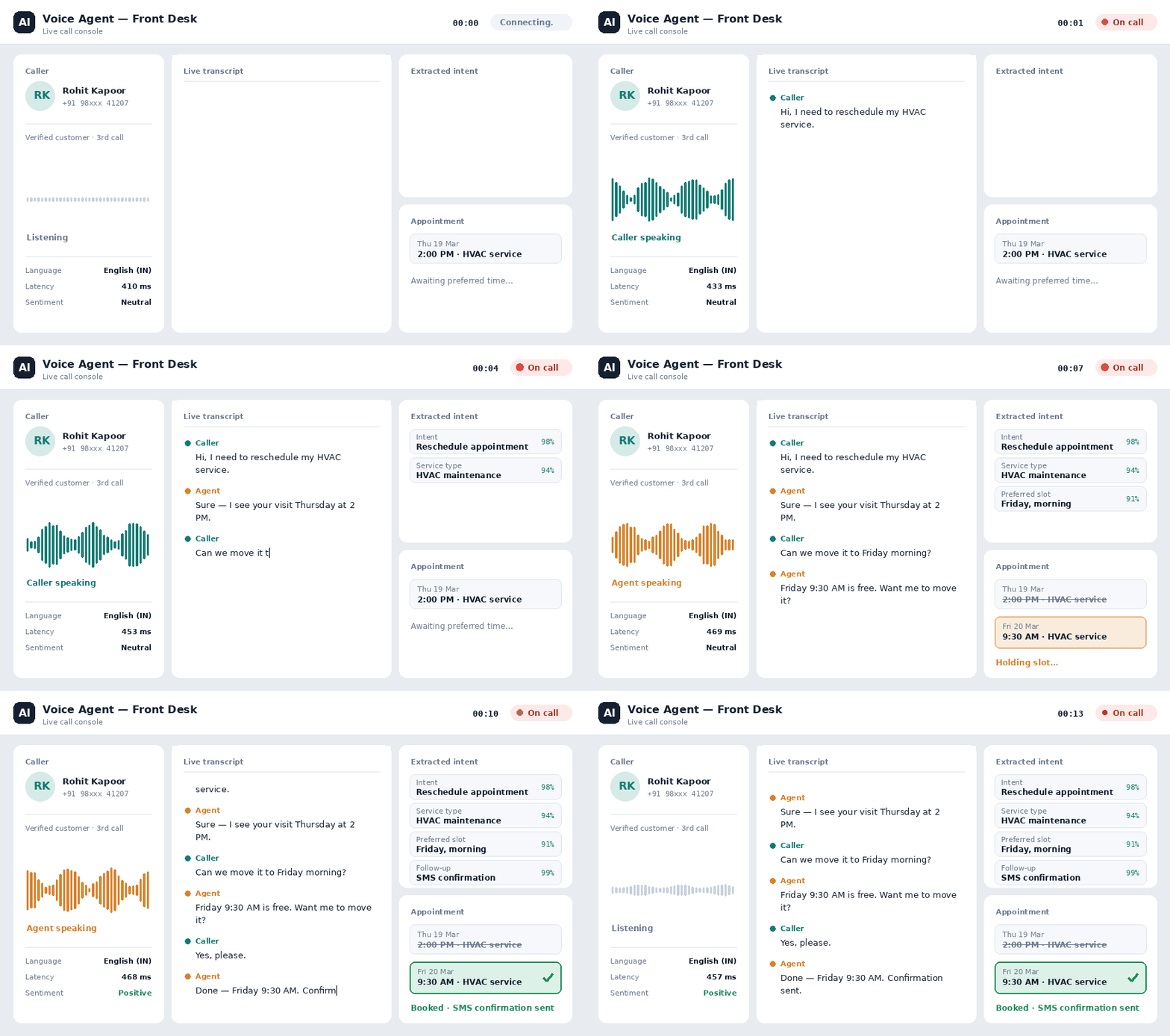
- Sub-Second Latency – We combined fast Speech-to-Text (STT) and streaming Text-to-Speech (TTS) models to keep conversation delays under 800 milliseconds, so callers do not experience awkward pauses.
- Two-Way API Integration – The AI connects directly to the client’s CRM and scheduling software. It can check real-time seat availability and automatically record appointment bookings.
- Smart Contextual Memory – The agent remembers changes made during the call, such as “Actually, make that Thursday afternoon instead,” without losing the earlier conversation.
- Human-in-the-Loop Escalation – When there is an urgent clinical emergency or a complex billing dispute, the agent automatically transfers the call to live front-desk staff and provides them with an instant summary of the conversation.
💡 Looking to automate your inbound voice channels?
Stop losing qualified leads to voicemail queues. Book a Free 15-Minute AI Audit with our team to evaluate your call workflows and uncover high-ROI automation opportunities.
The Step-by-Step Implementation Process
Building a reliable voice agent requires more than linking a prompt to an audio pipe. As a specialized AI agent development company, we followed a structured 4-phase rollout to guarantee accuracy and reliability.
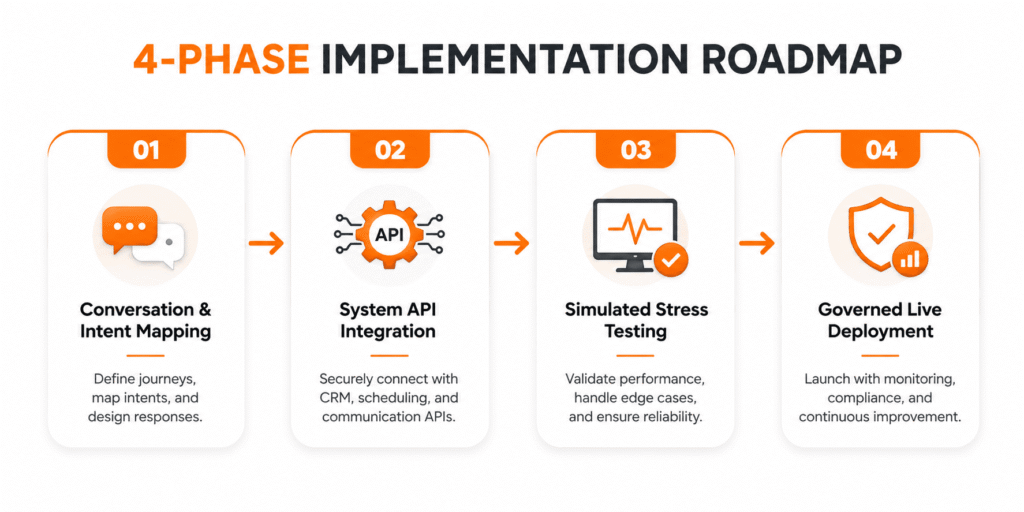
Phase 1 – Intent Mapping and Guardrail Design
We identified more than 50 specific customer intents, from rescheduling requests to service pricing questions. We also set clear rules for the agent to make sure it followed regulatory and operational requirements.
Phase 2 – Real-Time API Integration
We connected the AI receptionist engine to the client’s software using secure webhooks. This allowed the system to check database calendars, send text verification codes, and record customer information in real time during calls.
Phase 3 – Latency & Stress Testing
We tested the voice system with background noise, different accents, interruptions, and high call volumes. This helped ensure that response times stayed consistently low and reliable, even under heavy load.
Phase 4 – Governed Deployment & Continuous Tuning
We first launched the agent during off-peak hours before allowing it to handle the full daytime call volume. During the first two weeks, we reviewed live transcripts and call results to continuously improve the intent models.
🚀 Ready to scale your business operations with autonomous AI?
Explore our comprehensive framework on our Custom AI Development to see how agentic workflows transform productivity.
Technical Lessons Learned
- Interruptibility Is Essential
Callers naturally interrupt speakers. Implementing real-time full-duplex audio processing ensures the voice agent pauses immediately when the caller speaks, mirroring natural human cadence. - Fallbacks Must Be Seamless
If an intent isn’t recognized after two attempts, the agent transfers the call gracefully to a human staff member along with a transcribed summary of the context. - Keep Data Localized
Ensure data protection by sanitizing sensitive personal info before sending parameters to language models or database storage.
Frequently Asked Questions (FAQs)
Traditional Interactive Voice Response (IVR) systems use fixed menu options, such as “Press 1 for sales.” A voice AI agent understands natural speech, can have back-and-forth conversations, perform actions in backend software, and complete tasks without forcing callers to choose from fixed options.
Modern text-to-speech models provide sub-second response times, human-like voice changes, natural pauses, and different tones. This makes conversations feel smooth and natural for callers.
A specialized AI agent development company can usually design, integrate, and test a single-function voice agent pilot in 4 to 6 weeks. Enterprise-wide integrations with multiple systems can take 8 to 12 weeks.
Yes. Custom voice agents connect with CRMs, scheduling tools, and ERPs through secure, authenticated APIs. They use enterprise-grade encryption and Role-Based Access Control (RBAC) to keep system access secure.
Transform Your Inbound Call Operations
Schedule a technical discovery session with our architects to see live agentic voice workflows in action.