Over 80% of enterprise AI projects fail. They don’t fail because the artificial intelligence isn’t smart enough; they fail because the project gets trapped in an infinite proof-of-concept loop, runs wildly over budget, or outputs software that your employees completely ignore.
If you’re shopping for AI consulting services, you’ve likely seen the pitch decks filled with futuristic buzzwords. But a high-value engagement doesn’t start with hype, it starts with business outcomes, secure architecture, and code that survives live operations.
Comparing AI Consulting Models
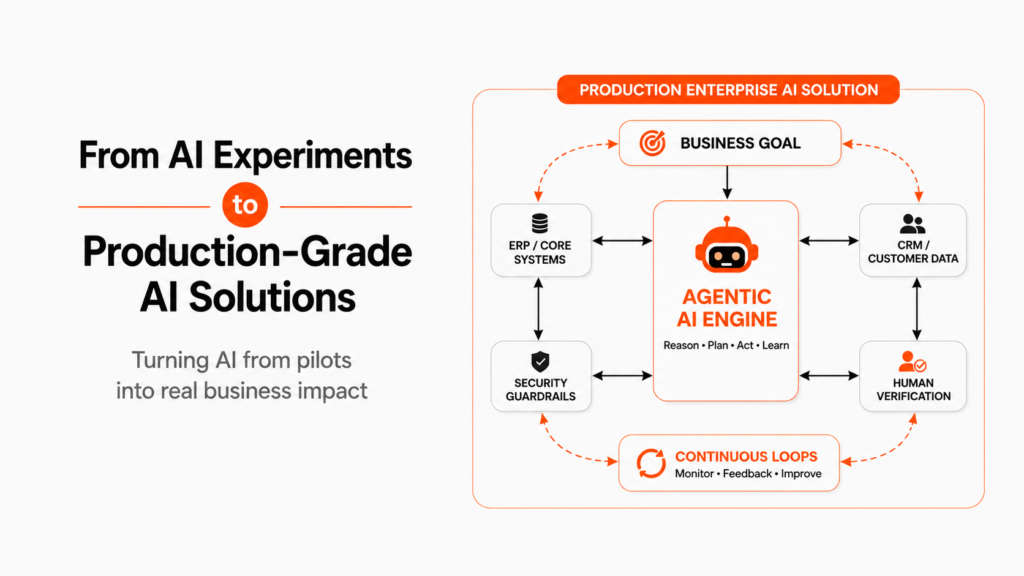
Securing autonomous workflows requires adding fixed validation checks between the LLM reasoning process and your software infrastructure.
| Engagement Model | Strategy-Only Agencies | Staff Augmentation | Full-Lifecycle AI Partners |
| Main Focus | Decks, Market Audits | Extra Developers | End-to-End Delivery |
| Time-to-Value | 2–3 Months | Varies | 6–12 Weeks (First Pilot) |
| MLOps Setup | None | Client-managed | Fully Managed |
| Post-Launch Support | Minimal | Ends with contract | Ongoing Monitoring |
| Best For | Strategic Alignment | Scaling Dev Teams | Enterprise Execution |
Here is what a successful partnership looks like from day one, how leading AI consulting companies operate, and how to make sure you aren’t paying for an expensive science project.
1. Discovery & Scoping: Finding the Hard Financial Impact
A good relationship starts with an actual business problem, not a shiny new Large Language Model (LLM). The fastest way to burn capital is trying to “add AI” to a process without defining what victory looks like.
During the first 2 to 4 weeks, top-tier AI consulting firms dig through your operations to separate realistic automation opportunities from marketing noise.
- Data Auditing: Consultants inspect your existing data pipelines to check quality, access speed, and compliance.
- ROI Modeling: Every proposal ties directly to a hard financial metric—like cutting customer ticket resolution times by 35% or processing invoices 5x faster.
- Feasibility Mapping: The team checks for technical blockers, security policies, and latency limits before anyone writes code.
Key Deliverable: A prioritized roadmap ranking use cases by technical ease and financial ROI.
Want to check your system setup first? Read our AI consultant role and responsibilities.
2. PoC to Pilot: Proving It Works in the Real World
Once a high-value use case is locked in, the project shifts to rapid prototyping. The biggest mistake executives make when hiring an AI consultancy is letting a Proof of Concept (PoC) drag on for months.
A focused PoC takes 4 to 6 weeks max. Its only job is to prove that a model can hit required accuracy levels using your messy, real-world data.
- Hard Metrics: Accuracy targets are set in stone from day one (e.g., “The model must hit 92% accuracy on complex invoice parsing”).
- Early Guardrails: Security, privacy, and hallucination checks are baked directly into the test framework.
- Fail-Fast Discipline: If the underlying data isn’t clean enough to yield real accuracy, a good team pauses the project before you waste money.
3. Integration & Scalability: Moving Code out of the Sandbox
Building an AI model in a test sandbox is easy. Plugging that model into legacy architecture without breaking uptime is where 80% of the real engineering lives. Top AI consulting services prioritize backend integration, system security, and real-time monitoring above everything else.
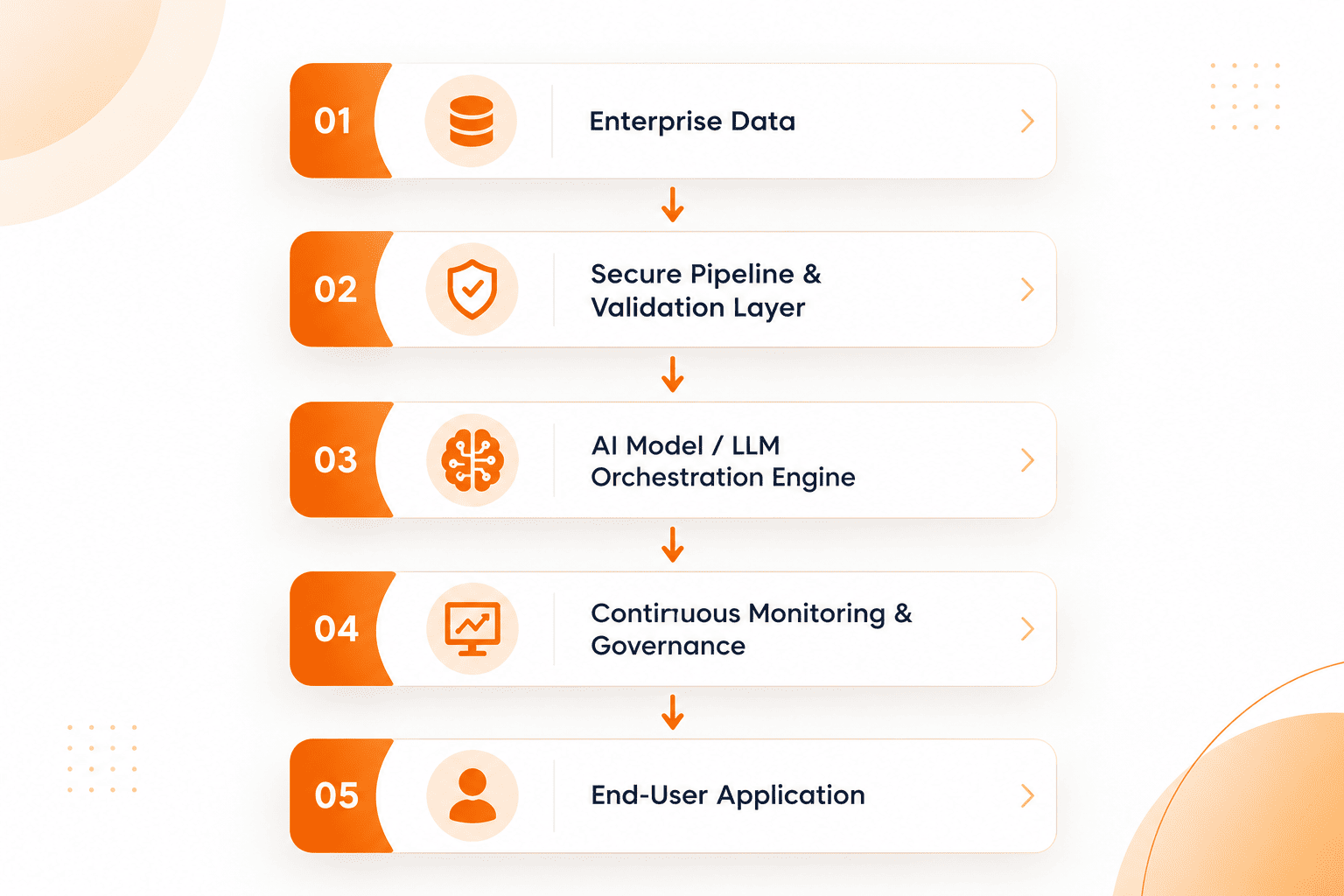
Production Essentials Include:
- Enterprise Security: Setting up role-based access control (RBAC) and end-to-end data encryption aligned with enterprise frameworks like Gartner.
- MLOps & LLMOps Pipelines: Building automated tracking systems that watch for performance drift, hallucination spikes, and data changes over time.
- Native Workflows: Connecting AI features directly into software your team already uses every day (like Salesforce, ERPs, or internal portals) so adopting it feels natural.
Need an internal technical review? Check out our engineering integration checklist.
4. Change Management: Getting People to Actually Use It
The most advanced custom model yields zero value if your employees work around it. High-performing AI consulting companies build team onboarding and training right into the contract.
User Feedback Loops: Creating direct buttons inside the app so team members can report bad outputs, feeding live data back into the retraining loop.
Practical Onboarding: Teaching employees how to write effective prompts, check outputs, and handle edge cases safely.
Workflow Alignment: Adjusting daily routines so AI handles repetitive busywork while freeing employees for strategic tasks.
5. Red Flags: How to Spot an AI Consultancy Selling Hot Air
Not all teams work with the same technical rigor. Keep an eye out for these red flags before signing a contract:
- Pushing specific models before seeing your data: Any agency pushing a specific platform or model before running a data audit is selling software licenses, not custom solutions.
- Vague promises: Walk away from vendors who offer general “productivity boosts” without agreeing to concrete, measurable KPIs.
- Zero MLOps plan: If a firm builds models but doesn’t handle live deployment, tracking, or support, you’ll be left with abandoned code.
🚀 Ready to Build AI Systems That Deliver Real ROI?
Stop wasting budget on endless prototypes. Work with engineers who map, build, and deploy secure AI tailored directly to your bottom line.
How Much Do AI Consulting Services Actually Cost?
Pricing shifts based on project depth and system requirements:
- Fixed-Scope PoC: $25,000 to $75,000 for a 4-to-6-week test pilot.
- Time & Materials: Hourly rates for expert ML engineers range from $150 to $350+ per hour.
- Full Enterprise Builds: Mid-market deployments generally run between $50,000 and $250,000+ depending on infrastructure complexity.
For standard software procurement benchmarks, check out resources on the US Small Business Administration website.
Frequently Asked Questions (FAQs)
An AI consulting firm audits your data infrastructure, finds high-ROI automation opportunities, builds custom models or LLM apps, and integrates them securely into your day-to-day operations.
An initial discovery and PoC pilot takes 4 to 8 weeks. Rolling out a fully integrated, enterprise-scale production system usually spans 3 to 6 months depending on technical complexity.
You don’t need perfect data to start. Knowing where your data lives, establishing access rights, and identifying your biggest operational bottlenecks is enough to kick off scoping.
Take the Next Step
Building enterprise AI doesn’t have to feel like a gamble. Work with partners who deliver measurable outcomes, tight security, and battle-tested code from day one.