The decision to choose the best partner out of numerous self-acclaimed ai consulting firms could prove to be one of the most important decisions the executive leadership has to make this decade.
As per the research conducted by Gartner and RAND Corporation, over 80% of the enterprise AI projects fail to reach the production phase. In most cases, the failure has nothing to do with the algorithms themselves, but instead stems from the failure to align technical execution, company data readiness, and financial benefits.
In order for your expenditure to yield measurable enterprise returns, you must sift through sales pitches put forward by vendors. Below are the 11 questions that you should ask in order to distinguish the best consulting firms in AI.
The Enterprise AI Partner Evaluation Framework
To keep your evaluation simple and structured, use this evaluation table during discovery calls:
| Evaluation Stage | Question to Ask | What Bad Vendors Say | What Top AI Consulting Firms Prove |
| 1. Business RO | How do you tie technical KPIs to P&L results? | “We deploy state-of-the-art LLMs to boost efficiency.” | “We baseline cycle times to drive a target $1.2M in annual savings.” |
| 2. Data Foundation | How do you address legacy data debt? | “We fix data issues after setting up the pipelines.” | “We run an audit upfront—60% of effort goes into data readiness.” |
| 3. Production Readiness | What is your pilot-to-production conversion rate? | “We build quick proofs-of-concept (POCs) in 30 days.” | “Over 85% of our custom pilots scale to enterprise production.” |
| 4. Domain Experience | Can you demonstrate custom vertical builds? | “AI works the same across every industry.” | “Here is an audit of our fine-tuned workflows for your sector.” |
| 5. IP & Security | How do you handle data privacy & IP ownership? | “Your data is stored securely in our private cloud.” | “Models deploy in your VPC; you retain 100% IP ownership.” |
| 6. User Adoption | What is your framework for user adoption? | “The software is intuitive; workers adapt quickly.” | “We embed change management to bridge the capability-usage gap.” |
| 7. Tech Agnosticism | Are you bound to a specific tech stack? | “We exclusively build on Provider X.” | “We build stack-agnostic architectures tailored to your stack.” |
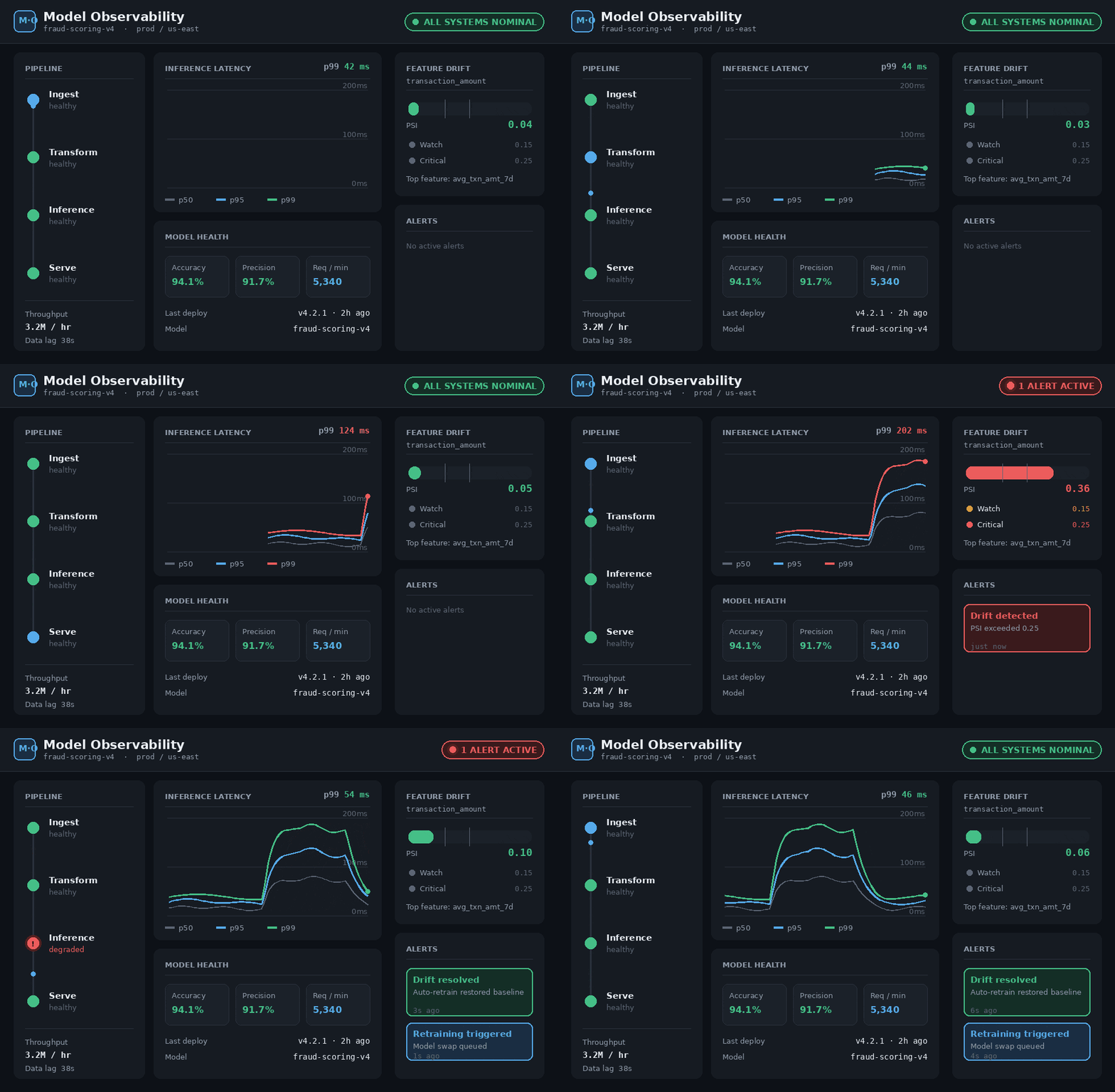
| 8. Risk Control | How do you prevent hallucinations & model drift? | “Our models are 99% accurate out of the box.” | “We integrate automated guardrails and observability platforms.” |
| 9. Pricing Structure | What is your pricing structure? | “Time-and-materials with rolling estimates.” | “Milestone-based or value-shared pricing tied to deliverables.” |
| 10. Long-Term Support | What happens after production deployment? | “We offer standard post-launch helpdesk support.” | “We run continuous monitoring, retraining, and drift mitigation.” |
| 11. Proven Proof | Can we talk to a client with a similar profile? | “Due to strict NDAs, we cannot share references.” | “Here are three client references and detailed case.” |
Deep-Dive – Vetting AI Consulting Companies
When evaluating top AI consulting firms, use these specific criteria during your technical discovery calls
1. Tying KPIs to Profitability
A company that boasts about its context window size or latency, without ever mentioning operational throughput or margin, is likely offering science projects. The best companies in the field align model accuracy with direct business metrics such as CAC, inventory turns, and order processing.
2. Measuring and Paying Off Your Data Debt
According to a report from McKinsey, 68 percent of the failed enterprise AI implementations have a problem of underinvestment in their data architecture and governance process. When speaking to your vendors, ask them to share their data readiness framework. If they don’t check your data hygiene, pipelines, and access controls before making an offer for the architecture, then walk away.
3.Proportion of the pilots turns into enterprise production
S&P Global has revealed that on average, an organization dumps almost 46% of its AI proof of concept and fails to reach production. It is time to ask for actual figures on their pilot to production journey. Expert teams manage to keep high graduation rates because they build for scalability, compliance, and integration from day one.
4. Showcase vertical-specific deep custom solutions
Plugging in commercial API into generic shell does not build a competitive moat. You need partners that understand system integrations with legacy systems, supply chain, or complex transaction systems.
Learn how we helped a retailer cut returns by 30% through predictive demand forecasting to see how domain-specific engineering drives bottom-line impact.
Enterprise Model Observability
Guarantee data protection, compliance, and ownership of intellectual property?
Your enterprise information is your true competitive advantage. Make certain that the top AI consulting companies develop your solutions in your Virtual Private Cloud (VPC) or physical location. Make sure that proprietary information is never used in training third-party public models, and that you have full legal ownership of the customized weights and codes.
Your strategy for change management that guarantees the entries are accepted in practice
A system that remains unused is not worth a single penny. As IBM research indicates, there is a significant discrepancy between technology adoption and actual usage. Make sure to find out the methods and techniques that consultants are using to teach employees to integrate AI solutions and to reach every department involved in operations.
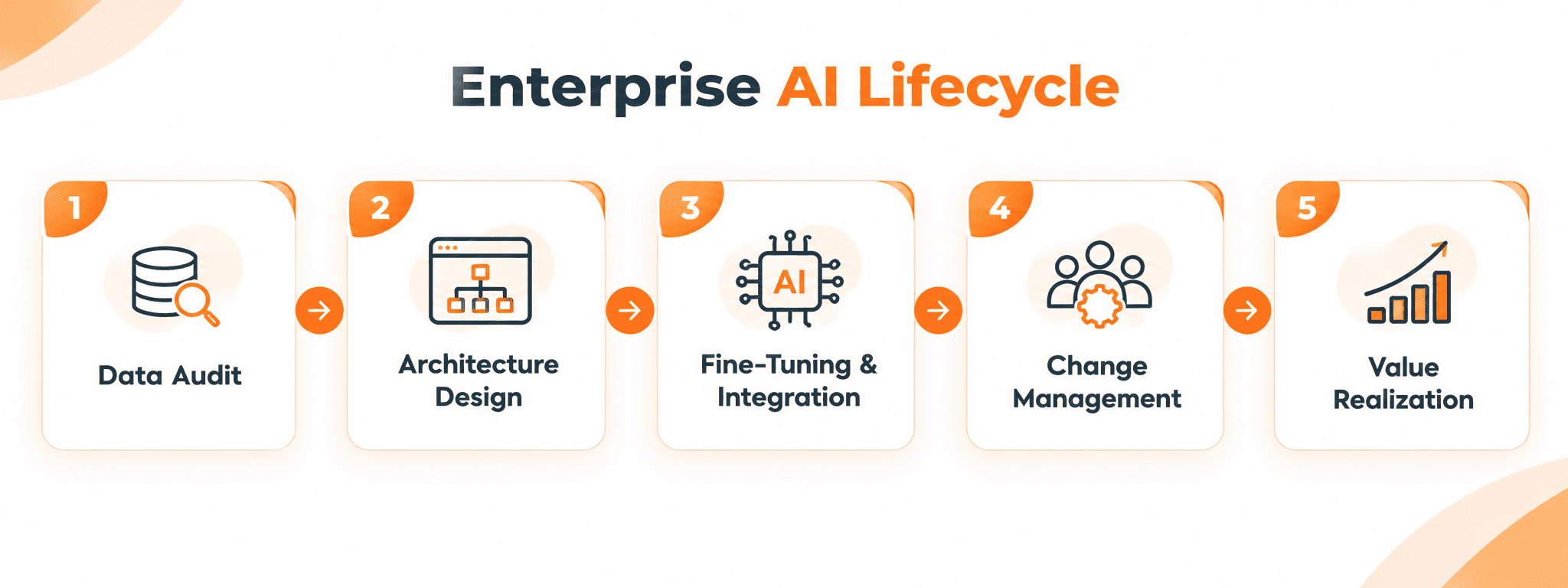
Enterprise AI Lifecycle
Are your offerings neutral to any infrastructure and provider?
Pay attention if the company ties itself to one provider or technology. Vendor lock-in leads to increased costs over time. It is often recommended by industry leaders to build stack-agnostic architecture so that it is possible to change the initial model whenever something convenient appears on the market.
How do you deal with edge cases, hallucinations, and performance drift?
The implementation of an AI solution in the enterprise requires a high degree of governance. It is necessary to know how vendor agencies evaluate the technology they offer in terms of retrieval-augmented generation, hallucinations, and continuous monitoring.
In what way is the pricing built? Is it based on milestones or value delivery?
Avoid having open-ended time-and-material contracts. It has been noticed that in many cases such an approach leads to increased costs in the future and insufficient results.
Explore AI consulting services to learn more about how the companies engaged in this process are able to protect their investments successfully.
What post-implementation infrastructure support do you have available?
Machine learning models will eventually lose effectiveness owing to the variations in real-world data. It is important that your partner gives you the necessary SLAs for monitoring models, making necessary adjustments, and maintaining the infrastructure long after the launch.
Are you able to provide us with reliable references in our sector?
Make sure you have a direct conversation with previous and existing clients of the firm to identify its strengths in budget adherence, deadline management, and technical issue solutions.
Read our strategy guide on developing enterprise AI roadmap to plan your timelines. Alternatively, you can check our in-depth analysis of enterprise AI costs.
Frequently Asked Questions (FAQs)
The majority of enterprise AI consulting engagements include an initial discovery and strategic audit which costs anywhere from $20,000 to $50,000. Tailored development and integration projects typically cost anywhere from $100,000 to more than $500,000 matching the intricacies of both data and infrastructure.
Unlike conventional information technology outsourcing firms, which deal primarily with staff augmentation and general software engineering, specialized AI consulting firms focus on implementing machine learning due to their deep knowledge and experience in the fields of data engineering and customized architecture solutions, and their implementations.
Existing data is leveraged in a proof of concept but it usually takes between 4 and 8 weeks. Scaling that proof of concept into an integrated system designed for an enterprise environment usually takes between 3 and 6 months.
Ready to skip the vendor sales pitches and build high-impact AI systems that drive real enterprise value?