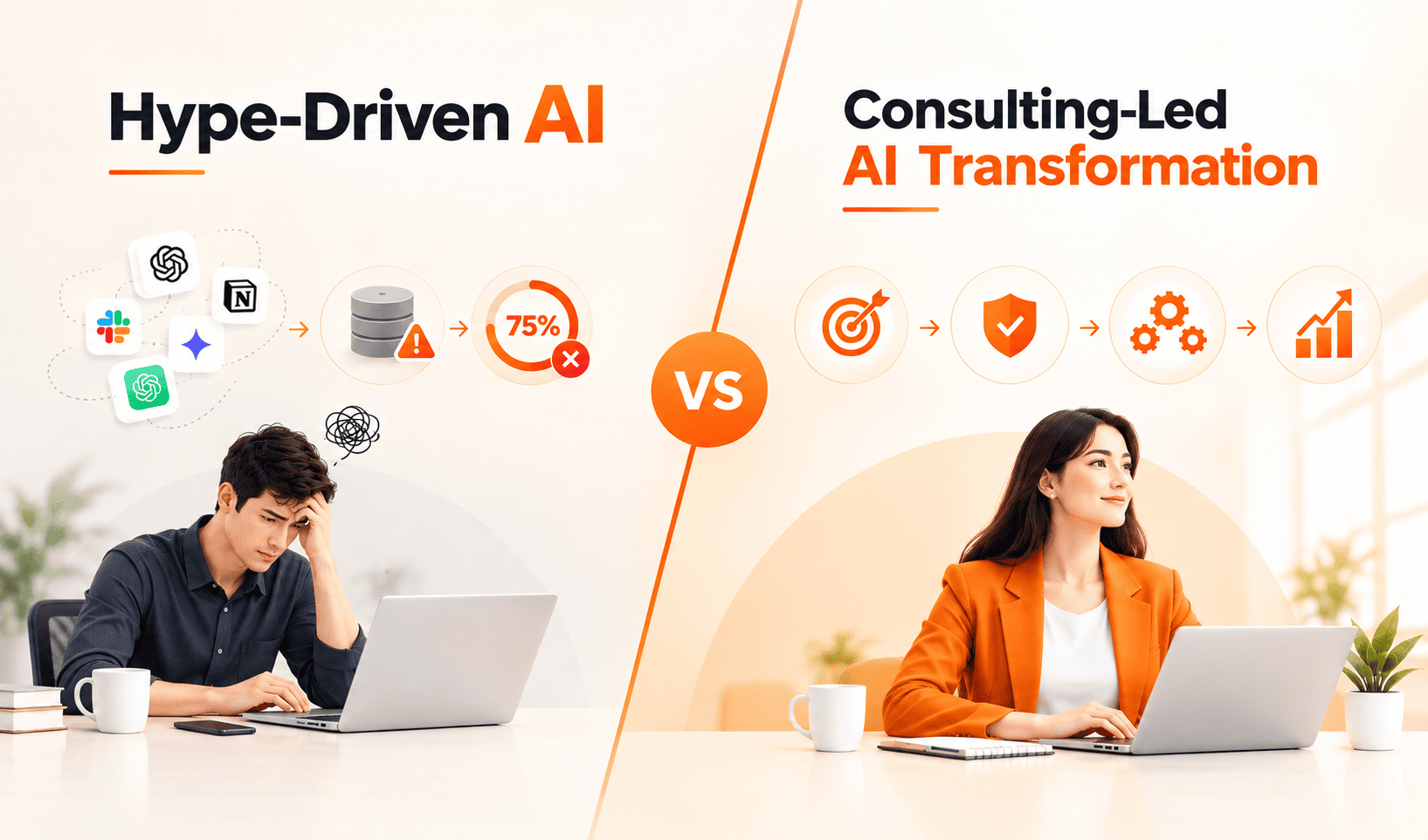
Executives in many businesses are struggling to gain any return on their outlays on artificial intelligence. Studies by the RAND Corporation indicate over 80% of business AI programs do not make it off the ground which is more than twice the failure rate in traditional IT projects. Similarly, other business studies confirm that approximately 75% of corporate generative AI programs obtain little, if any, return on investment (ROI).
As high-ranking officers move quickly to implement generative AI technology, they realize that to apply these technologies successfully, more effort is needed in terms of organization and strategy rather than just making use of advanced software. In essence, the deployment of sophisticated language models without proper coordination between their operations merely introduces increased costs without eliminating existing inefficiencies.
As enterprise AI research continuously emphasizes when evaluating organizational readiness:
“Future workforces in enterprise will be a combination of humans and digital systems… The real competitive moat is not access to models, but the operational alignment that allows those systems to execute strategy safely and profitably.”
This guide breaks down why enterprise initiatives fail, how strategic AI business consulting creates measurable value, where to deploy automation, and how to approach organizational scaling without getting bogged down in technical jargon.
Failure Analysis: Why Enterprise AI Projects Miss ROI
To understand how AI business consulting turns around underperforming software investments, you first need to distinguish between reactive tech buying and strategic implementation.
| Operational Layer | Hype-Driven Implementation | Unstructured Tech Experiments | Consulting-Led AI Transformation |
| Logic Basis | Point-solution adoption | Ad-hoc prompt engineering | Goal-oriented business metrics |
| Data Foundation | Fragmented & unverified databases | Unstructured, legacy data silos | Clean, governed data pipelines |
| Employee Usage | Low adoption / shadow IT usage | Fragmented team pilots | Structured change management & training |
| Financial Tracking | Untracked software overhead | Unmeasured productivity claims | Clear monthly ROI & operational KPIs |
Compared to standalone software tests that take place in distinct business contexts, a transformation strategy focuses on four principal failings in the process of business implementation
- Launch Without Investment Justification
Due to the popularity of a certain technology, organizations usually resort to using it without analyzing if it can resolve a costly business problem. - Data Foundation Failure
Studies conducted by Gartner show that over 60% of the AI initiatives fail because of the lack of data governance. The raw data, when it is manipulated with duplicate or inconsistent information, brings unreliable results. - Underestimating Organizational Change Management
Software alone cannot create value, but rather it is the people that produce it. If the personnel are not trained properly, the costly solutions might end up in oblivion. - Premature Scaling
If the businesses ignore pilot testing, they will end up investing millions in implementation of tools that have not been tried on a smaller scale.
4 Core Pillars of Successful AI Business Consulting
In order to convert challenging algorithms into tangible profits, company executives depend on four basic principles
- Defining the Use-Case
You present the business objective (for instance, “cut the customer churn by 15%”) and consultants indicate the profitable business processes to be automated. - Arranging the Data Pipeline
Consultants structure internal enterprise data and provide effective connection of contemporary models with safe legacy databases. - Change Management
Employees are provided with the requirements to use the new system, receive training, and are fully supported in this. - Human Oversight
Operations of high importance (such as approving supplier refund or changing client contracts) are stopped for human approval before execution.
💡 Is your technology stack ready for profitable automation?
Don’t spend months experimenting without clear ROI.
Book a Free 15-Minute call with our strategy team to identify your top 3 high-impact workflows for autonomous deployment.
High-Impact Use Cases Across Business Operations
Organizations experiencing quick ROI put their attention to specific processes that can be measured and allow eliminating manual roadblocks with the help of AI consulting firms
1. Customer Care and Service Management
Utilizing automated systems helps to authenticate users instead of providing them with standard answers, check their purchase history in an ERP system, return items, and issue credit notes through an accounting application.
2. Finance and Operations Audit
Custom automation systems track invoices, orders, and bank statements. When errors are detected, they find the place of error, send email clarification requests to suppliers, and wait for an approval.
3. Sales Processes and Lead Generation
Using intelligent systems helps to evaluate leads, search for information about potential clients in available databases, customize outreach requests, and arrange meetings for sales agents.
4. Monitoring Logistics
Real-time tracking systems monitor the performance of shipping companies in case of delays.
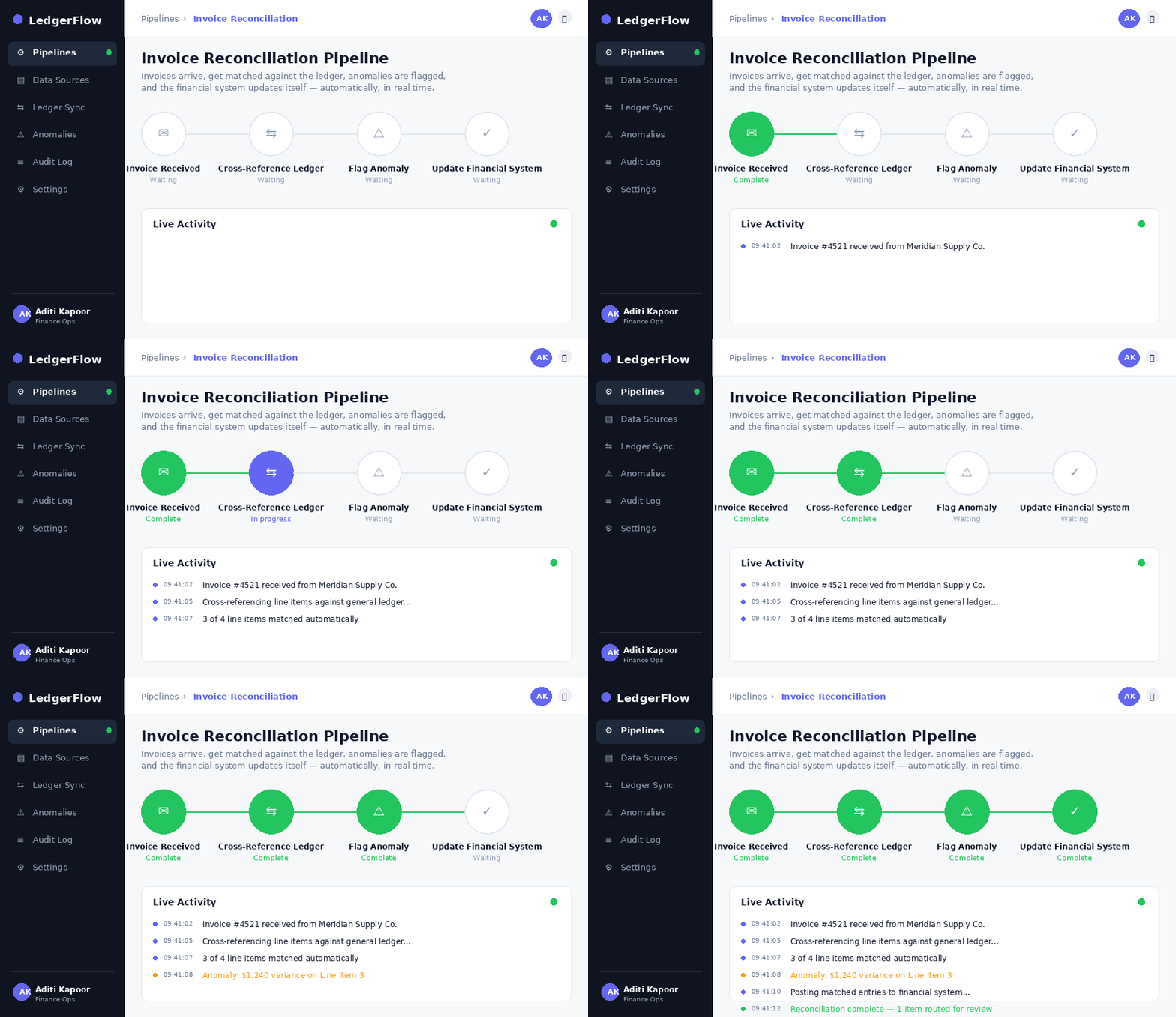
When we implemented these automated workflows for a high-growth distributor, we helped a mid-market enterprise cut manual invoice processing costs by 64%.
The Executive Guide to AI Transformation Consulting
Executing a successful enterprise strategy around AI transformation consulting doesn’t require writing code, it requires defining business rules, governance, and clear boundaries.
Step 1: Picking the Right Workflow
Avoid generic phrases like “automate processes.” Instead, focus on a very specific, standardized process with dedicated metrics to measure success, such as “process requests for standard product replacements.”
Step 2: Set Boundaries and Limits
Establish specific parameters. Indicate what types of software the automation can use, what kind of information it can alter, and what financial or operational thresholds warrant a manager’s approval.
Step 3: Choose Your Technology Approach
- Off-the-Shelf Programs: Software readily available with platforms like Salesforce or HubSpot. Fast implementation but only available to certain software systems.
- Custom Framework: The software architecture developed according to the specific requirements of the software infrastructure and security measures. Offers a broader level of automation and ability to scale up over time.
Step 4: Conduct 90-Day Supervised Pilot
Implement the systems together with human team members. Monitor the performance before fully developing the system.
Mitigating Risk: Security, Governance, and ROI
Introduction of cutting-edge technologies brings in certain challenges that leaders should deal with
Execution risk: Towards that end, the impacts of software executing erroneous operations could be more troublesome than the impact of an erroneous response generated by a simple query tool. Therefore, strict validation and sandbox testing is required.
Data security and access control: It is also necessary that systems utilize only Role-based access control (RBAC). It is mandatory that the access to data is strictly controlled by its necessity.
Clear metrics: According to the latest industry benchmarks, projects fail to achieve scaling capabilities if teams neglect to come up with baseline operational KPIs before the project implementation. Therefore, cycle times, error rates, and cost-per-transaction are to be continuously tracked.
Frequently Asked Questions (FAQs)
Internal enterprise projects fail to succeed not because they are poorly designed, but chiefly because of lack of proper and clean data.
The proper AI projects focused on any specific improved business operations can generate positive ROI from the investment within 3 to 6 months.
An AI consulting firm performs audits of operations and processes to identify profitable use cases.
Not at all. Business persons can manage and supervise the operations through partnering with an AI consultancy firm or using good systems management practices.
📞 Transform Your Business Operations
Stop experimenting Start scaling.
Schedule a tailored walkthrough with our technical architects to see live transformation workflows in action.