Every owner or executive across numerous companies aims to benefit from artificial intelligence by automatically streamlining processes and boosting their business growth. Nonetheless, few corporations have the time to waste money acquiring yet another subscription or trying out an unviable proof-of-concept pilot. A successful tech roll-out should not involve rushing to buy the latest solution or immediately start training custom models. A viable execution plan is needed instead. In the absence of an articulated strategy, the costs of cloud infrastructure are rising, timelines of projects are getting longer, and the top management loses interest.
In order to create a workable AI consulting strategy that results in tangible benefits without spending too much money, one should link their technological goals to the business reality. Specialized consulting services can help bridge the gap between the big vision of the executive and the on-the-ground implementation. As industry statistics by Gartner indicate, 50% of enterprise artificial intelligence projects face failure in achieving the originally planned returns on investment. The issue does not lie in the algorithms that are being used, but rather in the processes of scoping the project, the data architecture, and the financial risk preparation.
As Nvidia CEO Jensen Huang noted when describing the future of enterprise software deployment
“Future workforces in enterprise will be a combination of humans and digital humans… Our company’s IT department is going to be the HR department of digital employees of the future.”
This comprehensive guide breaks down how to build an adaptable technological framework, evaluate complex financial trade-offs, account for hidden operational line items, choose between custom and pre-built solutions, and approach AI implementation consulting without getting bogged down in market hype.
Unplanned Deployments vs. Structured Roadmaps: What Is the Difference?
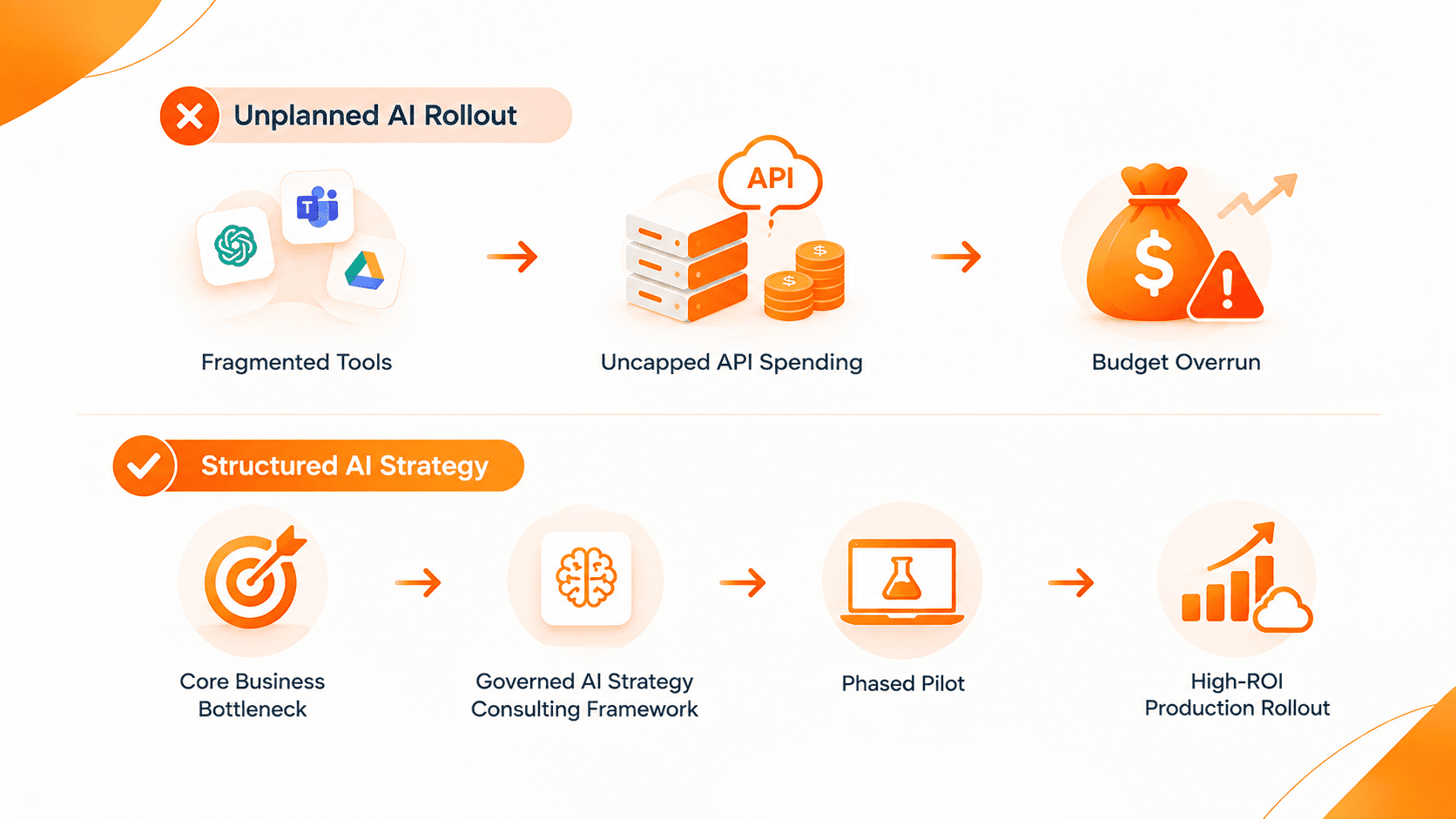
To understand how structured AI consulting services transform enterprise operations, you must first distinguish between opportunistic, ad-hoc experimentation and a fully governed strategic roadmap.
| Capability Layer | Ad-Hoc AI Experimentation | Governed Strategic AI Roadmap |
| Logic Basis | Isolated tools, scattered team subscriptions | Unified, modular enterprise operational architecture |
| Financial Control | Uncapped API consumption and hidden infrastructure fees | Phased budget caps linked directly to clear ROI milestones |
| System Access | Siloed desktop utilities and basic chat windows | Secure, role-based database & core system API integrations |
| Autonomy & Risk | Unmonitored employee usage and privacy risks | High-value automation with strict human-in-the-loop guardrails |
Unlike an uncoordinated implementation of tools which results in or leads to severe blind spots in data security, unpredicted invoices for software, and bottlenecks in operation, an enterprise solution asserts the continuous value loop in a structured manner.
- Understand – Analyze friction points and dilemmas in operation at different levels of different departments including manually performed account adjustments, invoice matching, and adaptation in relation with clients.
- Analyze and Plan – Assess the readiness of data while calculating total cost of ownership (TCO), defining the most effective architecture model that would reduce costs and limitations that a company would face.
- Respond – Introduce concrete automation by means of strong API integration, effective security measures, principles of access allotment including a role and other operational elements.
- Evaluate and Adjust – Control the results of the implemented solution according to previously defined results in operation and improvise and extend the application of the model to other organizational units.
4 Basic Stages of a No-Budget AI Strategy
To implement scalable tech solutions in the right way, management teams should prepare their long-term road map based on four major financial and technical constituents.
- Data & Infrastructure Audit – Determine obsolete system silos ahead of time to avoid unpredicted costs for data formatting and computing power in the course of integrating processes.
- Use-case Prioritizing – Represent possible initiatives in a proper value-vs-complexity matrix in order to benefit from the early success in raising funds for subsequent developments.
- Total Cost of Ownership (TCO) Estimation – Take into consideration maintenance costs, API usage limits, data preparation costs, security regulations, and change management from the very beginning.
- Human-in-the-Loop-based Control – Set clear operational limits concerning engagement of people in any risky financial, legal, or customer matter.
💡 Is your technology stack ready for agentic automation?
Don’t spend months experimenting without clear ROI. Book a Free 15-Minute AI Audit with our strategy team to identify your top 3 high-impact workflows for autonomous deployment.
Understanding the Importance of Secret Financial Aspects
One component of the project estimate is the deployment of software licenses and expenses related to vendor installation at first. The main reason behind cost overruns on corporate technology implementations is not taking into consideration daily operating costs. In order to ensure the project is financially viable, it is necessary to consider costs that are underestimated.
1. Cleansing Data as well as Developing Data Pipeline
Corporate data cannot be processed in its raw form. Therefore, formatting raw text, cleaning the database entries, dealing with vector search indexing, and creating automatic data pipelines may absorb up to 60 percent of the total planned budget in the beginning.
2. Computing Infrastructure and API Token Costs
No matter what method is used to host open-source models (whether it is done via the cloud or by calling external vendors) expenses will incur based on the volume of transactions. If there is no query caching or optimization of requests or limitations for the tokens usage, the regular monthly costs will grow significantly.
3. Maintenance, Assessment, and Unreliable Change of AI Models
Artificial intelligence systems are dynamic, which means their effectiveness declines due to changing consumer behaviors, market trends, and internal rules and regulations. Thus, it is critical to constantly assess the AI model and refactor it in case its accuracy drifts.
4. Change Management and Employee Education
It does not matter how advanced your automation system is; if the employees do not want to utilize it, the overall automation system will fail. Successful implementation of automation requires comprehensive retraining, proper adjustments of existing operating procedures, and clarity in documentation regarding the usage of the system.
Good professional consultants become your guide through uncharted waters, helping you to reveal hidden items and remain within the budget during the entire exploration phase.
Business Departments Utilizing High-Impact Business Use Cases
Companies that achieve rapid returns on investment invest in selective processes that are efficient and can be repeated often that automates repeatable processes causing a bottleneck in the manual labor of their processes.
1. Customer service
Modern systems, instead of using angry, pre-arranged responses, make use of back-end databases that allow them to respond in real-time to customer queries and ensure that any complex issues get passed on to human employees with a full history of the events.
2. Finance and operations
Automated finance monitoring automatically checks invoices, orders, delivery confirmations, and banking documents against each other. If discrepancies occur, systems immediately inform vendors about the problem.
3. Sales
Intelligent systems evaluate incoming leads and ensure that other processes are triggered and customers receive personalized messages that match their interests.
4. Transport
When problems with transport occur, predictive systems analyze shipping data to proactively inform affected customers about the situation and monitor the stock automatically.

When we implemented these automated workflows for a high-growth distributor, explore our case study to know the real insight.
The Non-Technical Leader’s Guide to AI Implementation Consulting
Executing a successful initiative around AI agent development doesn’t require writing complex code; it requires defining practical business rules, robust governance, and clear operational boundaries
Phase 1: Select the Ideal Workflow
Avoid vague terms such as “automate customer service.” Instead, opt for one specific operational process that is repetitive and has established reliable metrics of success; for instance, “handle routine requests for standard product replacements under $200.”
Phase 2: Establish Secure Boundaries
Impose safety regulations in terms of system permissions. Clearly mention which software systems the platform will have reading access to, which database records it will be able to modify, and which financial/legal thresholds will require human managerial consent at all times.
Phase 3: Decide on the Technology Strategy
- Buy Standard Programs: Highly suitable for standardized business processes such as handling helpdesk tickets, conducting in-house search, or processing standardized documents. Facilitates quick launch and low initial outlay.
- Custom Enterprise Frameworks: Customized solution creation according to your proprietary software stack and security needs. Assures your operational advantage over your competitors and allows for long-term enterprise growth.
Phase 4: Implement a 90-Day Controlled Pilot
Launch the solution jointly with human operators within a regulated sandbox or limited production environmental setting. Monitor performance speed, errors, costs, and frequency of human intervention before providing autonomy.
🚀 Accelerate Your Strategy Ready to build or deploy autonomous workflows in your enterprise?
Read our in-depth guidance on how to choose an AI strategy partner or explore our full suite of enterprise AI services.
Mitigating Risk: Security, Governance, and ROI
Introducing advanced automation entails certain operational and structural risks, which require corporate administration to address before making substantial investments
- Execution Risk: In contrast to simple text generation mistakes, improper automated actions performed by software systems lead to far greater operational disturbances. Hence, necessary steps include rigorous sandbox testing of systems, use of output validation filters, and strict execution rules.
- Data Security and Access Control: All systems need to comply with strict Role-Based Access Control (RBAC). That ensures data accessed and processed includes only information vital for each specific functionality of the program.
- Clear Metrics Benchmark: In accordance with research conducted by McKinsey & Company, enterprises’ technological projects fail to achieve scaling due to the absence of performance metrics set up at the launch. Monitoring of cycle time, cost per unit, error ratio, and labor hours is an essential prerequisite for business statistics.
Frequently Asked Questions (FAQs)
Basic Generative AI centers on generating content (text, code, synthetic images) in response to restricted user queries via chat window. Strategic automation takes the next step by intervening into essential operational databases and APIs to conceive and execute a series of steps, fulfilling jobs in the real world across software tools while adhering to strict security requirements.
Initial proof-of-concept projects are generally quite small and involve low-complexity, but high-value case. Therefore, you should organize your budget properly so that your spending does not cover just the software licenses and development costs, but also data preparation, infrastructure integration, monitoring systems and employee training. In most cases, a pilot costing between $25,000 and $50,000 would suffice for success assessment before implementation across the whole company.
Specific quick-win initiatives (for instance, streamlining invoice processing or acquiring internal documents) usually lead to the attainment of visible operational performance improvement after a period of 3 to 6 months. More extensive company-wide changes such as multi-departmental implementation and custom software automation usually develop during the period of 12 to 18 months as the organization’s employees master the technology and the advantages of the software are accumulated.
It must be noted that the budget overruns are commonly not a consequence of software purchases only, instead they are usually caused by bad quality of initial data, unexpected problems with the integration of legacy systems, the problem of changing the project’s scope in the course of implementation, as well as complete neglect of the future expenses on tokens, hosting of a vector database, and maintenance of the model after project launch.
Not. Current organizational strategies emphasize management of adaptable, efficient structures rather than creating one’s own frameworks for machine learning systems from the ground up. Non-engineering management teams can keep things under control by using easy control panels coupled with consulting companies providing necessary services.
Ready to Build a Realistic AI Strategy?
Stop experimenting without clear direction or burning capital on uncoordinated tools. Start scaling your operational capabilities with confidence and full budget control.
Schedule a tailored walkthrough with our senior technical architects today to analyze live workflow automations in action and map out a high-ROI strategic execution plan tailored specifically to your financial budget.