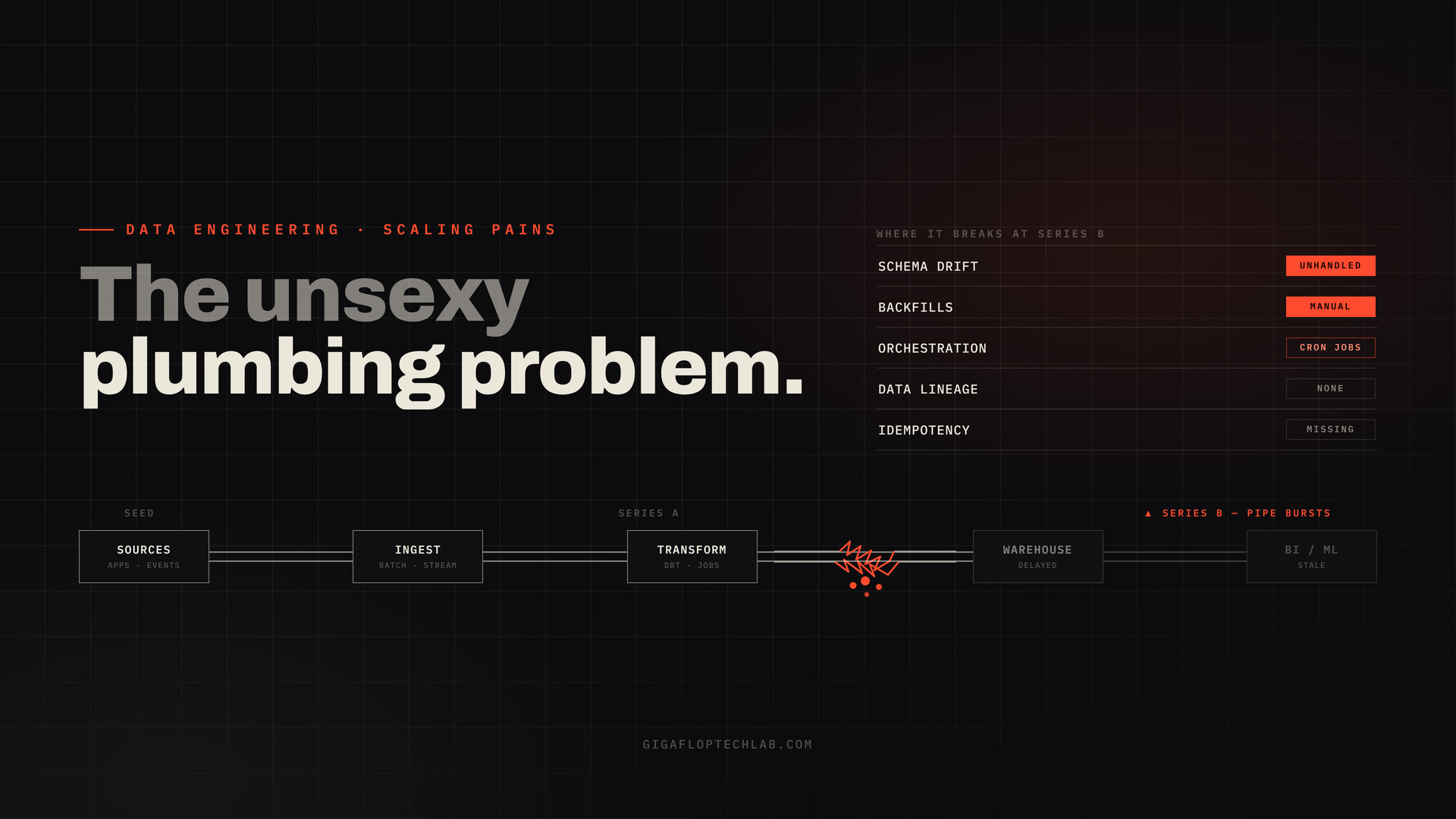
Nobody puts “our data pipelines held” in a board deck. Data infrastructure is plumbing invisible when it works, catastrophic when it doesn’t, and never the thing anyone wants to spend money on. Which is exactly why it breaks at Series B, right when the business can least afford it.
Here’s the pattern we see repeatedly. A startup hits Series A with pipelines that work fine. The data volume is modest, the sources are few, one engineer understands the whole thing, and the dashboards are roughly right. Then the company scales more customers, more data sources, more questions asked of the data and somewhere in the Series B stretch, the plumbing starts failing. Dashboards show nulls. Attribution stops reconciling. The warehouse bill doubles. Engineers spend more time firefighting pipelines than building anything.
The instinct at that point is to greenlight a big rebuild. Sometimes that’s right. Often it’s premature you can’t fix what you haven’t diagnosed. This piece is the diagnostic: why pipelines fail at this stage, the three failure modes to check for, and how to tell what you’re actually dealing with before you spend a quarter and a budget rebuilding the wrong thing.
Why Series B specifically? Because the assumptions break
The uncomfortable root cause: the pipeline didn’t get worse your scale assumptions did. As one 2026 architecture analysis puts it bluntly, data sources evolve, business requirements change, and scale assumptions break; pipelines are not deployed once and forgotten. The Series A pipeline was built (reasonably) for Series A reality. Series B is a different physics:
- More sources, each evolving independently. Every SaaS tool and API you integrate changes its own schema on its own schedule. At three sources you can hand-patch the breaks. At thirty, you can’t.
- More questions, higher stakes. At Series A, “roughly right” dashboards are fine. At Series B, the board, investors, and revenue team depend on the numbers and “roughly right” becomes “actively misleading.”
- More volume, exposing lazy architecture. Design shortcuts that were invisible at low volume (no compute/storage separation, monolithic jobs) start showing up as cost and latency.
The decisive insight, and the one that should shape your response: the difference between a pipeline that scales and one that becomes a liability usually isn’t the tools it’s the architectural decisions made before the first line of code (2026 pipeline architecture guidance). That’s why throwing a new tool at the problem so often fails. The problem is structural, and you have to diagnose the structure.
Failure Mode 1 – Schema drift (the silent killer)
This is the single most common cause of pipeline failure in production, and the most insidious because it fails quietly. Schema drift is when a data source changes its structure a renamed column, a new field, an altered type without warning. A marketing platform renames campaignId to campaign_id in a v2 API. An event schema gets restructured. Each change is reasonable inside its own system.
Downstream, it’s carnage: broken joins, corrupted aggregations, dashboards full of nulls, attribution models that break mid-month and frequently the pipeline doesn’t error, it just produces wrong data that looks fine. That’s the nightmare scenario: not a pipeline that’s down (you’d notice), but one that’s confidently feeding the business bad numbers until someone happens to spot that the totals don’t add up.
Diagnostic questions:
- When a source changes its schema, does your pipeline fail loudly, handle it gracefully, or corrupt silently? (If you don’t know, assume the worst.)
- Do you have a schema registry or schema-conformity checks, or does every upstream change require manual code edits?
- How would you even detect that an aggregation has been silently wrong for two weeks?
If schema drift is your failure mode, the fix is often not a full rebuild it’s schema-drift handling (a registry, conformity checks, graceful evolution) added to the existing pipeline.
Failure Mode 2 – Warehouse bloat (the silent cost)
The cost cousin of schema drift. As the pipeline accretes sources, transformations, and “temporary” tables that became permanent, the warehouse fills with redundant data, inefficient transformations, and compute that scales faster than the value it produces. The bill climbs faster than the data does the classic tell that the problem is configuration and architecture, not genuine need. (We’ve written separately about how a single cost audit found four oversized warehouses, twelve inefficient queries, and three ghost dashboards.)
A common architectural root cause: no separation of storage from compute, so you scale (and pay for) both even when you only need one. The 2026 consensus is to scale only what you need, when you need it the core principle behind every cloud-native platform and pipelines that didn’t design for that pay a permanent surcharge.
Diagnostic questions:
- Is the warehouse bill rising faster than data volume or usage? (If yes, it’s waste, not growth.)
- Can you scale compute independently of storage, or are they coupled?
- How many transformations and tables are still running that nobody actually consumes?
If bloat is your failure mode, the fix is a cost/architecture audit and targeted optimization frequently recovering 30%+ not necessarily a rebuild.
Failure Mode 3 – Broken attribution & data quality (the silent trust collapse)
The most business-visible failure: the numbers stop being trustworthy. Low-quality data entering at ingestion missing values, inconsistent formats, drift propagates and silently corrupts everything downstream (dbt Labs, 2025). At Series B this surfaces as attribution that doesn’t reconcile, metrics that disagree between dashboards, and the slow poison of an org that stops trusting its own data and reverts to gut feel and spreadsheet exports.
The architectural root cause is almost always the same: quality checks were bolted on last (or never), so bad data travels three stages before anyone notices, by which point it’s baked into aggregations and reports.
Diagnostic questions:
- Do you validate data quality at ingestion, or do problems surface in dashboards downstream?
- When two dashboards disagree, can you trace which pipeline stage introduced the discrepancy?
- Has the team started quietly distrusting the data and working around it? (This is the real cost a data platform nobody trusts is worse than none.)
If trust/quality is your failure mode, the fix is data-quality checks at every layer plus observability catching bad data at the source instead of in the boardroom.
The diagnostic framework: which failure(s) do you have?
Before greenlighting any rebuild, run this. The point is to separate “the architecture is fundamentally wrong” from “the architecture is fine but missing three controls” because those have wildly different price tags.
| Symptom you’re seeing | Likely failure mode | Usual fix (cheapest viable) |
| Dashboards show nulls / break after a source update | Schema drift | Schema registry + conformity checks |
| Numbers are silently wrong; found late | Schema drift / quality | Drift detection + ingestion-layer validation |
| Warehouse bill rising faster than data | Warehouse bloat | Cost/architecture audit + optimization |
| Attribution won’t reconcile; dashboards disagree | Quality / attribution | Quality checks at every layer + observability |
| One failure takes down everything downstream | Monolithic architecture | Modularize (one stage, one job) |
| Every source change needs manual code edits | No schema handling | Schema registry / graceful evolution |
| Team has stopped trusting the data | Quality collapse | Observability + validation + lineage |
The rebuild decision rule: If your symptoms map to missing controls (drift handling, quality checks, observability) on a sound modular architecture, add the controls don’t rebuild. If your symptoms map to fundamental architecture (monolithic, coupled compute/storage, no path to schema evolution), a rebuild may be justified but scope it to a lean target, not a bigger version of what failed. The most expensive mistake at Series B is rebuilding the architecture when you only needed to instrument it.
Common mistakes at the Series B inflection point
- Rebuilding before diagnosing. The big-rebuild instinct often spends a quarter solving the wrong problem. Diagnose first.
- Blaming the tools. New tools rarely fix architectural problems; they relocate them. The decisions before the first line of code are what matter.
- Treating schema drift as an edge case. It’s the #1 failure mode. If you’re not handling it, you have latent silent failures right now.
- Bolting quality checks on at the end. Catch bad data at the source, or it travels three stages and corrupts everything downstream.
- Ignoring the trust signal. When the team stops believing the dashboards, that’s the most expensive failure of all and it doesn’t show up on a status page.
Conclusion
Data pipelines fail at Series B because the quiet architectural decisions made for Series A reality stop holding sources multiply and drift, volume exposes lazy design, and “roughly right” numbers become a liability the moment the board depends on them. The three failure modes schema drift, warehouse bloat, broken attribution are all silent, which is exactly why they’re dangerous and why they surface all at once and feel like a crisis.
But “crisis” doesn’t automatically mean “rebuild.” Diagnose which failure mode you actually have, and most of the time the fix is adding the controls a Series A pipeline never needed not tearing it down. The plumbing is unsexy. Diagnosing it before you spend a quarter rebuilding the wrong thing is the most valuable unglamorous decision you’ll make this year.
CTA
Pipelines breaking, costs climbing, or dashboards no one trusts and not sure whether you need a rebuild or just the right controls? That’s exactly the question to answer before you commit a quarter to it.
Start with a Data Audit → we’ll diagnose which failure mode you’re actually facing (drift, bloat, or quality), tell you honestly whether it’s a controls problem or an architecture problem, and scope the cheapest viable fix. Diagnose before you rebuild.
FAQs
Because the scale assumptions break, not the tools. A Series A pipeline was built for fewer sources, lower volume, and “roughly right” dashboards. At Series B, sources multiply and drift independently, volume exposes architectural shortcuts, and the numbers now matter to the board — so latent weaknesses (schema drift, bloat, weak quality checks) surface all at once.
Schema drift is when a data source changes its structure a renamed column, new field, or altered type — without warning. It’s dangerous because it often fails silently: instead of erroring, the pipeline produces wrong data that looks correct, breaking joins and corrupting aggregations until someone notices the numbers don’t add up. It’s the most common cause of pipeline failure in production.
Diagnose first. If your symptoms map to missing controls (schema-drift handling, quality checks, observability) on a sound modular architecture, add the controls that’s weeks, not a rebuild. If they map to fundamental architecture problems (monolithic design, coupled compute/storage, no path to schema evolution), a rebuild may be justified but scope it lean. Rebuilding before diagnosing is the expensive mistake.
That gap is almost always waste, not genuine growth redundant data, inefficient transformations, “temporary” tables that became permanent, and often no separation of compute from storage so you pay for both. It usually responds to a cost and architecture audit and targeted optimization (frequently recovering 30%+) rather than a full rebuild.
Telltale signs: attribution that won’t reconcile, dashboards that disagree with each other, and the most serious a team that has quietly stopped trusting the data and reverted to spreadsheets. The root cause is usually quality checks bolted on late, letting bad data travel several stages before anyone notices. The fix is validation at ingestion plus observability.
Resist the urge to immediately rebuild. Start with a diagnosis: map your symptoms to the failure mode (schema drift, warehouse bloat, or quality/attribution), determine whether it’s a missing-controls problem or a fundamental-architecture problem, and scope the cheapest viable fix. A focused data audit answers that before you commit a quarter and a budget.