Let’s be precise about what’s dying, because the headline overstates it on purpose and you deserve the real version.
Robotic process automation RPA is not dead. Bots that move structured data between systems on a fixed path still work, still save money, and aren’t going anywhere soon. What’s quietly dying is the assumption that scripted, rule-based automation alone is enough to run a modern operation. That assumption is breaking, and the people who built RPA are the ones saying so. When Blue Prism, one of the companies that invented the category publishes a piece arguing the future is fusing RPA with AI agents rather than retiring it, the debate is effectively settled (Blue Prism / SS&C, 2026).
So this isn’t a eulogy. It’s a comparison and a decision framework for where each approach actually belongs.
The real problem: most automation breaks the moment reality changes
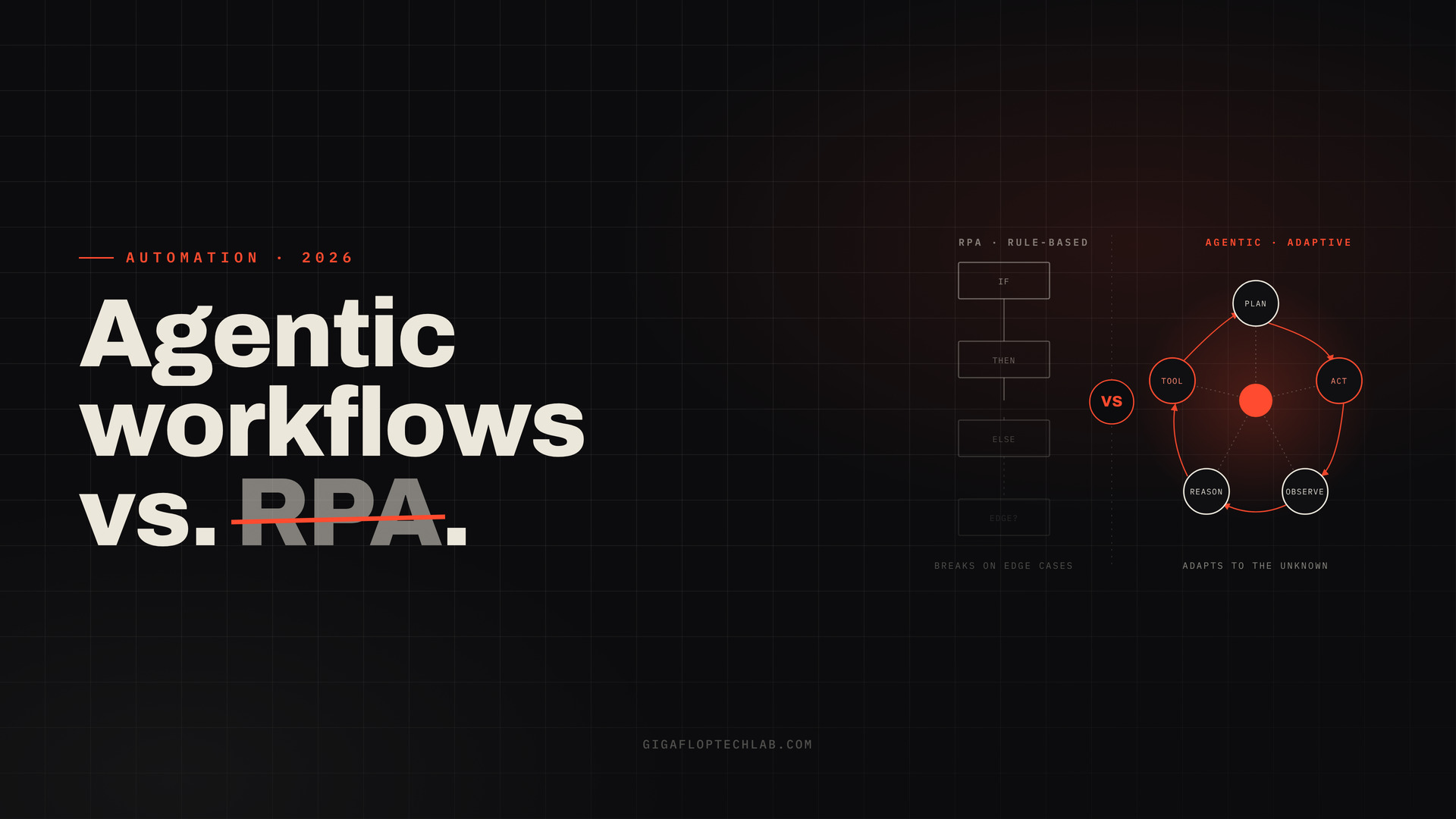
If you’ve run an RPA program, you already know its dirty secret: the bots are brilliant until something moves. A vendor changes an invoice layout. An ERP field gets renamed. A supplier emails a PDF instead of sending structured data. The script doesn’t adapt it fails, and someone gets paged to patch it.
That’s not a flaw in any particular bot. It’s the nature of rule-based automation: it can only handle the cases you anticipated and hard-coded. Every real-world deviation is an exception, and exceptions are where RPA programs quietly bleed time and money. The maintenance tax is the part nobody put in the original business case.
Agentic workflows attack exactly this weak point. Instead of following a fixed script, an AI agent reasons toward a goal: it can read unstructured input, handle a case it hasn’t seen before, and decide what to do next within the guardrails you set. It doesn’t need every path pre-programmed because it can work one out.
Agentic workflows vs. RPA: the honest comparison
| Dimension | Traditional RPA | Agentic workflows |
| How it works | Follows fixed, pre-programmed rules | Reasons toward a goal within guardrails |
| Input it handles | Structured, predictable data | Structured and messy/unstructured input |
| When something changes | Breaks; needs reconfiguration | Adapts within its instructions |
| Exceptions | Each one is a manual patch | Handles many; escalates the rest |
| Best at | High-volume, identical, rule-based tasks | Variable, judgment-laden, context-heavy tasks |
| Maintenance burden | High as processes drift | Lower for change; needs evals + oversight |
| Predictability | Fully deterministic (a strength) | Probabilistic — needs guardrails and monitoring |
| Failure mode | Stops (visible) | Can be wrong confidently (needs checks) |
Notice the last two rows, because the hype usually skips them. RPA’s determinism is a genuine advantage for tasks that must run identically every time. And an agent’s flexibility comes with a real cost: it can be wrong in ways a script can’t, which is why a production agent needs evals, guardrails, and human-in-the-loop checks that a simple bot doesn’t. Anyone selling you agents without mentioning that is selling you a future incident.
Three places the difference shows up in real numbers
This is where the “2026 shift” stops being a slogan. The advantage clusters around change and exceptions:
- Maintenance cost. Industry analysis in 2026 reports organizations running agentic automation citing large reductions in automation maintenance cost versus legacy RPA one widely-shared figure puts it as high as a 73% reduction (Vegavid, 2026). Treat the exact percentage with healthy skepticism (vendor-adjacent sources inflate), but the direction is consistent everywhere: less hand-patching when processes drift.
- Process coverage. RPA alone tends to automate the 20–30% of a process that’s cleanly structured; analyses of the agentic transition argue well-executed agent programs can reach 60–80% of in-scope processes by absorbing the messy middle RPA couldn’t touch (Lasting Dynamics, 2026).
- Momentum. A CrewAI survey of 500 senior executives reported that 100% planned to expand agentic AI deployments in 2026 (reported Feb 2026). Even allowing for survey enthusiasm, “every respondent” is a signal about where budgets are pointing.
The pattern across all credible 2026 coverage is the same, and it’s worth stating plainly: agentic AI doesn’t make RPA obsolete, it makes RPA useful again by taking over everything RPA was never built for (MultiQoS, 2026).
So what should you actually do? A selection framework
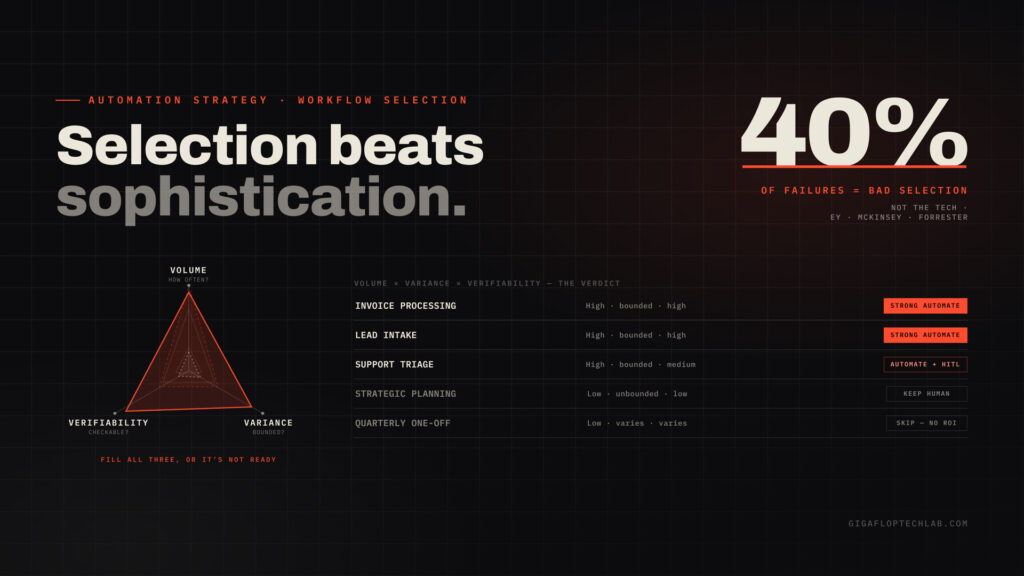
The wrong move is religious “we’re an agentic shop now” is as silly as “we’ll never touch AI.” The right move is matching the tool to the task. Score each candidate workflow on three questions:
- Volume × Variance. High volume, low variance (same inputs, same steps every time)? That’s RPA’s home turf keep it. High variance (unstructured inputs, frequent exceptions, judgment calls)? That’s where agents earn their cost.
- Rate of change. Does the process or its systems change often? Frequent change punishes RPA (constant reconfiguration) and rewards agents (they adapt).
- Verifiability. Can you check whether the output was correct? Agents need this it’s how you build the eval and human-in-the-loop layer that keeps them trustworthy. Low-verifiability, high-stakes tasks need heavier oversight regardless of approach.
The output is usually a hybrid: RPA for the predictable, transactional core; agents for the variable, cognitive layer; humans on the exceptions that matter. That’s not a compromise it’s the architecture the best 2026 operations are converging on.
Where agents already win a concrete shape
To make this less abstract: consider invoice processing, a classic RPA target that’s secretly full of exceptions missing fields, odd formats, suppliers who email instead of integrate. A rule-based bot handles the clean ones and pages a human for the rest. An agentic approach reads the messy ones too, validates against the system of record, posts what it’s confident about, and routes only genuine edge cases to a person with an eval pipeline watching accuracy over time.
In the agent builds we’ve shipped for finance operations, that “handle the messy middle, escalate the rest” pattern is exactly where the hours come back a high-accuracy invoice agent running at meaningful monthly volume, with human-in-the-loop gating on the low-confidence cases. [[EDITOR: CS-INVOICE confirm 96% accuracy / ~12K-per-month figures + approval before stating them outright; keep illustrative if unconfirmed.]] The lesson generalizes: agents don’t win by replacing the script, they win by handling what the script always punted to a human.
Common mistakes in the RPA-to-agentic shift
- Ripping out working RPA. If a bot reliably handles a stable, structured task, replacing it with an agent adds cost and risk for no gain. Don’t.
- Deploying agents without evals or guardrails. An agent you can’t measure isn’t automation — it’s an unmonitored decision-maker. Stand up evals and human-in-the-loop before scaling.
- “Agent-washing” your roadmap. Rebranding chatbots or existing bots as “agents” without real reasoning capability just buys hype. Judge by behavior on exceptions, not the label.
- Skipping the selection step. Automating the wrong workflow low volume, or unverifiable fails regardless of how good the technology is. Selection beats sophistication.
Conclusion
The honest version of the headline: rule-based automation isn’t dying, but betting your operation on rules alone is. The systems that win in 2026 reason where the world is messy and follow scripts where it isn’t with humans on the exceptions that carry real consequence. RPA earned its place and keeps it. Agents extend that place to the work RPA could never reach.
The question for your operation isn’t “RPA or agents?” It’s “which of my workflows need reasoning, and which just need reliable repetition?” Answer that, and the architecture designs itself.
FAQs
No. RPA still excels at high-volume, structured, repetitive tasks that run the same way every time, and most enterprises are keeping it. What’s fading is relying on rule-based automation alone. The 2026 consensus is hybrid: RPA for predictable work, agentic AI for the variable, exception-heavy work RPA can’t handle.
RPA follows fixed, pre-programmed rules and breaks when inputs or interfaces change. Agentic workflows use AI to reason toward a goal, so they can handle unstructured input and unforeseen cases within set guardrails. RPA executes; agents decide. Most real operations need both.
Per task, agents can cost more to run and require evals and oversight RPA doesn’t. But on processes that change often, agents frequently lower total cost by slashing the maintenance and exception-handling burden that quietly inflates RPA programs. The right comparison is total cost of ownership, not per-run price.
Yes, that’s the dominant 2026 pattern. A hybrid stack uses RPA for transactional precision and agents for reasoning, orchestration, and exceptions, with humans reviewing the cases that matter. Even legacy RPA vendors now position agents as an augmentation of RPA, not a replacement.
Score each one on volume × variance, rate of change, and verifiability. Low-variance, stable, structured work stays RPA. High-variance, frequently-changing, verifiable work is where agents pay off. Unverifiable or low-volume tasks usually shouldn’t be automated at all yet.