When an automation project fails, the post-mortem almost always blames the technology. The model wasn’t good enough. The tool was wrong. The integration was hard. Buy a better platform next time.
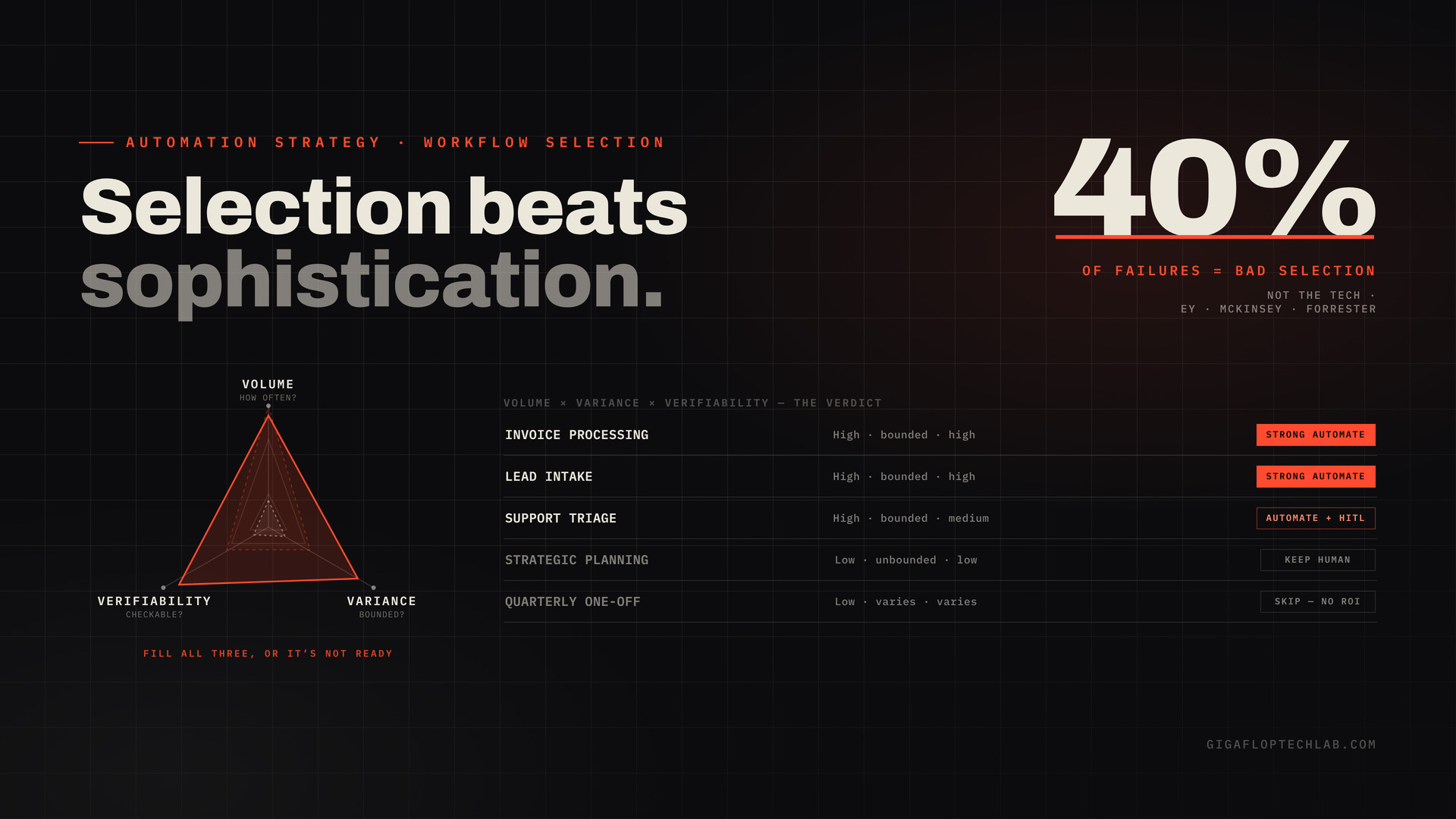
The data says that’s the wrong autopsy. Research across EY, McKinsey, and Forrester pins roughly 40% of automation failures directly on poor process selection not the technology, not change management (2025 analyses). Teams automated a workflow that was never a good candidate, and no amount of model quality could save it. Meanwhile the cost of not automating the right things is brutal too: Gartner pegged the cost of manual rework at around $878,000 per year for a typical enterprise (Dec 2025).
So the highest-leverage decision in automation isn’t how you automate. It’s what you choose to automate. This piece is the selection framework a way to score candidate workflows before you spend a dollar, so you stop automating the wrong ones and start finding the right ones.
Why selection beats sophistication
Here’s the counterintuitive truth: a mediocre automation on a well-chosen workflow beats a brilliant one on a poorly-chosen workflow, every time. Selection sets the ceiling; technology only determines how close you get to it.
The reason teams get this wrong is that the workflows that feel like they should be automated (visible, annoying, high-status) are often poor candidates, while the genuinely good ones (boring, high-volume, invisible) get overlooked. Gut instinct is a bad selector. You need a scoring rubric and it comes down to three questions.
The framework: Volume × Variance × Verifiability
Score every candidate workflow on three axes. The best candidates score high on all three; a weak score on any one is usually disqualifying or a flag to redesign before automating.
1. Volume – how often does it run?
Automation has a fixed cost (build) and a variable return (every run it saves). The math only works at volume. A task done 10,000 times a month justifies real engineering; the same task done 12 times a year almost never does.
- Good: high-frequency, recurring invoice processing, lead intake, report generation, ticket triage.
- Trap: low-volume tasks that feel painful but happen rarely. The pain is real; the ROI isn’t. Automating these is how budgets evaporate on projects that never pay back.
Score it: roughly how many times per month does this run? More is better; under a threshold, the build won’t pay back.
2. Variance – how predictable is it?
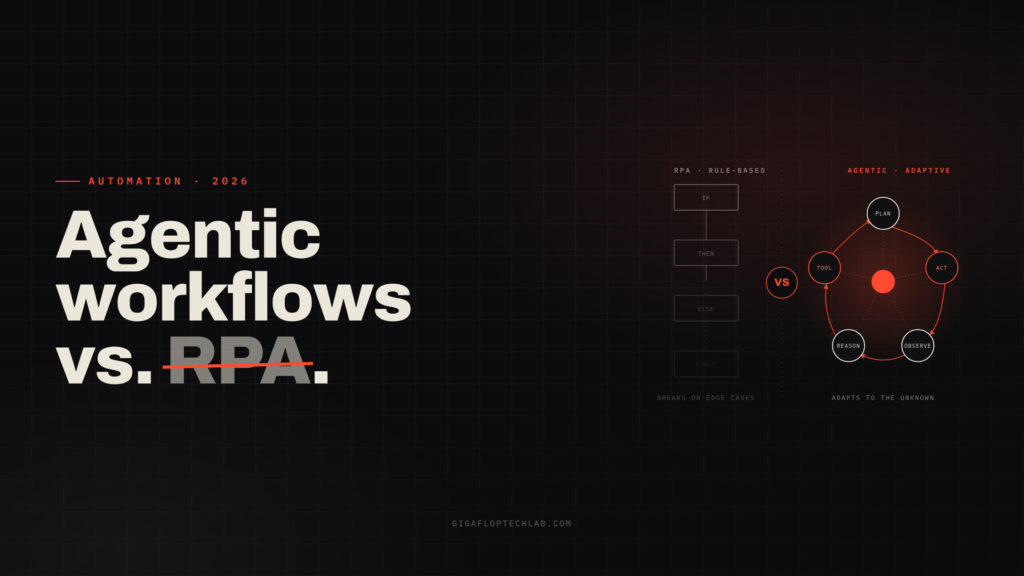
Variance determines what kind of automation fits, and whether it’s automatable at all. Low-variance work (same inputs, same steps every time) suits rule-based automation. High-but-bounded variance (messy inputs, edge cases, judgment within limits) suits agentic AI. Unbounded variance — genuinely novel, high-judgment work usually shouldn’t be fully automated yet.
- Good (rules): stable, structured, predictable data entry, reconciliation.
- Good (agents): messy inputs with a bounded set of outcomes invoice exceptions, lead qualification, support triage.
- Trap: high-stakes, high-judgment, unbounded work strategy, complex negotiation, novel decisions. Forcing automation here produces confident errors.
Score it: is the range of inputs and outcomes bounded and describable? Bounded = automatable (rules or agents). Unbounded = keep humans, or narrow the scope first.
3. Verifiability – can you tell if the output was right?
This is the axis everyone forgets, and it’s the one that separates a safe automation from a liability. If you can’t verify whether the output is correct, you can’t build an eval pipeline, you can’t catch errors, and you can’t trust the system at scale. Verifiability is what makes an automation governable.
- Good: clear right/wrong or checkable output extracted invoice fields (matches the PO or doesn’t), a booking (confirmed or not), a classification (correct or not).
- Trap: outputs with no ground truth “is this the optimal strategy?” If you can’t check it, you can’t safely automate it, no matter how high the volume.
Score it: could you define, today, how you’d measure whether an output is correct? If not, fix that before automating or don’t automate.
Putting it together: a scoring table
Run your candidate workflows through this. The point is to make selection explicit instead of political.
| Workflow | Volume | Variance (fit) | Verifiability | Verdict |
| Invoice processing | High | Bounded (agent) | High (matches PO) | Strong automate |
| Lead intake & qualification | High | Bounded (agent) | High (qualified or not) | Strong automate |
| Report generation | High | Low (rules) | High | Strong automate |
| Customer support triage | High | Bounded (agent) | Medium-high | Automate w/ HITL |
| Contract negotiation | Low | Unbounded | Low | Keep human |
| Strategic planning | Low | Unbounded | Low | Keep human |
| “That one annoying quarterly task” | Low | Varies | Varies | Usually skip — low volume |
Notice the pattern: the winners are high-volume, bounded, checkable. The traps are either low-volume (no ROI), unbounded (not automatable), or unverifiable (not safe). The framework’s whole job is to stop you funding the traps because they felt worth it.
Anti-patterns: the wrong workflows enterprises keep choosing
These are the recurring mistakes that the framework is designed to catch:
- The squeaky wheel. Automating the loudest complaint instead of the highest-ROI workflow. Visibility ≠ value.
- The moonshot. Trying to automate the most complex, high-judgment process first (“let’s have AI do strategy”) high-status, low-feasibility, and the fastest way to a failed flagship project. Start narrow.
- The unverifiable bet. Automating something you can’t check, then having no way to know it’s drifting. High volume makes this worse, not better you’re wrong faster.
- The low-volume vanity project. Spending a real build on a task that runs rarely. The pain is real; the payback isn’t.
- Automating a broken process. If the manual process is broken, automating it just produces broken output faster. Fix the process first, then automate.
- Skipping the framework because it’s “obvious.” It’s never as obvious as it feels that’s exactly why ~40% of failures are selection failures.
What good selection actually looks like (the workflow discovery)
The practical version: inventory your candidate workflows, score each on volume × variance × verifiability, and rank. Then sequence deliberately start with a high-scoring, lower-risk workflow to build trust and prove ROI, then tackle harder ones. The early win funds and de-risks the program.
This is also why the discovery is worth doing as its own step, before any build. The selection decision controls more of your eventual ROI than any technology choice you’ll make afterward and it’s far cheaper to get right on a spreadsheet than to discover in production that you automated the wrong thing.
Conclusion
Automation success isn’t a model problem; it’s a selection problem. The teams that succeed aren’t the ones with the best technology they’re the ones who picked the right workflows: high-volume, bounded, verifiable. The teams that fail mostly automated something that was never a good candidate, then blamed the tool.
Score before you build. Volume, variance, verifiability. Three questions, asked honestly, will save you from the ~40% of automation projects that fail not because the technology couldn’t do it, but because it never should have been pointed there in the first place.
CTA
Not sure which of your workflows are the high-ROI automations and which are expensive traps? That’s a scoring exercise with a clear answer and it’s far cheaper to run before you build than to learn in production.
Run a Workflow Discovery Audit → we’ll inventory your candidate workflows, score them on volume × variance × verifiability, and hand you a ranked, sequenced shortlist of what to automate first (and what to leave alone). Selection before sophistication.
FAQs
The best first candidates are high-volume, predictable (or bounded-variance), and verifiable invoice processing, lead intake, report generation, ticket triage. Start with one that scores high on all three and carries lower risk, to prove ROI and build trust before tackling harder workflows. Avoid low-volume, high-judgment, or unverifiable processes early on.
Most failures trace to selection, not technology research across EY, McKinsey, and Forrester attributes roughly 40% of automation failures directly to poor process selection. Teams automate a workflow that was never a good candidate (too low-volume, too high-judgment, or unverifiable), and no amount of model quality can rescue a bad choice.
Score it on three axes: volume (how often it runs automation’s ROI scales with frequency), variance (how predictable it is bounded work is automatable, unbounded high-judgment work isn’t yet), and verifiability (whether you can check the output is correct required to build evals and trust it). High on all three is a strong candidate; weak on any one is usually a trap.
Verifiability whether you can tell if the output was right. Teams obsess over volume and feasibility but forget that an output you can’t check can’t be evaluated, monitored, or trusted at scale. High volume on an unverifiable workflow just means being confidently wrong faster. If you can’t define how you’d check correctness, don’t automate it yet.
Not automatically. “Most painful” often means “most visible,” not “highest ROI.” A painful task that runs only occasionally rarely justifies the build cost, and a painful process that’s actually broken should be fixed before automation (or you just produce broken output faster). Score it on volume, variance, and verifiability rather than on how loudly people complain.
It’s a structured pre-build step that inventories your candidate workflows, scores each on volume × variance × verifiability, and ranks them into a sequenced automation roadmap starting with high-ROI, lower-risk wins. Because selection controls more of your eventual ROI than any technology choice, doing this on paper first is far cheaper than discovering in production that you automated the wrong thing.