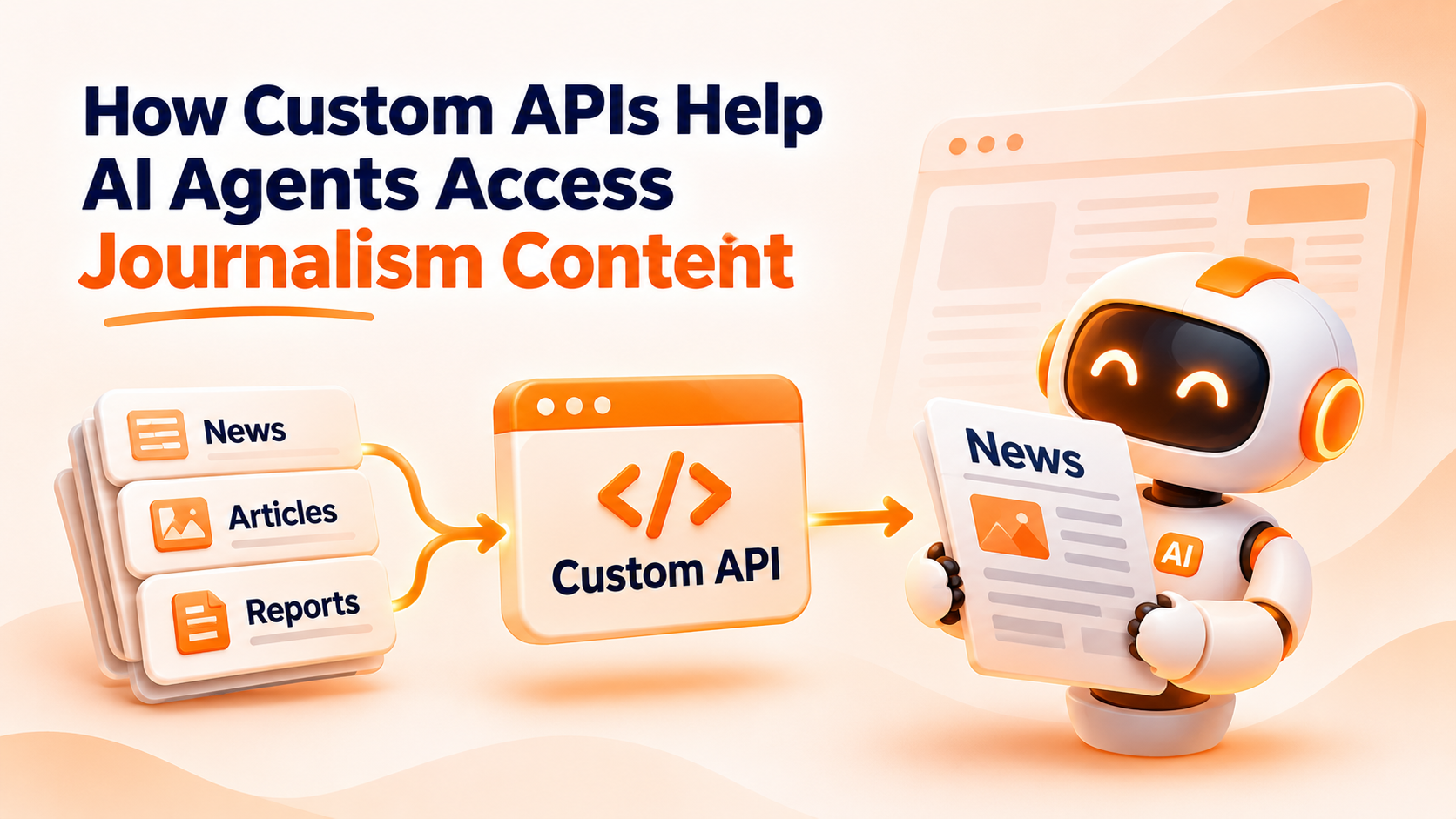
AI agents can summarize thousands of articles, but how do they access trusted journalism in the first place? For publishers, the challenge is not simply making news available to AI. It is controlling how that content is accessed, processed, and distributed.
Custom APIs for AI agents provide a practical way to connect journalism platforms with AI-powered applications. They allow publishers to share approved content, manage access permissions, and explore new ways to distribute their information.
For media businesses, this creates opportunities to reach more users, support research, and develop new digital services without losing control over their content.
Why AI Agents Need Access to Journalism Content
AI agents are becoming useful for research, information discovery, and business analysis. However, their responses depend on the quality of the information they can access.
Journalism platforms contain valuable information, including breaking news, business reports, interviews, industry updates, and investigative stories.
Imagine an AI agent helping a company monitor the US retail industry. It needs recent information about consumer spending, competitor announcements, ecommerce regulations, and market changes.
Without reliable access to these sources, the agent may miss important updates or provide incomplete answers.
APIs for AI agents help solve this problem by creating a direct connection between approved content sources and AI applications.
What Are Custom APIs for AI Agents?
An API (Application Programming Interface) allows two software systems to communicate and exchange information.
A custom API is designed around specific business requirements. It determines what information another application can request, how requests are processed, and what data is returned.
For a journalism platform, a custom API can connect its content management system (CMS) or news database with an AI agent.
For example, an authorized AI agent could request:
- Recent articles about a particular industry.
- News published within a selected date range.
- Article headlines, summaries, and publication dates.
- Author information and content categories.
- Updates to previously published stories.
The API returns approved information in a structured format, such as JSON, making it easier for AI applications to process.
Businesses exploring these connections can also consider custom AI development solutions to build integrations around their existing systems.
How AI Agent API Integration Works
A custom API acts as a communication layer between a publishing platform and an AI agent.
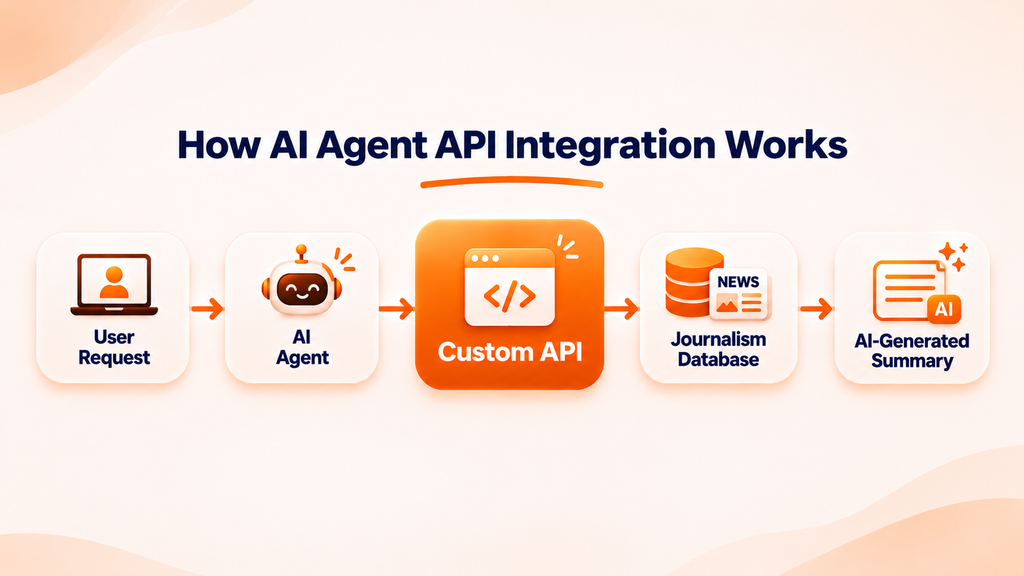
The process generally follows five steps:
- User request: Someone asks an AI agent to find recent news about the ecommerce industry.
- Agent request: The AI agent identifies the required information and sends a request to the API.
- Permission check: The API verifies access rights and determines which content can be shared.
- Content retrieval: The publishing system returns approved articles and their metadata.
- AI response: The agent organizes the information and generates a summary with links to original sources.
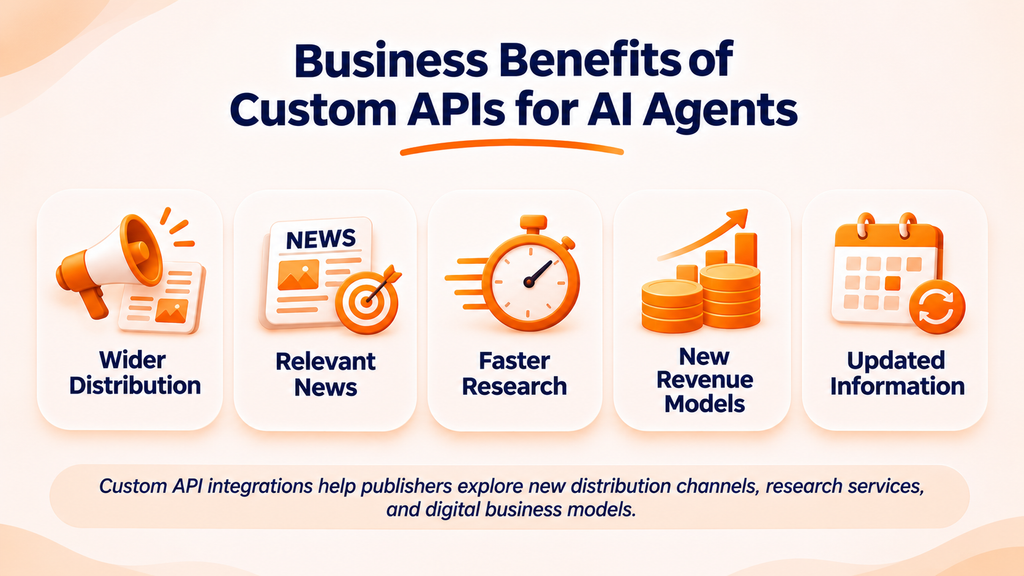
5 Business Opportunities Created by Custom APIs
Connecting journalism platforms with AI agents is not just a technical improvement. It can create new ways for publishers to distribute information and serve customers.
1. Expand Content Distribution
Publishers traditionally distribute content through websites, mobile applications, newsletters, and social media.
Custom APIs create another distribution channel by allowing authorized AI applications to retrieve selected articles.
For example, a business research application could display relevant news alongside industry reports, helping users access information without visiting multiple websites.
2. Deliver More Relevant News
Readers often need information about specific industries rather than hundreds of unrelated articles.
AI agents can use API connections to retrieve content based on topics, dates, categories, and locations.
An ecommerce research assistant could collect reports about consumer spending, online shopping trends, and supply chain developments.
This makes information discovery more focused and useful.
3. Improve Research and Analysis
Reviewing multiple news articles manually takes time.
AI agents can retrieve approved journalism content, compare reports, identify common topics, and organize findings into summaries.
For example, a research team could use an AI assistant to prepare a weekly industry report using relevant articles from licensed news sources.
The original reporting should remain accessible so users can verify important findings.
A similar approach to information discovery is useful in business knowledge management. Gigaflop TechLab’s ViDoShare AI knowledge management case study demonstrates how AI can help teams search, understand, and summarize information from different sources. This is an example of related AI capabilities, not a journalism API deployment.
4. Explore New Revenue Opportunities
Publishers can explore licensed content feeds, subscription-based access, and third-party application integrations.
Consider a publisher offering selected news content to a business intelligence application through an authorized API.
The application retrieves approved articles, organizes them through an AI agent, and provides relevant reports to its subscribers. The publisher receives revenue through an agreed licensing or subscription arrangement.
This creates opportunities to distribute content beyond traditional publishing channels.
5. Keep Information Updated
News changes quickly. Articles may receive corrections, additional details, or updated information.
A custom API can support updated content retrieval and notifications when an article changes.
This helps connected AI applications work with current information rather than relying on outdated versions.
Content Security and Copyright Must Come First
Making journalism accessible to AI agents also creates important responsibilities.
Publishers must decide who can access their content and how applications can use it.
A reliable API integration should include:
- Authentication: Verify which applications can access the system.
- Access permissions: Control which articles and information can be retrieved.
- Content licensing: Define whether content can be displayed, summarized, stored, or redistributed.
- Rate limits: Prevent excessive API requests.
- Source attribution: Retain references to original reporting.
- Content updates: Handle corrections and removed articles appropriately.
Technical access does not automatically provide copyright permission. Publishers should establish clear usage agreements before sharing content with AI applications.
APIs vs. MCP: What Is the Difference?
Traditional APIs provide predefined ways for software applications to request and exchange data. Developers typically work with specific endpoints, parameters, and response formats.
The Model Context Protocol (MCP) is designed to help AI applications connect with external tools and information sources through a more AI-friendly interface.
For example, an AI agent can use an MCP connection to discover available tools and request information as part of a larger task.
Both approaches can support AI integrations, but they are not interchangeable. An organization may use traditional APIs behind an MCP server to make existing services available to AI applications.
The choice depends on the application, technical requirements, and existing systems.
A Real-World Example: Reuters and AI Content Access
Reuters provides a practical example of how journalism companies are adapting content delivery for AI workflows.
In July 2026, Reuters announced its Model Context Protocol (MCP) server, allowing customers to integrate subscribed Reuters journalism into AI-powered and agentic workflows.
The service supports searching, retrieving, and downloading journalism content programmatically through AI tools.
This gives customers another way to access trusted reporting within their existing workflows.
Read the Reuters MCP announcement.
The example shows that publishers can explore AI-native content access while maintaining subscription and usage conditions.
How to Build a Custom API for an AI Agent
Building an effective integration starts with understanding the publishing system and the business objective.
Follow these steps:
- Identify content requirements: Decide which articles, metadata, and archives should be accessible.
- Review existing systems: Understand the CMS, databases, and current integrations.
- Design API endpoints: Create endpoints for article searches, individual articles, categories, and updates.
- Implement security: Add authentication, permissions, and usage controls.
- Connect the AI agent: Enable the agent to request and process approved information.
- Test the integration: Check accuracy, response quality, security, and performance.
- Monitor usage: Track requests, errors, and content updates.
The right development approach depends on the publisher’s content structure, technical requirements, and licensing model.
Businesses planning these projects can explore AI integration and implementation services. An experienced senior AI development team can also help assess the technical requirements and build the required connections.
Make Journalism More Accessible Through AI
AI agents are creating new ways to discover, process, and use information. For journalism companies, custom APIs provide an opportunity to make valuable content available through more digital applications.
The real opportunity is not simply giving AI agents access to more articles. It is making approved content useful across different applications while maintaining control over accuracy, ownership, and usage rights.
Looking to connect your content systems with AI agents?
Gigaflop TechLab helps businesses develop custom AI solutions, API integrations, and automated workflows.
Discuss Your AI Integration Requirements and explore a practical development approach.
Frequently Asked Questions
APIs for AI agents allow AI systems to communicate with external applications, databases, and content platforms. They help agents retrieve approved information and perform specific tasks.
AI agents can retrieve approved journalism content through APIs connected to publishing platforms, news databases, or content management systems.
Custom APIs help publishers control content access, connect with AI applications, improve distribution, and explore new digital services.
APIs can enforce authentication, permissions, and content restrictions. However, publishers must also establish appropriate licensing agreements to define permitted usage.
An API provides predefined methods for software systems to exchange data. MCP provides a standard way for AI applications to connect with external tools and resources. Both can work together in an AI integration.
Yes. Publishers can use authentication, access permissions, content filters, and licensing rules to determine which articles and information an AI agent can retrieve.