San Francisco is at the forefront of the artificial intelligence Industry. Choosing a suitable partner for AI Consulting Services in San Francisco will help your company obtain an important competitive advantage or waste your budget thousands of dollars on working prototypes that fail.
With many companies advertising their expertise in this field in Northern California, finding a partner can be quite complex when choosing a company. Tooling from robot process automation and building a custom predictive model to the use of excellent LLMs and implementation of intelligent document systems or setting up a quality control system using LLMs’ functions can lead you to the wrong partner with defective software and issues of data security.
In this practical guide, C-level executives and business owners will find the necessary information on vetting, finding, and working with the right AI Company in San Francisco to multiply their cash flows.
As Jensen Huang, CEO of NVIDIA, highlighted when addressing the shift toward autonomous enterprise workflows:
“AI is the automation of automation, where software writes software. This is the single most powerful force of our time… Future workforces in enterprise will be a combination of humans and digital humans.”
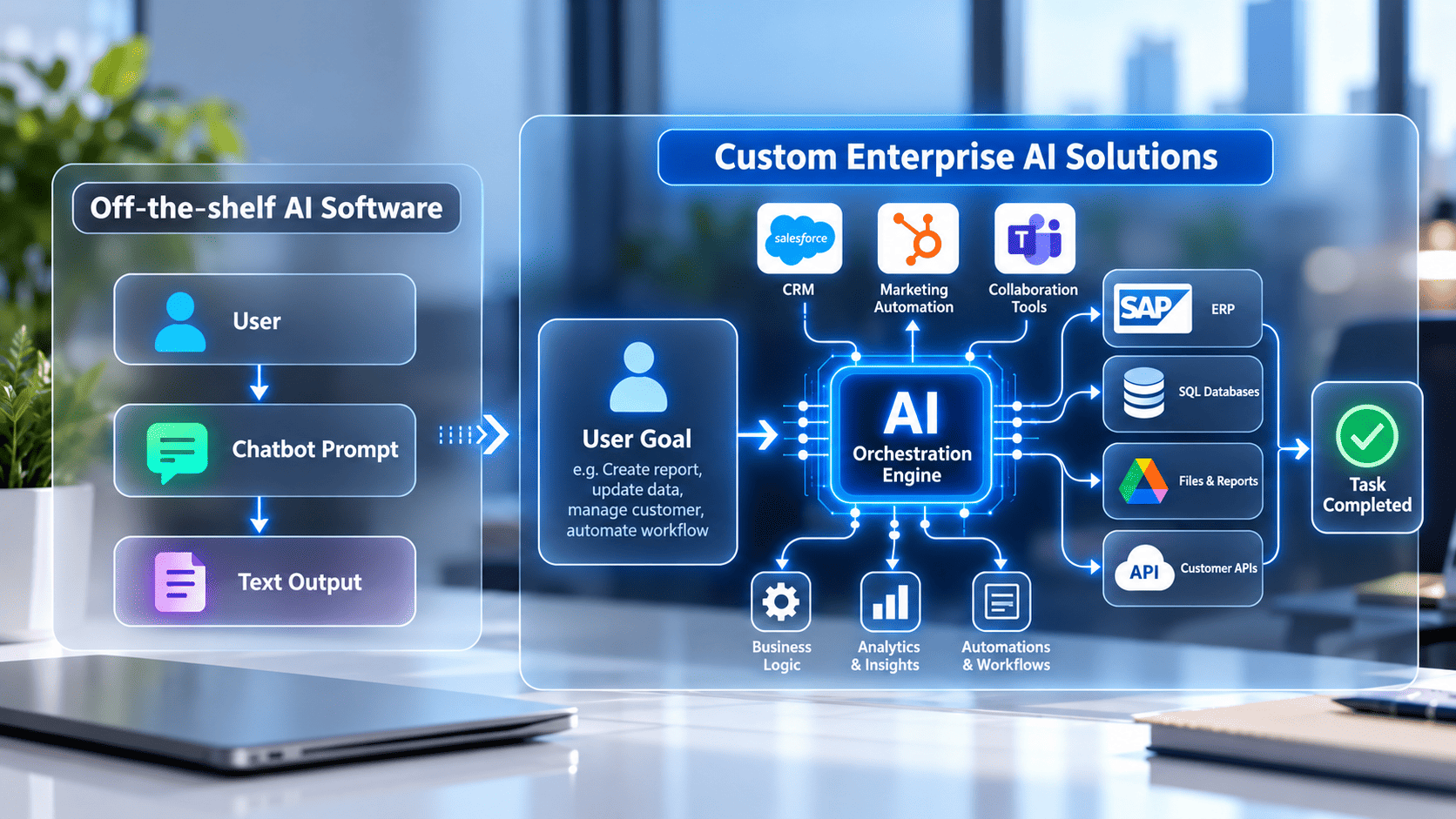
Chatbots vs. Custom AI Solutions: What Is the Difference?
To select the right AI Strategy Consulting Services provider, business leaders must first distinguish between simple transactional chat tools and true, scalable enterprise AI architectures.
| Capabilities | Off-the-Shelf Chatbots | Generative AI Assistants | Custom Enterprise AI Solutions |
| Logic Basis | Rule-based (if/then paths) | Large Language Models | Custom RAG & MLOps Pipelines |
| User Interaction | Rigid menu options | Text & prompt responses | Direct objective inputs & software APIs |
| System Access | Isolated knowledge base | Read-only text generation | Full read/write access across enterprise software |
| Autonomy Level | Low (scripted decision branches) | Medium (human triggers every step) | High (autonomous execution with strict guardrails) |
- In contrast to standard software tools which rely on repetitive requests from employees, enterprise-level Business AI Consulting Solutions employ an ongoing execution cycle of the following nature.
- Interpret: The AI technology processes triggers from operational data in the company’s infrastructure (for example, “search and compare unpaid vendor invoices older than 30 days”).
- Reason and Strategize: It breaks the complex tasks into systematic assignments, communicates with internal SQL databases, and identifies the appropriate software connectors.
- Perform: It accomplishes its tasks directly talking to ERP databases, registering in the CRM system, and activating the corresponding software links outside the company.
- Inspect and Improve: It compares results with compliance requirements, finds malfunctions, and informs human managers about anything unusual.
Why Local Bay Area Presence Matters for AI Strategy
The commonality of remote development teams does not negate the necessity of significant integration of those teams to the core business model and operational stack when it comes to high-stake AI Strategy Consulting Services. The technology teams operating in San Francisco are a part of a special ecosystem characterized by top-tier talent, rapid innovation, and strict regional regulations like the California Consumer Privacy Act (CCPA).
Benefits of working with a local Bay Area company are evident
- Conducting in-person workshops – Getting the necessary alignment through conducting intensive in-person workshops that facilitate mapping of complicated internal processes and identification of high-value automation initiatives.
- Real-time collaboration – No struggles with time zones in the process of deploying systems and onboarding employees.
- Silicon Valley’s ecosystem leverage – Taking advantage of cutting-edge software integrations, MLOps systems, and hardware acceleration technologies from Bay Area laboratories.
4 Core Capabilities to Demand From Your AI Partner
When searching for relevant agencies in San Francisco and Silicon Valley, it is crucial to go beyond showing impressive marketing campaigns and search for evidence of four core technical competencies
When assessing prospective agencies in San Francisco, it is necessary to look past what they proclaim in their marketing materials and instead focus on the reality of their capabilities, especially the following four key competencies:
1. Purpose-Oriented System Architecture
An effective consultant does not settle for creating rigid scripts. Instead, it creates systems where the client specifies a goal, i.e. what business goal it wants to accomplish, and the system figures out what approach to take.
2. Extensive Integration within Enterprises
Custom enterprise AI should be able to work with the existing tech ecosystem in a secure manner. Your agency of choice should demonstrate a high level of capability in building APIs, database connectors, and cloud microservices, which work with Salesforce, SAP, Snowflake, HubSpot, AWS, and so on.
3. Data Usage and Governance
Custom models should have retained their memory and follow RBAC principles. Your sensitive operational data should be segregated from public datasets for the purposes of model training.
4. Human Oversight
Some sensitive operations need to be subject to approval, i.e. issuing refunds above $ 1,000 or changing important contracts for your clients.
Is your technology stack ready for custom AI automation?
Don’t spend months experimenting without clear financial benchmarks.
Book a Free 15-Minute AI Audit with our strategy team to identify your top 3 high-impact workflows for autonomous deployment.
High-Impact Use Cases Across Business Operations
San Francisco’s elite AI consulting services are providing organizations with specific solutions which help eliminate time-consuming processes by automating them.
1. Coordination of E-Commerce and Supply Chain
There are more sophisticated AI solutions available now which do more than simple chatbot assistance, because they can determine who the customers are, and verify their status within the warehouse management system.
Proven impact: See how we managed to reduce the inventory error level from 35% to something much lower thanks to the custom predictive algorithms we developed.
2. Financial and Operational Reconciliation
Machine learning algorithms are capable of getting data from the unstructured PDFs, as well as cross-referencing the data against the invoices, purchase orders, and bank statements. If there are any discrepancies, the automated system will indicate the case when it comes across a difference between the figures presented in the documents.
3. Sales Process and Lead Intelligence
The autonomous system is able to evaluate incoming leads, get information data from external databases, and prepare personalized letters aimed at potential clients based on already available data.
When we deployed these automated workflows for a high-growth distributor, we helped a mid-market enterprise reduce manual processing costs by 64%. Explore our full suite of custom software development solutions to learn more.
The Non-Technical Leader’s Roadmap to AI Implementation
Executing a successful enterprise project with an AI Consulting Company in San Francisco doesn’t require writing code; it requires clear business governance, defined boundaries, and disciplined pilot execution.
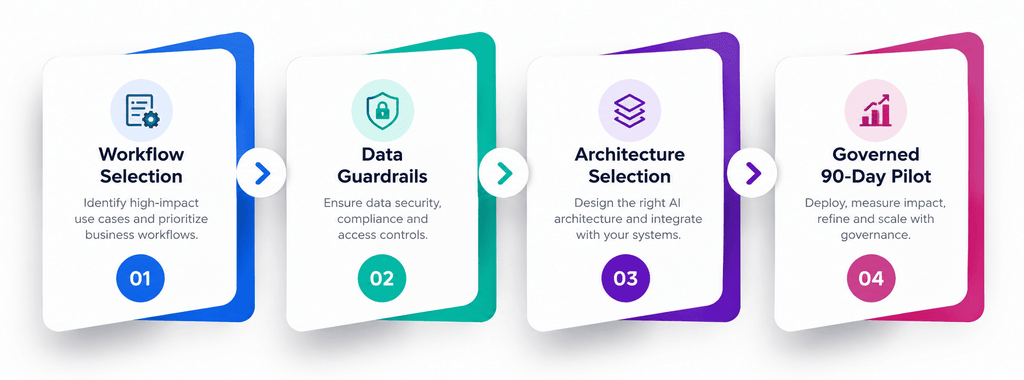
Phase 1: Identify High Return on Investment Workflows
Avoid the ambiguity of instructions like “use AI in customer service.” Instead, opt for a distinct, frequently done task with well-defined measures( like, “decrease the amount of time needed to accomplish a usual product replacement”).
Phase 2: Set limits on data usage
Identify what kinds of software the AI is able to access, which confidential entries can be modified, and what financial restrictions require managing authority approval.
Phase 3: Decide on Technology
Pre-made software as a service products: rapid to install but limited to the functionalities of the original platform. Therefore, it does not create a serious competitive advantage in the long run.
Custom AI frameworks: customized options developed for the specific software and the existing data architecture. This offers more opportunities in terms of scalability and building a business model which is hard to replicate.
Phase 4: Launch the 90-day trial
Incorporate the AI system into practice in cooperation with human specialists. Train its performance initially using such indicators as speed, the quality of output, number of errors, and the extent of human involvement.
Mitigating Risk: Security, Governance, and ROI
The introduction of independent business AI consulting comprises important enterprise issues which the leadership of the company must tackle
- Execution Risk – An untested system which makes wrong decisions with the database brings about much more operational troubles than a simple chatbot can create with one wrong statement. Proper sandbox testing, the validation of automatic tools, and the fail-safe measures that will have to be put in place.
- Data Security & CCPA compliance – California law has strict requirements as for the privacy of data. It is necessary to convince your consulting company to create reliable retrieval-augmented generation (RAG) architecture that performs in the cloud environment to guarantee that your private data won’t be used to train public models.
- Defining the benchmark metrics & KPI tracking – Gartner Research conducted an analysis of the market and predicted that global enterprises will spend over $500 billion on the AI services. However, the possibilities of the projects to develop will be missed if the executive team doesn’t define clear financial KPIs beforehand. Track transaction cycle times, mistake rates, and costs-per-transaction before and after the launch.
Frequently Asked Questions (FAQs)
An AI consulting firm analyses business operations already in use in a company, pinpoints the automation areas that would produce the highest profit, devises specific machine learning models or Risk Assessment Goals systems, integrates them into the company’s software with maximum efficiency, and provides professional training of the company’s staff.
The first technical audits and Proof of Concept phases usually take approximately 4 to 6 weeks. Production processes with many system interfaces and control systems usually take from 3 to 6 months.
It is important to work with consulting companies that are capable of using proprietary cloud technologies (Amazon Web Services, Google Cloud Platform, Microsoft Azure) and isolated LLM frameworks based on zero-data-retention APIs.
The answer is no. To facilitate the management of the AI systems, experienced consultants create user-friendly dashboards and panels that allow executive staff and managers to manage permissions, check on the operation logs and make changes.
Finding the best company for AI Consulting Services in San Francisco makes solving complicated software engineering issues possible. Quit wasting time trying out useless solutions and focus on developing flexible automated processes that boost your profit margins.
Ready to Accelerate Your Business ROI?
Stop guessing which AI tools fit your infrastructure. Book a Free 15-Minute AI Discovery Call with our San Francisco engineering team today. We will audit your current technology stack, identify your highest-ROI automation opportunities, and map out a clear implementation roadmap.