It has been seen that numerous executive AI initiatives do not fail due to technological reasons but due to leadership teams leveraging advanced and complicated custom models without understanding how they can gain monetary returns through them. In order to drink from the fountain of executive excitement and arrive at the crucial revenue stream of action, executives will need to adopt a proven and effective model to choose the relevant use cases and avoid uncertain costs.
Getting a two-week AI opportunity evaluation enables leaders to find an efficient way to examine their operational processes and assess the level of preparedness of their systems and select projects according to prospective financial returns. Working with qualified professionals in AI strategy consulting services will allow companies to devise a sound plan in order to spend their resources wisely and profitably.
The business firms that employ structured opportunity assessments are usually able to speed their deployment process up to twofold as well as reduce their integration costs in excess of 40%. With the requirement of revealing true returns always existing, the attending of careful initial evaluation helps distinguish market leaders from teams wasting their budgets on merely experimental projects.
Key Assessment Overview
| Assessment Phase | Primary Focus Area | Key Deliverables | Core Business Outcome |
| Week 1: Audit & Discovery | Process Mapping & Data Hygiene | Workflow Bottleneck Scorecard, Data Readiness Index | Eliminates non-viable AI projects early |
| Week 2: Scoring & Strategy | ROI Calculation & Architecture | Prioritization Matrix, 90-Day Execution Plan | Delivers a clear payback model & vendor roadmap |
What Is a 2-Week AI Opportunity Assessment?
AI opportunity assessment is a quick, practical diagnostic tool designed for executives, entrepreneurs, and business leaders. Instead of taking several months to debate theoretical ideas, this approach assesses actual operational processes, examines data integrity, and makes a business case based on real economic results.
Unlike general software diagnostics, targeted assessments focus solely on finding operational points with high ROI
Labor-Intensive Processes – Identifying labor-driven operations in customer service, inventory logistics, supply chain monitoring, and financial record-keeping.
Data Quality – Confirming whether internal data repositories, enterprise software systems, and API systems are sufficient for automation.
Return on Investment Estimations – Determining the expected pay-back periods, the amount of labor that will be saved, and the opportunity for profit enhancement before starting coding.
Week 1 – Operational Audit & Data Readiness
The initial week is dedicated to identifying hidden inefficiencies, evaluating the architecture of the systems, and identifying the areas in which human action is responsible for undermining profit margins.
Process Discovery and Examining Workflows
The consultants work closely with the managers of the different departments to define repetitive high-volume tasks in the most important functions. For online retail and growing businesses, this involves reviewing such procedures as supply chain management, inventory synchronization, order processing, and customer service.
Data Control and Hygiene Assurance
In order for the AI to derive consistent outputs, it is critical to ensure systematic functioning of data processing. The audit deals with following issues:
- Data Quality: The audit assesses the level of accuracy, completeness, and relevance of internal databases.
- API Connectivity: The audit assesses the interaction between two software systems using secure endpoints.
- Security and Compliance: The audit establishes the adherence to strict policies related to data processing and security.
Technical Debt Evaluation
Legacy platforms often create friction when connecting modern tools. Spotting technical debt early prevents unexpected costs later in the development cycle.
“A mid-market enterprise automated 40% of standard customer support queries and cut order reconciliation timelines by half within 60 days of their initial evaluation.” — Read how we helped an ecommerce enterprise scale operations with AI.
💡 Ready to eliminate guesswork from your technology stack?
Don’t spend months experimenting without clear ROI. Book a Free 15-Minute AI Audit with our strategy team to identify your top 3 high-impact workflows for autonomous deployment.
Week 2: ROI Prioritization & Implementation Roadmap
The second phase converts operational insights into a practical roadmap built around profit margin, execution speed, and risk control.
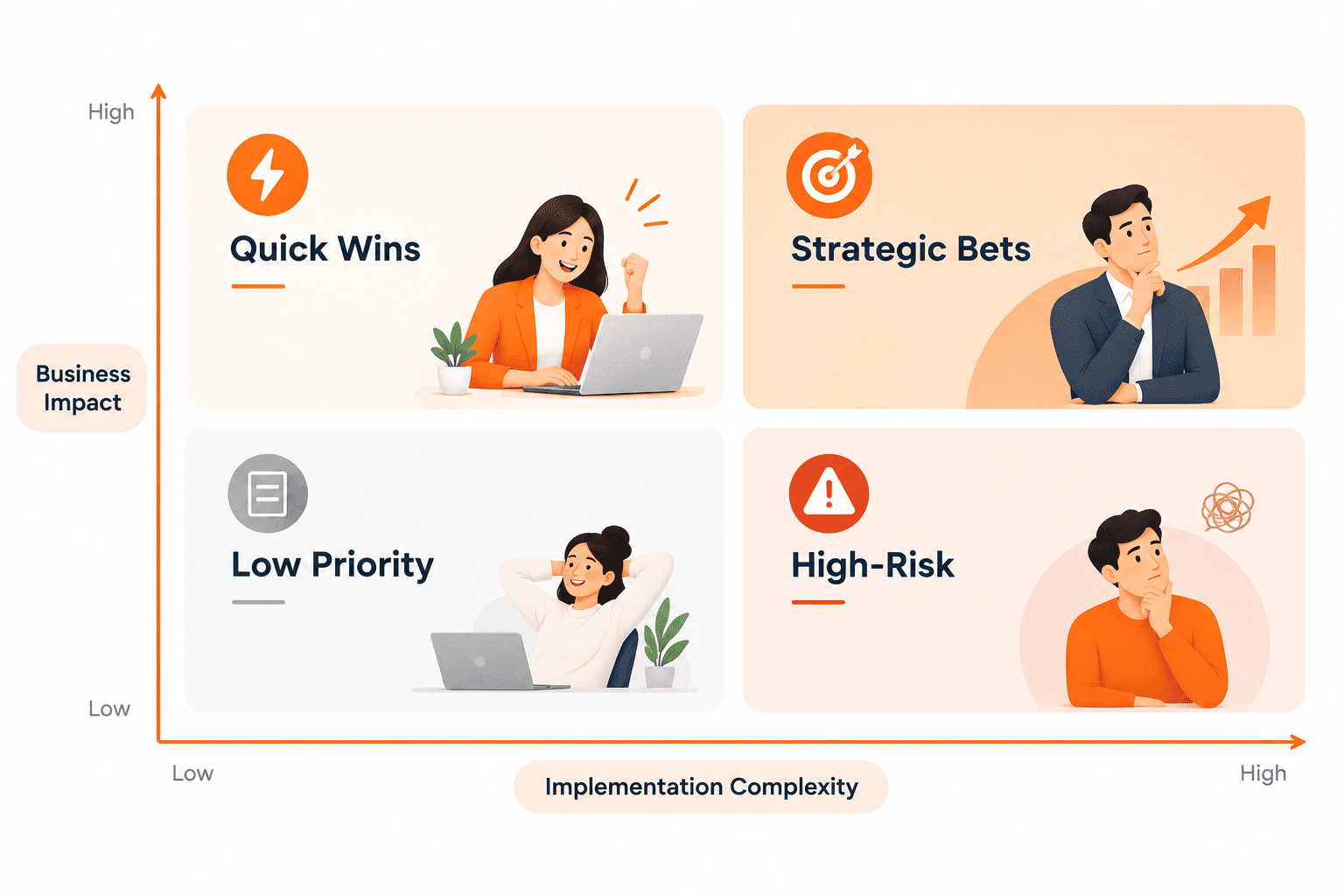
Feasibility vs. Impact Scoring Matrix
Every opportunity gets evaluated using a clear framework
- High Impact, Low Complexity (Quick Wins): Projects you can roll out in weeks to show fast financial returns.
- High Impact, High Complexity (Strategic Initiatives): Larger transformations that require custom development or core system upgrades.
- Low Impact Projects: Scrapped immediately to protect budget and keep team energy focused.
Choice of Building or Purchasing
Collaborating with specialists in AI implementation consulting aids management in determining the right course of action – to purchase a pre-existing software solution or to create custom-made ones. Pre-existing software is easier to implement; however, creating tailor-made systems can bring a long-lasting competitive edge to the company.
For an in-depth breakdown of the technical aspects of various types of structures, please check our article about the organization of scalable AI infrastructure; alternatively, you can use specialized AI consulting services designed for growing companies. According to an independent study by McKinsey & Company, companies that have employed structured ways of implementing the moves achieve double the ROI than that of informal implementation teams.
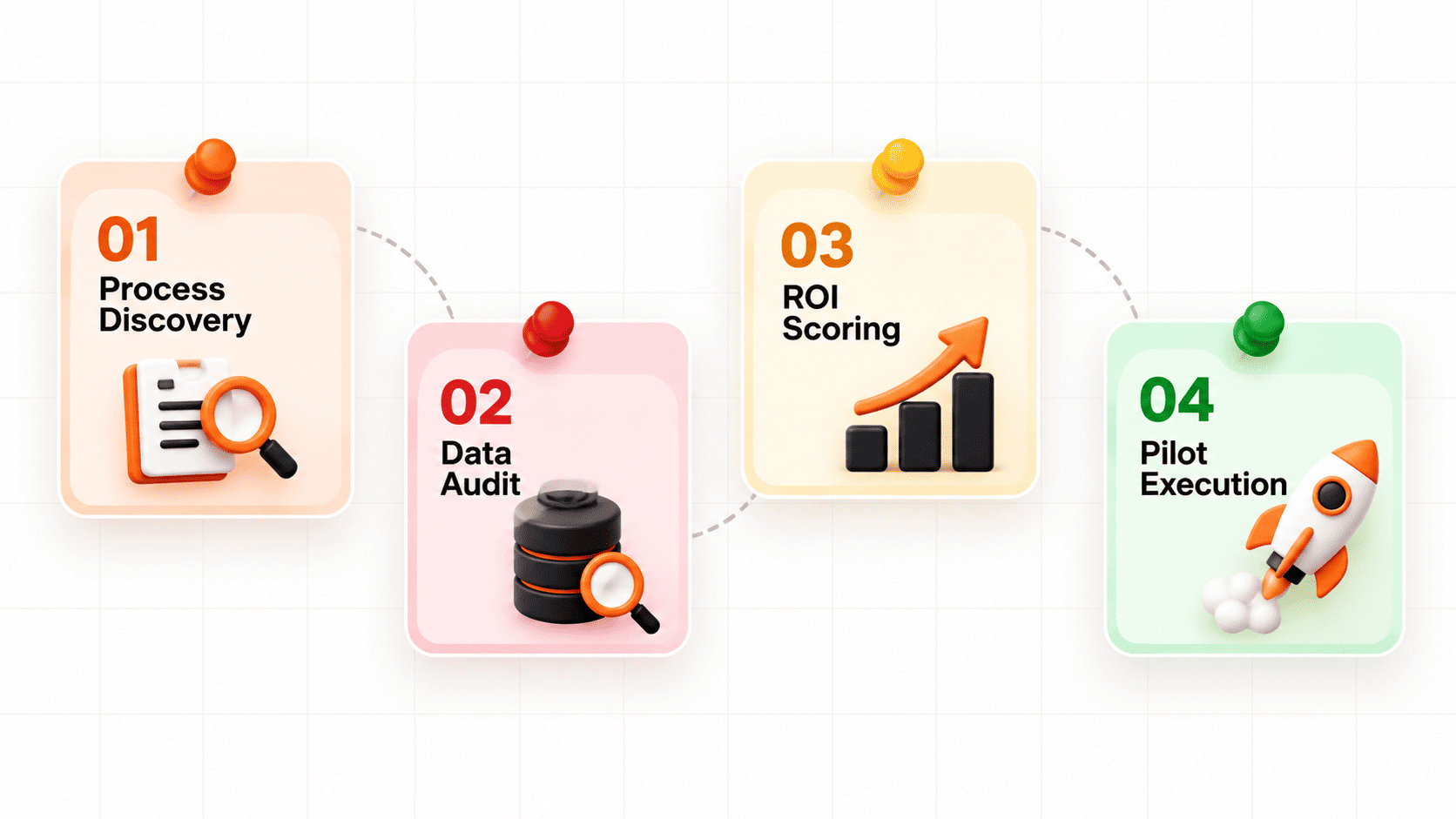
4 Basic Components of Successful AI Deployment
To ensure sustainability in growth, leadership must prioritize these four aspects of operations while implementing any strategic initiative
Aim Orientation: Have specific target metrics, like cutting the shipping process by 30% rather than focusing on general technology trends.
Integration of Tools: Make sure that the new application integrates well with the ERP, internal system, and communication tools.
Contextual Memory: Keep operational contexts and business memories safe while protecting customer privacy and security.
Human-in-the-Loop Safeguards: Create checkposts that allow the supervision of high-risk activities like approving payment to a vendor over a certain amount but keep the control in the hands of managers.
🚀 Accelerate Your AI Strategy Ready to plan, deploy, and scale intelligent workflows across your organization?
Read our in-depth Automation Solutions Guide to explore real-world deployment frameworks.
Frequently Asked Questions (FAQs)
A complete diagnostic evaluation takes two weeks’ time. Week 1 focuses on mapping workflows, interviews with teams, and checking the quality of data. The second week models ROI, evaluates tools, and provides prioritized action plans for 90 days.
An experienced external partner provides benchmarks from various industries, effective techniques, and unbiased opinions. This ensures the avoidance of internal prejudices, saves money on wasteful experiments, and accelerates the acquisition of measurable results.
We receive a complete set of decision-making frameworks, including a Use Case Matrix and ROI predictions for one year, and recommendations about technology.
We evaluate costs related to the whole project implementation, compare them with base labor expenses, error reduction, speed of throughput, and direct margin benefits from the target units.
📞 Transform Your Business Operations Stop guessing which AI projects will drive growth.
Start scaling with confidence.
Schedule a 30-minute strategic walkthrough with our team to map out your highest-ROI operational opportunities today.