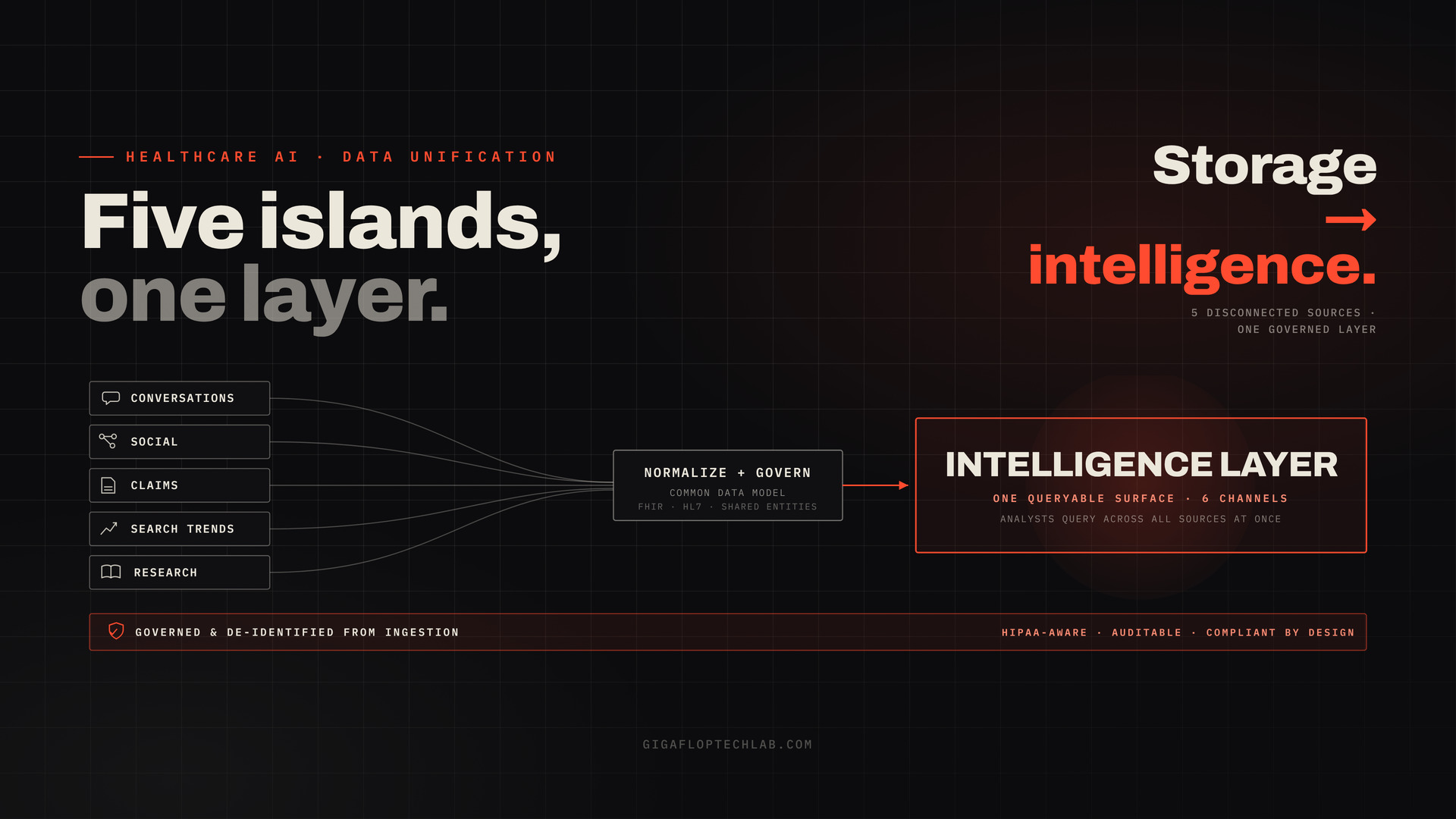
Ask a pharma or healthcare product leader where their data is, and you’ll get a list, not a location. Claims sit in one system. Patient and HCP conversations live in another. Social signals are somewhere else entirely. Search-trend data is a separate subscription. Research literature is a fourth island. Each one is valuable. None of them talk to each other.
That fragmentation is the hidden goldmine not because the data is missing, but because the connections between it are. The insight that matters in healthcare almost never lives in a single source; it lives in the overlap. What patients say, what they’re prescribed, what they search for, and what the research shows only become a decision when you can see them together. This piece is about what it actually takes to build that connected view — and why the hard part isn’t AI, it’s the unification underneath it.
Results at a glance
| Starting state | Insight data fragmented across ~5 disconnected layers |
| What we built | A single, governed intelligence layer (six channels) |
| Channels unified | Conversations · social · claims · search trends · research |
| Outcome | One view analysts actually use insight, not just storage |
| Non-negotiable throughout | Compliant data handling (de-identification / governance) |
Engagement details anonymized. [[EDITOR: confirm CS-HEALTHINTEL specifics channel list, “six-channel,” and naming/anonymization approval before publishing as a real client result.]]
The context
The organization a healthcare/pharma product team wasn’t short on data. It was short on connected data. Analysts could pull claims in one tool, sentiment from conversations in another, search-trend reports from a third. Answering any question that crossed those boundaries does what patients search for predict what gets prescribed? do conversation signals lead claims data? meant manually stitching exports together, slowly, and re-doing it every time. The data existed. The intelligence didn’t.
This is the norm in healthcare, not the exception. Industry analysts in 2026 describe the sector as finally moving past its “long-tolerated fragmentation” toward a unified view precisely because the fragmented version leaves enormous value stranded (Healthcare IT News, 2026).
The challenge
Three things make unification genuinely hard in healthcare, and pretending otherwise is how these projects fail:
- The data is heterogeneous. Claims are structured. Conversations are unstructured text. Social is messy and noisy. Search trends are aggregate signals. Research is documents. Bridging them isn’t a join it’s a modeling problem: making fundamentally different data speak a common language.
- The compliance surface is real and uneven. Healthcare data carries PHI and sits under HIPAA but the picture is nuanced: some pharma-adjacent data falls inside HIPAA, some outside, and weak governance creates regulatory and reputational risk either way (Foley & Lardner, 2026). You cannot bolt compliance on afterward; it has to shape the architecture from ingestion onward.
- Analysts won’t use what they don’t trust. A unified layer that’s slow, stale, or opaque gets abandoned for the old manual exports. The bar isn’t “technically integrated” it’s “an analyst reaches for this first.”
The challenge, in one line: unify fundamentally different data, compliantly, into something analysts actually prefer to use.
Our approach how five layers become one
The work was data engineering more than it was modeling. The intelligence layer is the visible part; the unification underneath is what makes it possible. The build moved through four stages:
- Ingest each source on its own terms. Structured claims, unstructured conversation text, social streams, search-trend feeds, research literature each needs its own pipeline, not a one-size connector. This is where most “we’ll just integrate it” efforts stall.
- Normalize to a common data model. The heterogeneous sources get mapped to a shared schema and shared entities (drugs, conditions, patient cohorts, time) so a claim and a conversation can be reasoned about side by side. Healthcare interoperability standards FHIR, HL7 and common-data-model practice are the backbone here.
- Govern and de-identify from ingestion onward. Compliance is a layer of the architecture, not a review at the end: de-identification where required, access controls, data-use boundaries, and provenance tracking so every signal is auditable. This is what makes the platform safe to use and trusted.
- Expose one intelligence layer. On top of the unified, governed foundation sits the layer analysts actually touch query across all channels at once, surface cross-source patterns, and (with multimodal/AI capability) ask questions that span text, claims, and trends together. Six channels, one surface.
The results
The team went from five disconnected sources to one governed intelligence layer spanning six channels a surface analysts use directly instead of manually stitching exports. The shift wasn’t “more data”; it was connected data: questions that used to take days of manual joining (and often went unasked because of the effort) became answerable in the platform. Storage became intelligence.
| Before | After | |
| Data access | 5 disconnected systems, manual stitching | 1 governed intelligence layer (6 channels) |
| Cross-source questions | slow, manual, often skipped | answerable in-platform |
| Compliance posture | per-tool, inconsistent | governed from ingestion, auditable |
| Analyst behavior | exports + spreadsheets | reach for the platform first |
Why this is the “goldmine”
The value isn’t any single channel it’s the correlations between them that no single source can show:
- Leading indicators. Conversation and search-trend signals can move before claims data reflects a shift an early read on emerging patient concerns or market movement.
- Fuller patient/market picture. Claims tell you what happened; conversations and social tell you why; research tells you what’s coming. Together they’re a story, not four fragments.
- Questions you couldn’t ask before. Cross-channel queries that were too laborious to attempt manually become routine which is where genuinely new insight lives.
That’s the goldmine: not new data you don’t have, but the connections in the data you already own, made visible and compliant.
Common mistakes in healthcare data unification
- Treating it as a modeling problem. The hard part is the unification and governance underneath, not the AI on top. Lead with data engineering.
- Bolting compliance on at the end. PHI handling and de-identification must shape the architecture from ingestion. Retrofitting it is slow, risky, and often forces a rebuild.
- One-connector thinking. Heterogeneous sources need source-specific pipelines and a common data model not a single generic integration.
- Building for technical integration, not analyst adoption. If it’s slow, stale, or opaque, analysts revert to spreadsheets and the investment is wasted.
- Ignoring provenance. In healthcare, “where did this signal come from?” is a compliance and trust requirement, not a nice-to-have.
Could this work for your organization?
If your team’s most valuable questions die in the gap between data sources, the pattern applies. Worth asking:
- Which of our highest-value questions require stitching multiple data sources by hand today?
- Is our compliance handling consistent across every source, or per-tool and uneven?
- Would analysts actually adopt a unified layer i.e., is it fast and trustworthy enough to replace the spreadsheets?
- Are we sitting on data whose connections we’ve never been able to see?
If those land, the goldmine is already in your systems it just isn’t connected yet.
Conclusion
Healthcare’s biggest AI opportunity is quieter than the headlines suggest. It isn’t a smarter model; it’s a connected, governed view of the data you already have conversations, claims, search, research unified into one intelligence layer analysts trust and use. The technology to query it is the easy part. The unification and the compliance underneath are the real work, and they’re exactly where the value (and the risk) live.
The data is already a goldmine. Whether it stays buried in five disconnected systems or becomes one intelligence layer is a choice about engineering and governance not about AI.
Sitting on rich healthcare data that’s scattered across systems and never quite connects? That gap is where your best insight is hiding.
Explore Healthcare AI Platforms →we’ll map your data sources, the compliance constraints, and what a unified, governed intelligence layer would take for your organization. Built for analyst adoption and HIPAA-aware from ingestion, not bolted on.
FAQs
It’s a unified, governed surface that brings normally-disconnected data sources claims, conversations, social, search trends, research into one place analysts can query together. Rather than storing data, it connects it, so cross-source questions that previously required manual stitching become answerable directly and compliantly.
Because the sources are fundamentally heterogeneous structured claims, unstructured conversations, aggregate trends, research documents and they carry PHI under uneven regulatory coverage. Unifying them is a data-engineering and governance problem (common data models, interoperability standards, de-identification), not simply connecting tools together.
Compliance has to be built into the architecture from ingestion, not added at the end: de-identification where required, access controls, clear data-use boundaries, and provenance tracking so every signal is auditable. Because some healthcare data falls under HIPAA and some outside it, consistent governance across all sources is what manages the risk.
Each source answers a different question: claims show what happened, conversations and social show why, search trends can signal shifts early, and research shows what’s coming. Combined, they reveal leading indicators and a fuller patient and market picture that no single source can provide the real return on unification.
Mostly data engineering. The AI/analytics layer is the visible part, but the value depends on the unification and governance underneath ingesting heterogeneous sources, normalizing them to a common model, and handling compliance. Teams that lead with the model and treat the data as an afterthought tend to stall.
By designing for adoption, not just integration: it has to be fast, current, and trustworthy enough that analysts reach for it before their old spreadsheets. A unified layer that’s slow or opaque gets abandoned, so query speed, data freshness, and transparent provenance are treated as core requirements.