Here’s the uncomfortable truth behind most AI project post-mortems: the model was fine. The project still failed and it was doomed before anyone wrote a line of model code.
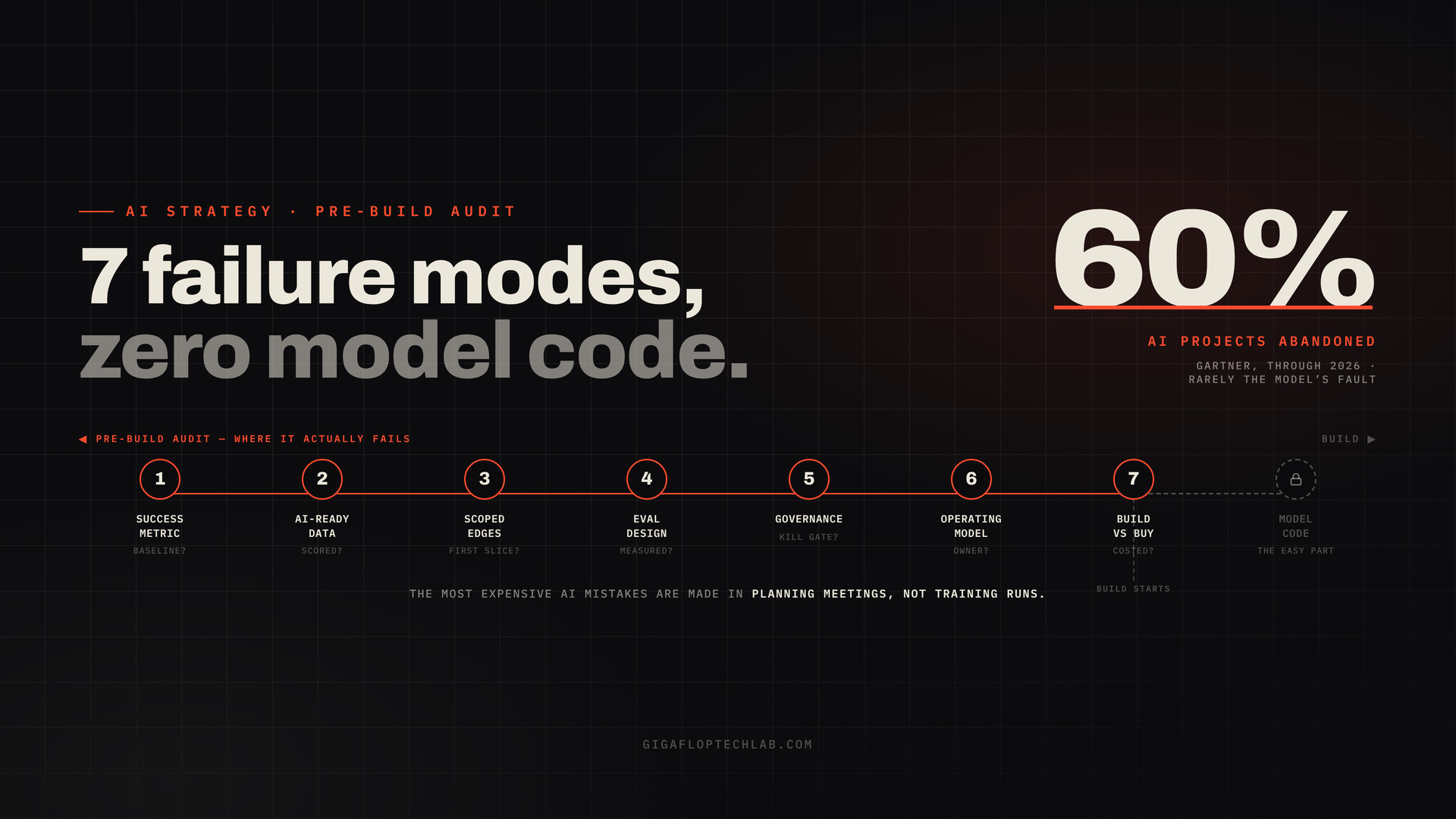
The data backs this up, hard. Gartner predicts organizations will abandon 60% of AI projects through 2026 specifically because they lack AI-ready data (Gartner, 2025). MIT’s NANDA research found the vast majority of generative-AI pilots deliver no measurable P&L impact (MIT, 2025). Deloitte reported that 42% of companies abandoned at least one AI initiative in 2025, up from 17% the year before. The headline failure rates vary wildly by source and definition anywhere from “most” to “95%” and that variation is itself a story we’ll return to. But the direction is unanimous, and so is the cause: as one analysis put it, the technology works; the failure is almost always in strategy, data readiness, and organizational design not in the AI itself.
That’s good news, oddly. It means most AI failure is preventable, and preventable early on paper, before the expensive part. A pre-build AI audit is how you find the failure modes while they’re still cheap to fix. Here are the seven that surface before you ever touch a model, distilled from our audit engagements.
Failure Mode 1 – No defined success metric
The single most common killer. A project starts with “let’s use AI for X” and never answers: what does success look like, measured how, against what baseline? Without that, the project can’t be steered, can’t be defended at a budget review, and can’t be called “done.”
MIT’s finding that pilots deliver no measurable P&L traces directly to teams that never defined the metric they’d be judged on. The audit fix is brutally simple and rarely done: before any build, write down the current baseline, the target KPI, and the lead indicators that confirm within ~2 weeks whether the thing is working. No metric, no project.
Audit check: Can you state today’s baseline and the target number in one sentence? If not, stop here.
Failure Mode 2 – Data that isn’t AI-ready
This is the one the data screams about. Gartner’s 60%-abandonment prediction is specifically about projects unsupported by AI-ready data. Informatica found only ~12% of organizations report data of sufficient quality and accessibility for AI. The model is only as good as what feeds it, and “we have lots of data” is not the same as “we have data this use case can use.”
AI-ready means aligned to the specific use case, governed at the asset level, accessible through reliable pipelines, and quality-assured continuously not audited once a year. The pre-build audit treats data readiness as a gate, not a task: a use-case-specific readiness score with documented gaps and named owners, completed before model work starts.
Audit check: For this exact use case is the data available, clean, accessible, and governed? Score it honestly.
Failure Mode 3 – Scope with no edges
“Expecting too much, too fast” was the single most-cited cause in Gartner’s April 2026 survey of I&O leaders. Overly ambitious, vaguely bounded scope is the primary driver of outright failure. Teams assume AI will instantly automate something complex and end-to-end, skip the unglamorous middle, and stall.
The audit fix is to find the smallest scope that demonstrates real value a defined, single-purpose first deliverable with crisp edges. Narrowly scoped, single-task projects succeed at dramatically higher rates than sprawling ones. Ambition is fine; ambition without edges is a failure mode.
Audit check: Can you describe the first shippable slice in one sentence, with explicit out-of-scope boundaries?
Failure Mode 4 – No eval design
This is the failure mode that’s invisible until it’s expensive. Teams plan to build the model but never plan how they’ll know it’s working — before launch and continuously after. Without an eval design, you can’t distinguish a good model from a confident-sounding bad one, you can’t catch regression, and you can’t prove anything at the 90-day review.
A pre-build audit specifies the eval strategy before the build: what “correct” means, how it’s measured across regression and edge cases, and what the lead/lag metric ladder looks like. The eval design is part of the spec, not an afterthought because an AI system you can’t measure isn’t an asset, it’s an unaudited liability.
Audit check: Do you know, today, how you’ll measure whether the model is right and keep measuring it?
Failure Mode 5 – Governance gaps
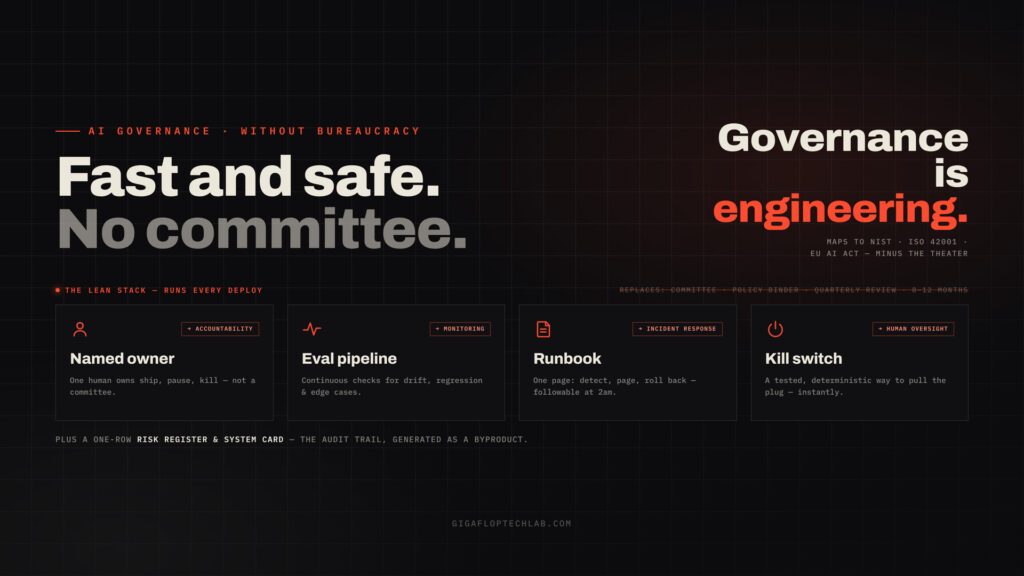
Not bureaucracy the basics. Who’s accountable for this system? What’s it allowed to do and access? What are the risk gates that would halt it? Where’s the audit trail? Projects that treat governance as a post-launch committee discover the gaps at the worst possible time.
Effective pre-build governance is lightweight and architectural: asset-level data ownership, access controls, defined risk gates, and provenance designed in, not bolted on. The audit surfaces these gaps while they’re still a paragraph in a design doc rather than an incident.
Audit check: Can you name the accountable owner, the access boundaries, and the risk gate that would stop this project?
Failure Mode 6 – No operating model
Who actually runs this once it ships and is AI work their real job, or a side quest? The research is striking: when AI work is distributed across an existing team alongside their day jobs, on-time delivery collapses; when a dedicated team of three or more owns it, on-time delivery roughly doubles (industry analysis, 2026). And loss of executive sponsorship mid-project is a top cited failure cause.
The audit asks the org-design questions before the build: who owns this, who sponsors it, and how does it get maintained and improved after launch? A model with no operating model behind it is a pilot that will never become production.
Audit check: Is there a named owner and sponsor, with AI as a real mandate not a side task?
Failure Mode 7 – The wrong build-vs-buy default
Many teams default to “build our own” without scrutiny and integration with legacy systems quietly eats the budget (in some sectors, integration consumes well over half of project resources, and in healthcare EHR integration routinely runs far over estimate). MIT’s research found vendor-led deployments succeed at roughly twice the rate of internal builds. That doesn’t mean always buy it means the default assumption deserves a hard look, before committing.
The audit forces the question deliberately: for this use case, what’s the honest cost and risk of build vs. buy vs. hybrid, including integration? Getting this wrong on day one is a failure you pay for every month after.
Audit check: Have you actually costed build vs. buy vs. hybrid including integration or just assumed “build”?
The pattern across all seven
Look back at the list. Not one of these is a model problem. They’re scoping, data, measurement, governance, org-design, and procurement problems every one of them upstream of the first line of model code. Across the audit engagements we run, this is the consistent finding: the failure is almost always designed in before the build, which is exactly why a pre-build audit pays for itself many times over. [[EDITOR: confirm “12+ engagements” count before publishing.]]
| # | Failure mode | The one question that catches it |
| 1 | No success metric | What’s the baseline and target KPI? |
| 2 | Data not AI-ready | Is this use case’s data ready scored? |
| 3 | Scope with no edges | What’s the smallest valuable first slice? |
| 4 | No eval design | How will we know it’s working, continuously? |
| 5 | Governance gaps | Who owns it, what can it touch, what’s the kill gate? |
| 6 | No operating model | Who runs it as a real job, with a sponsor? |
| 7 | Wrong build-vs-buy | Have we honestly costed build vs. buy + integration? |
This is also why the scary “X% of AI projects fail” statistics are misleading in both directions a point worth its own discussion. The number isn’t fixed or fated; it’s a function of how many of these seven gates a team walked past. Close the gates, and you’re not playing the average.
Conclusion
The most expensive AI mistakes are made in planning meetings, not training runs. By the time a model underperforms in production, the real failure the undefined metric, the unready data, the scope with no edges happened months earlier and quietly. A pre-build AI audit is simply the discipline of asking the seven questions above before anyone commits budget to a build.
Seven questions. Most failed projects couldn’t answer three of them at kickoff. The ones that can are the ones that ship.
CTA
Planning an AI build and want to know which of these seven gates you’re about to walk past? Two weeks now beats a six-figure write-off later.
Book a 2-Week AI Audit → we’ll pressure-test your scope, data readiness, eval design, governance, and operating model before you commit to a build, and hand you a prioritized go/no-go with the gaps named. Catch the failure on paper, not in production.
FAQs
Rarely because of the model. The most-cited causes are upstream and pre-build: no defined success metric, data that isn’t AI-ready, scope that’s too broad, no eval design, governance gaps, and a weak operating model. Gartner attributes much of the 60% abandonment rate specifically to a lack of AI-ready data a planning failure, not a technology one.
It’s an assessment done before model development that checks the things that actually determine success: success metrics, data readiness, scope, eval strategy, governance, operating model, and build-vs-buy. The goal is to catch failure modes while they’re cheap to fix on paper rather than discovering them in production.
Data aligned to the specific use case, governed at the asset level, accessible through reliable pipelines, and continuously quality-assured not just “lots of data.” Gartner predicts organizations will abandon 60% of AI projects unsupported by AI-ready data through 2026, which is why a readiness score should gate the build.
The headline numbers vary widely (from “most” to 95%) because sources define failure differently pilots, ROI, production. The variation is real and worth scrutiny, but the consistent finding underneath is that failures are concentrated in pre-build decisions, not the technology. The rate isn’t fixed; it reflects how many planning gates a team skipped.
It can be tightly scoped a focused two-week engagement is enough to pressure-test the seven failure modes and produce a go/no-go with named gaps for most projects. That’s a small fraction of the cost (and time) of building on a flawed foundation and writing it off later.
It depends on the use case, but the default “build” assumption deserves scrutiny: integration with legacy systems often consumes the majority of project resources, and research shows vendor-led deployments succeeding at roughly twice the rate of internal builds. A pre-build audit costs out build vs. buy vs. hybrid honestly before you commit.