There’s a false choice haunting AI governance, and it’s costing companies both ways. On one side: govern properly stand up a committee, write the policies, run the reviews, take 8–12 months and watch your AI roadmap stall while competitors ship. On the other: move fast, skip the governance, and find out what “unmonitored AI in production” costs when it goes wrong. Most teams pick a side and lose.
The premise of this piece is that the choice is false. Governance and speed aren’t opposites bad governance and speed are. Good governance is mostly engineering, and engineering runs at the speed you ship. A 200-person company releasing weekly can be genuinely well-governed without a single new committee. Here’s the framework for doing it.
(Note for the legal readers: what follows is a practical operating model, not legal advice. Your specific regulatory exposure — especially under the EU AI Act depends on your use cases and markets; confirm it with counsel. The point here is how to operationalize governance, not how to interpret a statute.)
First, strip governance down to what it actually requires
The reason governance feels like bureaucracy is that people confuse the artifacts (committees, policy binders, decision-rights matrices) with the intent. The major frameworks — NIST AI RMF, the EU AI Act, ISO 42001 differ in form, but underneath, the overlap zone is remarkably consistent. Strip them to intent and every one is asking for the same five things:
- Accountability — someone owns this system and its outcomes.
- Risk awareness — you know what could go wrong and how bad it’d be.
- Human oversight — a person can intervene, and there’s a way to stop it.
- Monitoring — you can tell, continuously, whether it’s behaving.
- Documentation — the above is written down and auditable.
That’s it. That’s the substance under NIST’s Govern/Map/Measure/Manage functions, under ISO 42001’s management-system requirements, and under the EU AI Act’s oversight-and-monitoring obligations. The bureaucracy is one implementation of those five things. It is not the only one — and for a fast-shipping company, it’s the wrong one.
The lean governance stack
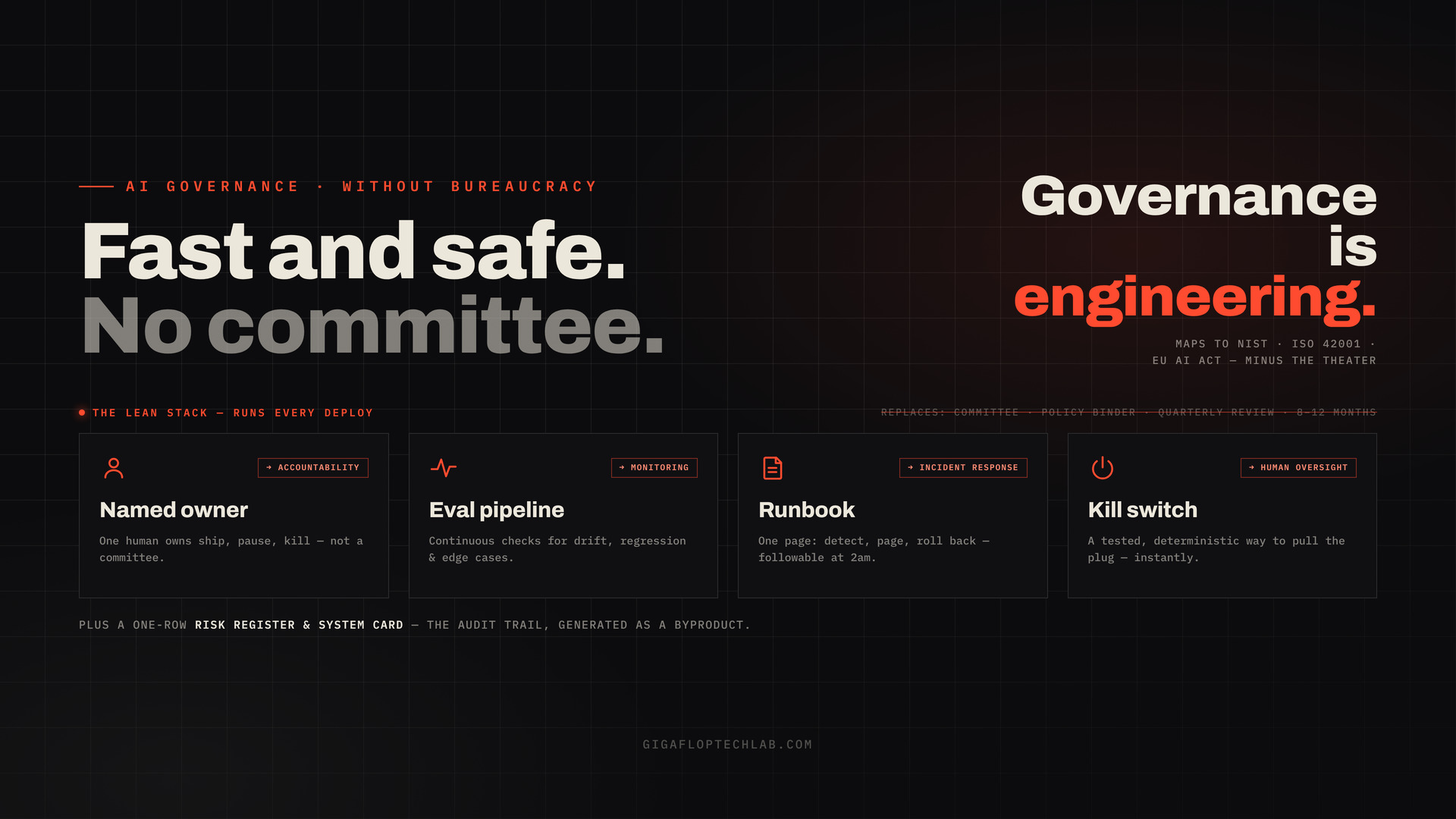
Here’s the same five intentions, delivered as engineering controls a team that ships weekly can actually run. Four artifacts, mapped to what they satisfy:
1. A named owner (→ Accountability)
Every AI system in production has one accountable human — not a committee, a person. They own its behavior, its budget, and the decision to ship, pause, or kill it. This is the entire governance structure for most systems: one name, written down. (NIST “Govern”; ISO accountability; EU AI Act oversight responsibility.)
2. An eval pipeline (→ Monitoring + Risk measurement)
This is the heart of lean governance. Continuous, automated evaluation of the system’s behavior — accuracy, regression, drift, and adversarial/edge cases — so you know it’s still working without a quarterly review cycle. The eval pipeline is governance that runs at deploy speed: every change is measured before and after. It does the job a “monitoring committee” pretends to do, except continuously and honestly. (NIST “Measure/Manage”; the monitoring obligation common to all three frameworks.)
3. A runbook (→ Incident response)
A short, living document: what can go wrong with this system, how you’d detect it, and exactly what to do when it does — who’s paged, what’s rolled back, who’s notified. Not a 40-page policy. A one-pager the on-call engineer can actually follow at 2am. Incident response is a governance requirement; a runbook is its lean form. (NIST “Manage”; ISO incident handling.)
4. A kill switch (→ Human oversight + control)
A deterministic, tested way to stop the system — immediately, outside the model’s own judgment. Human oversight isn’t a meeting; it’s the ability to pull the plug and have it actually work. Test it like you’d test a backup, because an untested kill switch is a story you tell yourself. (NIST “Govern/Manage”; EU AI Act human-oversight requirement.)
Supporting documentation (→ the audit trail): a lightweight risk register (one row per system: purpose, risk level, owner, data it touches) and a short model/system card. A page per system, kept current — not a binder kept for show. This is what makes the whole thing auditable, which is the part regulators and enterprise procurement actually check.
Why this is better, not just faster
The lean stack isn’t a compromise you accept for speed on the things that matter, it’s superior:
- Continuous beats periodic. An eval pipeline catches drift the day it happens; a quarterly governance review catches it a quarter late. Committees meet monthly; production fails in milliseconds.
- Engineering controls are testable. You can prove a kill switch works. You can’t prove a policy binder works.
- It scales with shipping, not against it. Governance embedded in the deploy pipeline gets stronger as you ship more, instead of becoming the bottleneck everyone routes around. The fastest way to get teams to evade governance is to make it slow.
- It’s honest. Bureaucratic governance often produces the appearance of control a signed policy, a documented committee — without the substance. Lean governance produces the substance and generates the documentation as a byproduct.
When you genuinely DO need the heavyweight version
Intellectual honesty matters here, because “lean” can’t mean “skip what’s legally required.” There are real cases where the formal apparatus is non-negotiable:
- EU AI Act high-risk systems. If you place or deploy AI in EU markets in a high-risk category (credit scoring, HR, critical infrastructure, etc.), binding legal obligations apply — with enforcement timelines already in effect (high-risk obligations applying from August 2026). That’s law, not preference. Confirm your classification with counsel.
- ISO 42001 certification for procurement. If enterprise customers require certified AI governance as a condition of the deal, you need the certifiable management system — the lean stack is the foundation, but certification is its own formal process.
- Regulated sectors (healthcare, finance) with sector-specific obligations layered on top.
The lean stack isn’t an alternative to these — it’s the operational core underneath them. Even a fully ISO-certified, EU-Act-compliant program still runs on owners, evals, runbooks, and kill switches. The heavyweight version adds formal documentation and third-party validation on top; it doesn’t replace the engineering. And a sobering note for anyone deploying agents: none of the three major frameworks was originally designed for autonomous agentic AI, so agent deployments need these controls extended for cascading failures and scope creep — exactly the kind of thing a kill switch and tight eval pipeline are built for.
Common mistakes
- Mistaking artifacts for intent. A committee that meets monthly isn’t oversight; a tested kill switch is.
- Governance that lives outside the deploy pipeline. If it’s a separate gate teams have to remember, they’ll route around it. Embed it.
- The untested kill switch. Extremely common, extremely dangerous. Test it on a schedule.
- Policy without measurement. A document saying “we monitor for drift” with no eval pipeline behind it is theater.
- Skipping governance because you’re “moving fast.” The lean stack is how you move fast safely. Skipping it isn’t speed; it’s deferred cost with interest.
- Over-governing low-risk systems. Match the rigor to the risk. An internal text summarizer doesn’t need what a customer-facing decision agent needs.
Conclusion
AI governance got a bad name because the first wave of it was bureaucracy — committees and binders that produced the look of control without the substance, and slowed everyone down doing it. The lean alternative inverts that: a named owner, an eval pipeline, a runbook, and a kill switch deliver real accountability, monitoring, oversight, and incident response — continuously, testably, at the speed you ship — and generate the audit trail as a byproduct.
It maps onto every serious framework because it’s doing what those frameworks actually intend, minus the theater. Ship fast and safe isn’t a slogan. It’s what happens when governance is engineering instead of paperwork.
CTA
Want governance that makes you faster instead of slower built into how you ship, not bolted on as a committee? That’s how we build.
Talk to a Governance-Aware Builder → we’ll help you stand up the lean stack (owner, eval pipeline, runbook, kill switch) mapped to whatever frameworks you’re actually on the hook for, so you ship fast and pass the audit. For the deeper read on where this is heading, subscribe to The Gigaflop Brief.
FAQs
Lean AI governance achieves what formal frameworks intend accountability, human oversight, monitoring, incident response, documentation through lightweight engineering controls rather than committees and policy binders. The core is a named owner, an eval pipeline, a runbook, and a kill switch, embedded in how you ship so governance runs continuously at deploy speed.
No. It means satisfying their underlying intent operationally. The lean stack maps directly onto NIST’s Govern/Map/Measure/Manage functions and the oversight and monitoring requirements common to all three. For EU AI Act high-risk systems or ISO 42001 certification, you still need the formal layer but it sits on top of the same engineering controls.
At minimum: a named accountable owner per system, a way to monitor behavior continuously (an eval pipeline), an incident-response plan (a runbook), and a tested way to stop the system (a kill switch), plus lightweight documentation (a risk register and system card). Those five satisfy the substance of every major framework.
By embedding governance in the deploy pipeline rather than bolting it on as a separate gate. An eval pipeline measures every change automatically; a kill switch and runbook handle failure; an owner is accountable. Governance that lives in the pipeline scales with shipping instead of becoming the bottleneck teams route around.
No. A policy that says “we monitor for drift” with no eval pipeline behind it is theater it produces the appearance of control without the substance. Effective governance is testable: you can prove a kill switch works and show eval results. Documentation should be the byproduct of real controls, not a substitute for them.
Yes, more of it. None of the major frameworks (NIST, EU AI Act, ISO 42001) was originally designed for autonomous agents, which introduce cascading failures and scope creep. Agent deployments need the lean controls extended tighter eval pipelines, least-privilege access, and a reliable kill switch precisely because the standard frameworks don’t fully cover them yet.