The demo always works. That’s the trap.
In a demo, the data is clean, the users are friendly, the inputs are the ones you expected, and nobody’s hitting it ten thousand times an hour. The model answers, the room nods, the steering committee approves, and everyone treats “go live” as the finish line. Then production arrives real load, hostile inputs, messy data, edge cases nobody anticipated and the system that wowed the room falls over by Wednesday.
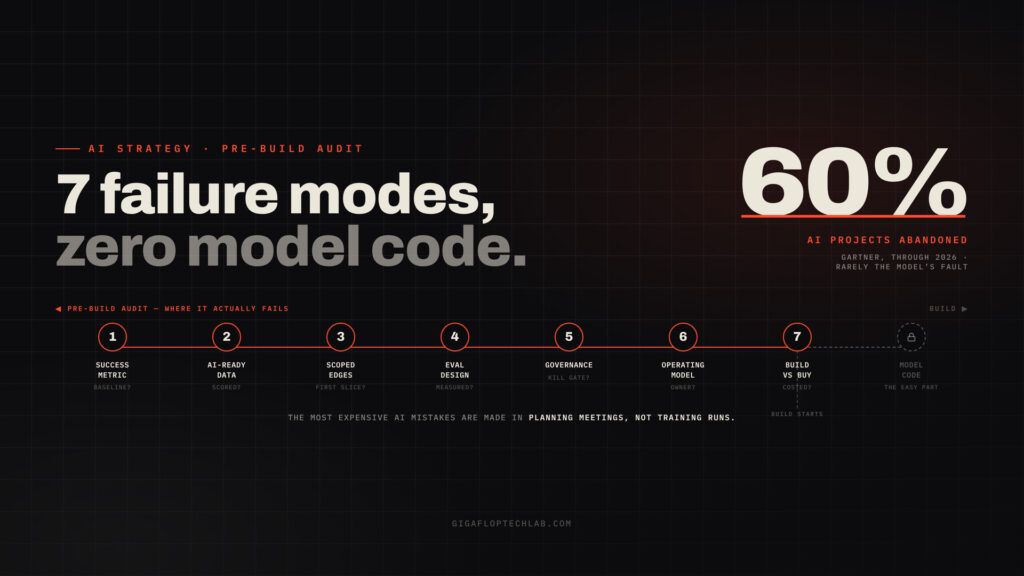
This is the single biggest reason AI initiatives fail. It isn’t the model. As the research consistently shows, a pilot runs on clean controlled data with enthusiastic users and no performance pressure, while production is the opposite of all three and only about half of AI models that complete a pilot ever reach stable production (Gartner; MIT NANDA’s much-cited finding that 95% of GenAI pilots show zero measurable return is the same gap from the business end). The work that closes that gap is unglamorous, and it’s exactly the work demos skip.
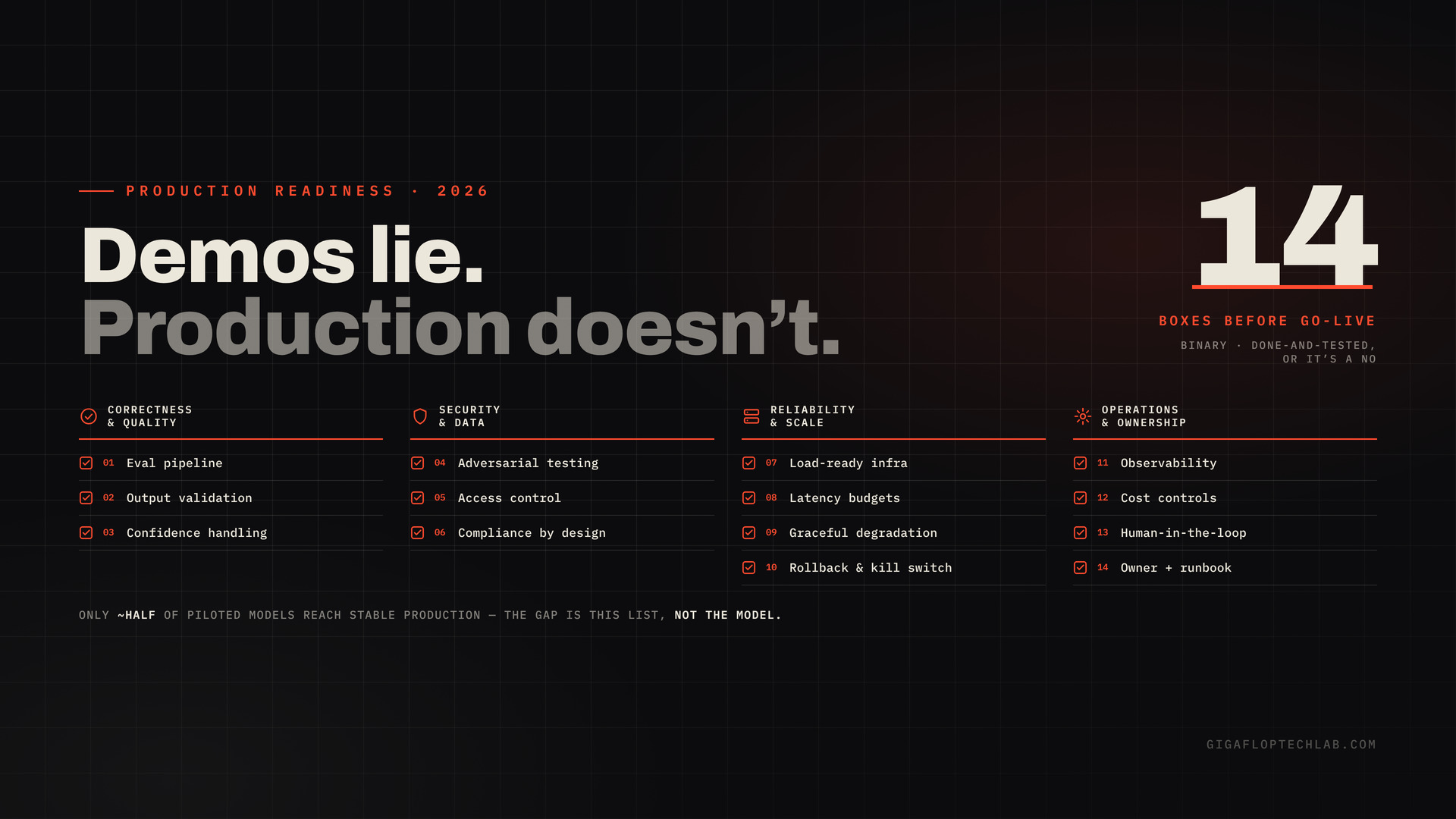
So here’s the checklist. Fourteen points, drawn from production deploys across SaaS, fintech, and consumer-insight platforms, that separate a demo from a system you can actually run. If you can’t check a box, that’s not a nitpick it’s a Monday-morning incident waiting to happen.
The 14-Point Production-Readiness Checklist
Correctness & quality
1. An eval pipeline, not a vibe check. Can you measure whether the system is correct continuously, automatically, on every change? Demos are validated by “looks right in the meeting.” Production needs a real eval pipeline (regression, adversarial, drift) that gates deploys. If you can’t prove quality this week versus last, you don’t have a product; you have an experiment. (This is the foundation see our deep dive on why the eval pipeline is the product.)
2. Output validation. GenAI outputs look correct even when they’re not. In production, users find the edge cases nobody anticipated, and without validation, bad outputs reach them at scale. Validate, constrain, and check outputs before they hit a user or trigger an action in deterministic code, not the model’s self-assessment.
3. Hallucination & confidence handling. Does the system know when it doesn’t know? A production system needs a confidence threshold below which it abstains, escalates, or routes to a human rather than confidently inventing an answer. “Model confidence without model reliability” is a top production failure.
Security & data
4. Adversarial testing (OWASP LLM Top 10). Has anyone hostile tried to break it? Demos assume cooperative users; production gets prompt injection, data-exfiltration attempts, and jailbreak probes. Test against the OWASP LLM Top 10 before launch, not after the incident. (See our pre-launch red-team and threat-model pieces.)
5. Access control at the right grain. AI-generated and demo code routinely handles authentication and skips real authorization. Enforce access at the row/column level, not just the table and make sure the AI can only reach data the current user is allowed to see. This is the most common silent data-leak vector.
6. Data handling & compliance, designed in. Audit trails, data-use boundaries, PII handling, and (where relevant) regulatory obligations have to shape the architecture from the start. Compliance bolted on after launch is always more painful and sometimes forces a rebuild.
Reliability & scale
7. Infrastructure built for load, not for ten users. A single server with no load balancing, no autoscaling, no connection pooling is fine at ten users and broken at ten thousand. Containerize, autoscale, and load-test under realistic conditions before real traffic finds the ceiling for you.
8. Latency budgets that hold under load. The demo was snappy with one user. What’s your p99 latency at peak concurrency and is it within the budget your use case (especially voice) actually requires? Test it, don’t assume it.
9. Graceful degradation & fallbacks. What happens when the model API is slow, a data source drops, or a dependency fails? Production systems degrade gracefully fall back, queue, or fail safe instead of cascading. Demos have no failure modes because demos never fail.
10. Rollback & a kill switch. Can you instantly revert a bad change and stop the system entirely, outside the model’s own judgment? A tested rollback path and a tested kill switch are non-negotiable. An untested one is a story you tell yourself.
Operations & ownership
11. Observability & monitoring. Can you see inside the system in production quality scores, latency, error rates, drift, cost and will your monitoring tell you something broke before a stakeholder does? You can’t operate what you can’t see.
12. Cost controls. Token and inference costs scale with success. Do you have per-request budgets, statement-style timeouts on runaway calls, and visibility into cost-per-outcome? The bill that’s trivial in a demo is the bill that surprises you when the product works. (See our cost-optimization work.)
13. Human-in-the-loop on consequential paths. For decisions with real stakes, is there a confidence-routing layer that puts a human on the cases that matter? In production, HITL isn’t a fallback it’s a competitive advantage and a safety control at once.
14. A named owner and a runbook. Who runs this once the project team moves on and is it their real job? Production AI needs an accountable owner, a sponsor, and a runbook (detect → respond → roll back → notify) that an on-call engineer can follow at 2am. A system with no operating model behind it is a pilot that will quietly rot.
How to use this checklist
Run it as a pre-launch gate, honestly. The scoring is binary on purpose: each item is either done and tested or it isn’t. “We have a plan for monitoring” is a no. “We validate outputs for the happy path” is a no. Production doesn’t grade on a curve.
A useful pattern: a quick first pass tells you roughly where you stand, but the items that feel done are usually the ones that aren’t tested — the kill switch nobody’s pulled, the autoscaling nobody’s load-tested, the eval suite that runs but doesn’t block a bad deploy. The gap between “we built it” and “we tested it works under production conditions” is exactly the demo-to-production gap this list exists to close.
Why this is the work that actually matters
Notice what’s not on this list: model selection, prompt cleverness, the latest framework. Those are the parts demos obsess over and production takes for granted. Every one of the 14 points is about operating the system reliably, safely, and affordably under real conditions which is precisely the work that separates the ~50% of pilots that reach stable production from the ~50% that quietly die.
That’s the real meaning of “GenAI has outgrown demos.” The industry has proven the models work. The frontier now isn’t capability it’s production discipline. The teams winning in 2026 aren’t the ones with the cleverest demo. They’re the ones who can check all fourteen boxes.
Conclusion
A demo proves a model can do something once, under ideal conditions. Production proves a system does it reliably, safely, and affordably, ten thousand times a day, including when someone hostile shows up and a data source drops mid-request. Those are different achievements, and confusing the first for the second is how capital and trust get destroyed thirty to ninety days after a triumphant launch.
Fourteen boxes. The good news is that none of them is exotic they’re known, doable engineering. The bad news is that demos let you skip every one, and production lets you skip none. Run the checklist before you go live, not after the incident report.
CTA
Want to know how many of the fourteen your AI system would actually pass under real conditions, not demo conditions? Most teams discover three or four “done” items aren’t tested.
Request the Full Checklist → get the complete 14-point production-readiness assessment with the test for each item, then book a readiness audit and we’ll run it against your system and hand you a prioritized go/no-go before launch. Catch the gaps on paper, not in production.
FAQs
Production readiness is whether an AI system can operate reliably, safely, and affordably under real conditions — real load, hostile inputs, messy data, edge cases not just perform once in a controlled demo. It spans correctness (evals, output validation), security, reliability and scale, and operations (monitoring, ownership, cost). Only about half of piloted AI models ever reach stable production, almost always because readiness was never assessed.
Because teams confuse a successful demo with a production-ready system, and they’re very different. A pilot runs on clean data, friendly users, and no performance pressure; production is the opposite of all three. MIT’s research found 95% of GenAI pilots deliver zero measurable return rarely because of the model, almost always because of the operational work demos skip.
A demo proves a model can do something once under ideal conditions. A production system does it reliably at scale, including under load, hostile inputs, and failures. The difference is the unglamorous engineering — eval pipelines, output validation, security testing, autoscaling, monitoring, cost controls, rollback, and ownership — that demos skip and production requires.
At minimum, four dimensions: correctness (eval pipeline, output validation, confidence handling), security and data (adversarial testing, access control, compliance), reliability and scale (load-ready infrastructure, latency budgets, graceful degradation, rollback and kill switch), and operations (observability, cost controls, human-in-the-loop, a named owner and runbook). Each item should be testable and treated as binary: done-and-tested, or not.
Run a binary pre-launch gate: each readiness item is either done-and-tested or it isn’t — “we have a plan” counts as no. The items most likely to fail are the ones that feel done but were never tested under production conditions: the untested kill switch, un-load-tested autoscaling, or an eval suite that runs but doesn’t block a bad deploy. A structured readiness audit surfaces these before launch.
No and that’s the surprise. Model selection and prompt cleverness are what demos obsess over; production takes them for granted. The factors that actually determine production success are operational: measurement, validation, security, scale, monitoring, cost control, and ownership. The frontier in 2026 isn’t model capability; it’s production discipline.