Most AI ROI decks are written backwards. Someone decides the project should happen, picks an impressive-sounding return, and reverse-engineers assumptions until the spreadsheet agrees. The number isn’t a forecast it’s a justification wearing a forecast’s clothes.
The data shows where that leads. McKinsey’s 2026 survey found roughly 73% of AI deployments fail to achieve their projected ROI; MIT’s NANDA research found the majority of generative-AI pilots deliver no measurable P&L impact at all (2025). That’s not a technology failure it’s a measurement failure. Teams couldn’t tell a good investment from a bad one before spending, because they never had an honest way to do the math.
The 5.5× Rule is that honest way. It’s a pre-spend test: estimate the real recoverable value of the specific workflows you’re targeting, weigh it against the engagement cost, and see whether the ratio clears the bar before you commit. Let’s break it down and be upfront that the rule is a decision heuristic, not a physics constant. [[EDITOR: “5.5×” is Gigaflop’s own threshold confirm the exact multiplier and how it was derived from engagement history before publishing; present as our rule, not an industry standard.]]
Why “ROI before you spend” is the only ROI that matters
Here’s the trap: ROI calculated after a project is an autopsy. It tells you whether you wasted the money, not whether you’re about to. The decision that actually controls your return is made before the spend when you choose what to build and whether it’s worth it.
So the useful question isn’t “what ROI did we get?” It’s “what’s the smallest honest estimate of recoverable value, and does it justify the cost before we start?” Every dollar of AI return is really decided at the scoping stage. The 5.5× Rule forces that decision into the open.
The 5.5× Rule, defined
In plain terms:
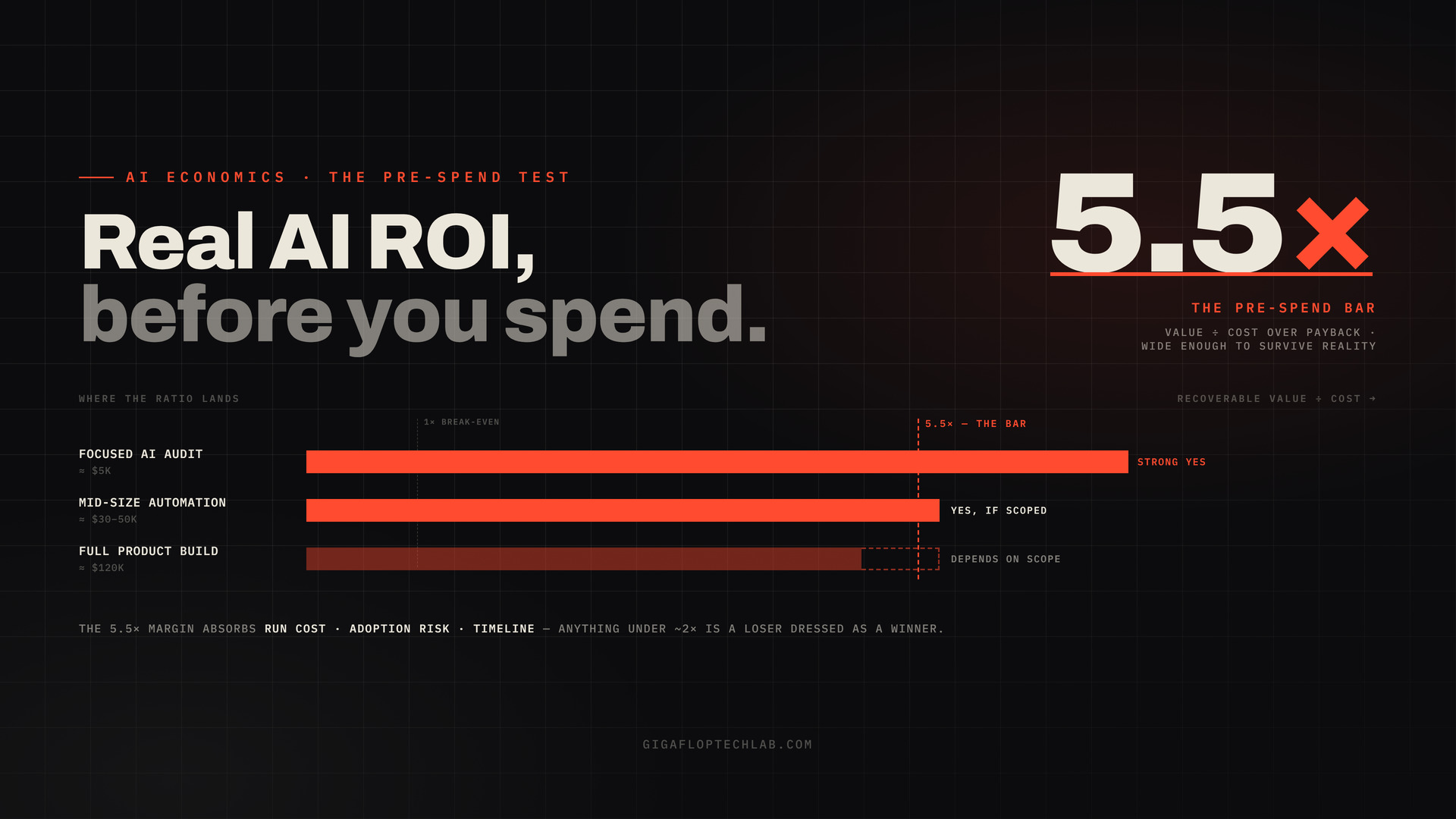
Estimated recoverable workflow value (over the payback horizon) ÷ engagement cost ≥ ~5.5×
The multiplier isn’t magic it’s a margin of safety. Why so far above break-even (1×)? Because honest ROI math has to survive three haircuts that fiction ignores:
- Run costs. The recoverable value isn’t free to capture there’s ongoing model, platform, and human-in-the-loop cost (see any production agent).
- Adoption risk. Not every targeted workflow gets fully recovered. User adoption is the single biggest threat to realized ROI.
- Timeline reality. Value arrives over months, not on day one so the gross multiple has to be comfortably large for the risk-adjusted, net return to still be worth it.
A project that only clears ~1–2× on paper will, after those haircuts, likely lose money. One that clears ~5.5× has the headroom to survive them and still return well. The exact threshold is a judgment Gigaflop tunes from engagement history; the principle — demand a wide safety margin on a pre-spend estimate is the part you should steal regardless of the number.
How to calculate it step by step
Step 1 – List the recoverable workflows (not “AI benefits”)
Forget vague “efficiency gains.” Name the specific workflows the engagement targets: invoice processing, CV screening, report generation, tier-1 support. If you can’t name the workflow, there’s nothing to recover.
Step 2 – Value each workflow honestly (fully loaded)
For each, estimate the recoverable cost: hours × fully-loaded labor cost, error/rework cost avoided, or revenue enabled. Use fully-loaded cost (salary + benefits + overhead), not base salary — a realistic loaded multiplier is ~1.25–1.4× base. (For reference, a single ops role often runs ~$55K–$75K/yr fully loaded; the recoverable share is the portion the AI actually offloads, not the whole role.)
Step 3 – Subtract what you won’t recover
No automation recovers 100%. A high-accuracy agent still routes exceptions to humans. Estimate the recoverable fraction honestly — and resist the temptation to round up.
Step 4 – Set the payback horizon (and be honest about it)
This is where most decks lie. Well-scoped, narrow automation (document processing, support, defined single-task agents) commonly shows payback in the 3–9 month range. Broad “transform the enterprise” AI is a different animal Deloitte finds most organizations take 2–4 years to reach satisfactory ROI, with only ~6% paying back inside a year (Deloitte, 2025–2026). Use the horizon that matches your actual scope, not the optimistic one.
Step 5 – Divide and apply the rule
Recoverable value over the horizon ÷ engagement cost. If it clears ~5.5×, the project has the headroom to survive run costs, adoption risk, and timeline. If it’s near 1–2×, it’s a likely loser dressed as a winner.
Step 6 – Risk-adjust
Multiply the expected return by a confidence factor based on comparable projects. Risk-adjusted = expected × (1 − risk factor). A 5.5× gross that risk-adjusts to a still-healthy multiple is a real yes; a borderline one that collapses under risk-adjustment is a real no found on paper, for free.
Worked examples (illustrative plug in your numbers)
These show the structure, not real client results. The engagement tiers reflect Gigaflop’s actual range (≈$5K audits up to ≈$120K builds). [[EDITOR: confirm tier figures.]]
| Engagement | Cost (illustrative) | Recoverable workflow value over horizon (illustrative) | Ratio | Verdict |
| Focused AI audit | ~$5K | Prevents a six-figure failed build / surfaces $30K+ in avoidable cost | well above 5.5× | Strong yes — audits clear the bar easily because they de-risk a much larger spend |
| Mid-size automation | ~$30–50K | Offloads a meaningful share of 1–3 loaded roles, 3–9 mo payback | clears 5.5× if workflow is high-volume + verifiable | Yes, if scope is right |
| Full product build | ~$120K | Must recover ~$650K+ in workflow value over horizon to clear 5.5× | depends entirely on scope & adoption | Only with a high-volume, high-value, verifiable workflow |
The pattern: audits clear the rule most easily (they’re cheap and prevent expensive mistakes), builds demand the most scrutiny (the recoverable value has to be large and real). That’s not a sales accident it’s why the honest first step is often the audit, not the build.
Common mistakes that produce fiction
- Counting gross value, ignoring run + adoption. The 5.5× margin exists precisely to absorb these. Skip them and your “10× ROI” is really 1.5×.
- Pricing labor at base salary. Use fully-loaded cost or you’ll misjudge both the numerator and the payback.
- Optimistic payback horizons. Applying a 6-month horizon to an enterprise-wide transformation is how decks become fiction. Match the horizon to the scope.
- No recoverable fraction. Assuming 100% automation. There’s always an exception tail with a human cost.
- No risk adjustment. Expected ROI isn’t realized ROI. Comparable-project risk factors keep the estimate honest.
- Reverse-engineering the number. If you started from the answer, you’re not calculating ROI — you’re decorating a decision.
Conclusion
The reason most AI ROI is fiction isn’t that AI doesn’t pay off it’s that nobody did honest arithmetic before spending. The 5.5× Rule is just that arithmetic, forced to the front: name the recoverable workflows, value them at loaded cost, subtract what you won’t recover, match the horizon to the scope, risk-adjust, and demand a safety margin wide enough to survive reality.
Run it and most “transformational” projects shrink to honest size and the genuinely good ones (often starting with a cheap audit that de-risks an expensive build) stand out clearly. That clarity, before you spend a dollar, is the whole point.
CTA
Want the 5.5× math run on a specific AI initiative — before you commit budget? Bring the workflows and a loaded cost-per-role; the estimate takes one working session.
Get a Pre-Build ROI Estimate → we’ll name the recoverable workflows, value them honestly, risk-adjust, and tell you whether the project clears the bar before you spend. If it doesn’t, we’ll say so. That’s cheaper than finding out in production.
FAQs
It’s a pre-spend test: estimate the recoverable value of the specific workflows an AI engagement targets, divide by the engagement cost, and check it clears roughly 5.5× over the payback horizon. The wide margin exists to absorb run costs, adoption risk, and timeline — so a project that clears it has real headroom to return well, not just break even.
Because gross estimates get eaten by reality: ongoing run costs, the workflows you won’t fully recover, and value that arrives over months. A project that looks like 1.5× on paper often loses money after those haircuts. Demanding ~5.5× gross builds in the safety margin that makes the net, risk-adjusted return reliably worth it.
Name the specific recoverable workflows, value each at fully-loaded labor cost (not base salary), subtract the share you won’t recover, set a payback horizon that matches the scope, divide recoverable value by engagement cost, and risk-adjust using comparable-project confidence. If you can’t name the workflows, the business case is incomplete.
It depends heavily on scope. Well-scoped, narrow automation (document processing, support, single-task agents) often pays back in 3–9 months. Broad enterprise transformations take far longer Deloitte finds most organizations reach satisfactory ROI in 2–4 years, with only ~6% inside a year. Matching the horizon to the actual scope is essential to honest math.
Because they’re built backwards from a desired number, ignore run and adoption costs, price labor at base salary, and use optimistic timelines. McKinsey found ~73% of deployments miss their projected ROI. The fix is calculating honestly before spending naming workflows, using loaded costs, and risk-adjusting rather than decorating a decision already made.
Often, yes on this math. A focused audit is inexpensive and frequently prevents a six-figure failed build or surfaces avoidable cost, so it clears the 5.5× bar easily. Builds can deliver strong ROI too, but only when they target a high-volume, high-value, verifiable workflow. That’s why the honest first step is often an audit, not a build.