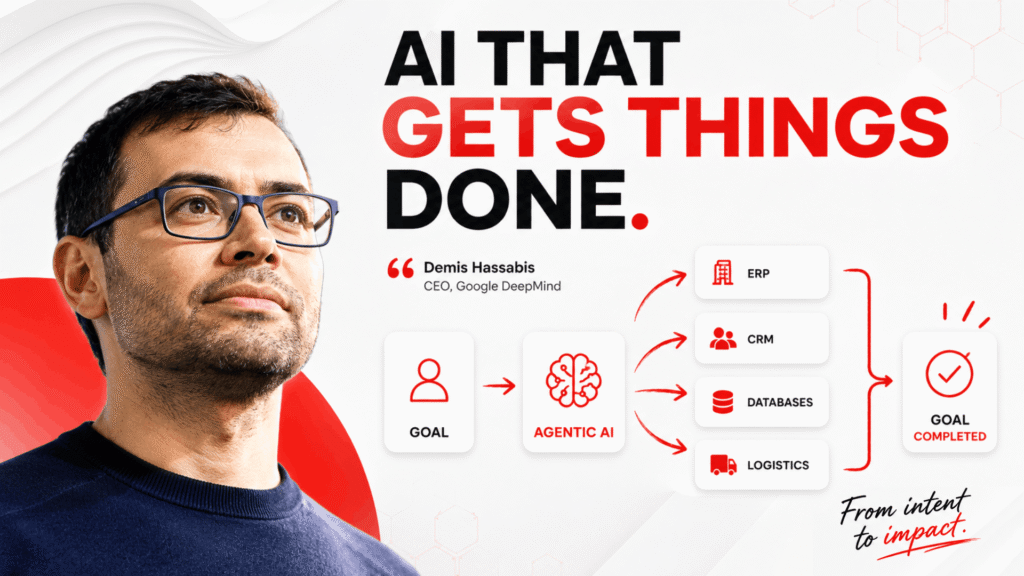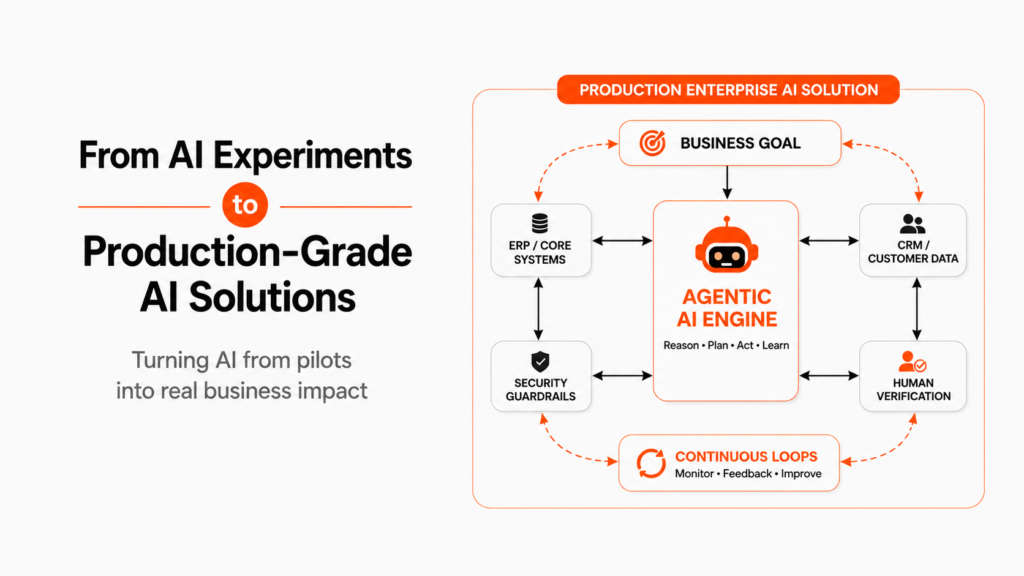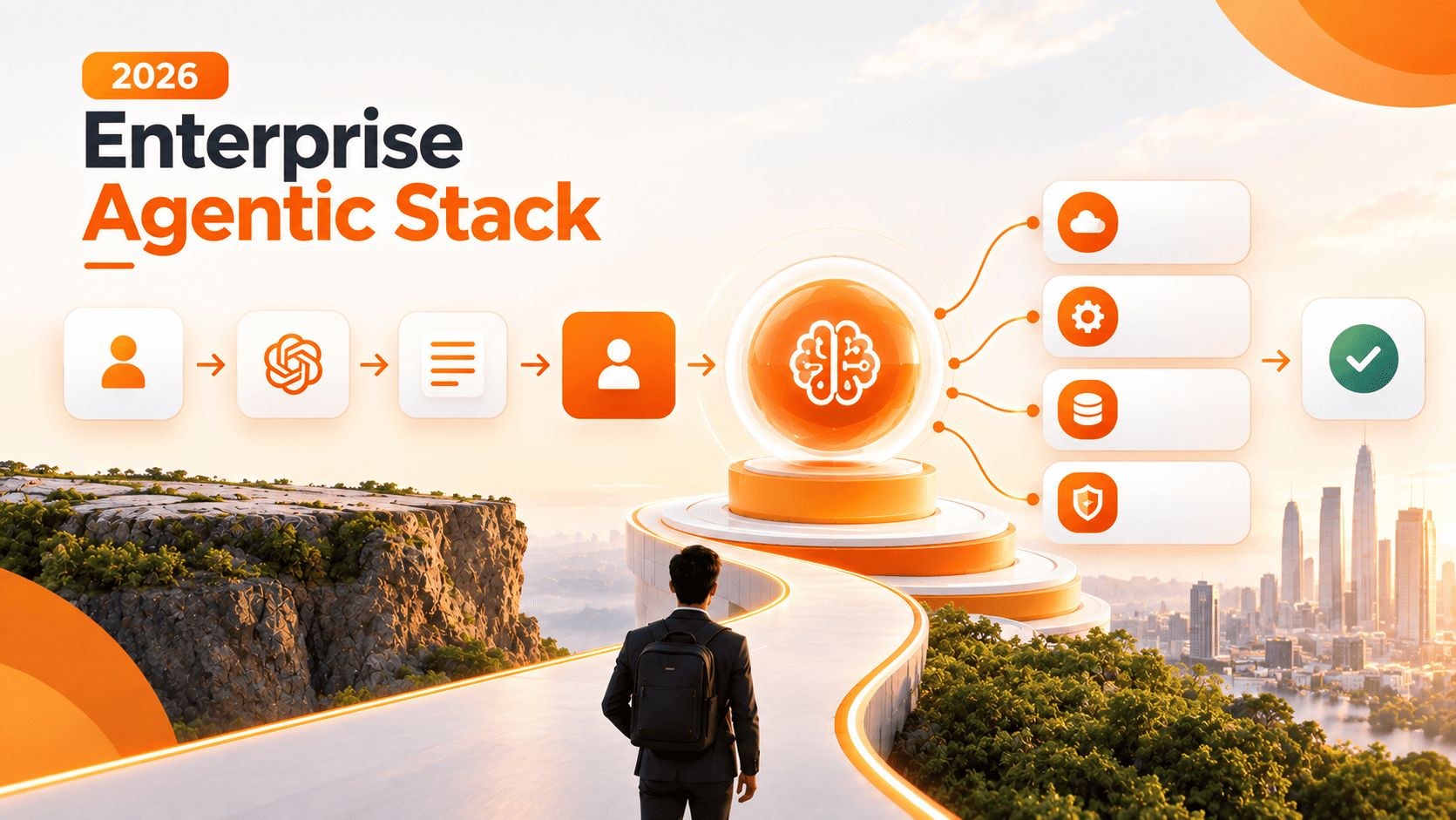
Artificial intelligence has gone past the use of traditional chatbots. It is now being harnessed by businesses as an informal AI agent in their systems.
AI agents do not only assist the employees with writing and summarizing but also carry out advanced functions in ERP systems, manage finances, organize logistics, and maintain customer records.
Gartner predicts that “over 40% of enterprise applications by 2026 will include specialized AI agents capable of multi-object processing.”
Gartner Distinguished VP Analyst Don Scheibenreif described the shift clearly:
“While digital business changes what the organization does, autonomous business changes how the organization does it.”
This pillar guide breaks down what has fundamentally changed in enterprise AI architecture, what timeless business fundamentals remain constant, and how forward-thinking executives can build scalable digital operations.
The Enterprise AI Paradigm : 2024 Shift vs. 2026
To understand how modern software platforms drive measurable ROI, compare how enterprise technical stacks have evolved over the last two years.
| Technical Dimension | 2024 Generative AI Approach | 2026 Agentic AI Architecture |
| Core Interface | Chat windows | APIs and automated triggers |
| System Access | Mostly read-only data | Read/write access to CRMs, ERPs, and databases |
| Workflow Logic | Single prompts | Multi-step planning, tool use, and self-correction |
| Primary Metric | Time saved on content | Faster processes and lower costs |
| Governance Focus | Privacy and prompt filtering | Access controls and tool safety limits |
While initial generative software required a human user to start and complete every task, modern autonomous AI agents act as digital team members. They receive broad operational goals, break them into logical steps, interact with business APIs, and escalate exceptions to human managers.
What Has Changed – 4 Major Changes in Enterprise Architecture
Enterprise AI systems have been modified in four important areas:
- From Search to Action – AI has evolved past the stage of merely providing data. In fact, AI is now capable of making modifications and updates to documents, as well as generating invoices and launching processes in applications such as SAP, Salesforce, and NetSuite.
- Dedicated AI Operations – Nowadays, organizations have specialized divisions that supervise the operations of AI, verify the operation of API and manage the systems of the applications.
- Automated AI Testing – Modern teams are now utilizing automatic Evals to assess AI systems and their decisions before deployment for the production processes.
- Improved Memory – Today’s AI technologies retain prior outcomes, aiding in the integration of context to preserve effort during long-term processes.
💡 Is your organization ready to upgrade from standard chatbots to agentic workflows?
Don’t waste budget on fragmented software tools. Book a Free 15-Minute Technical AI Audit with our systems architects to map your top automation opportunities.
High-Impact Deployment Use Cases Across Departments
Organizations deploying modern enterprise ai solutions achieve rapid payback by targeting complex, data-heavy operations:
1. Finance & Accounting Reconciliations
Instead of human accountants manually matching line items, autonomous agents cross-reference incoming vendor invoices against purchase orders in NetSuite. They flag exact pricing discrepancies, draft vendor inquiries, and queue verified payments for review.
2. Supply Chain & Logistics Operations
When carrier shipping delays occur, agents monitor tracking APIs, notify affected customers, recalculate inventory replenishment thresholds, and update warehouse management queues in real time.
3. Customer Operations & Service Escalations
Agents verify user identity, check live order histories in SAP or Shopify, execute product returns, and issue balance credits according to strict corporate policy guardrails
4. Revenue Operations & Inbound Prospecting
Autonomous agents qualify incoming sales inquiries, pull firmographic data from corporate intelligence platforms, answer technical product questions, and book sales calls directly onto rep calendars.
Major Applications of AI in Various Industries
AI applications can be beneficial for organizations in terms of time and cost effectiveness for processes.
- Finance & Accounting – ML apps are capable of processing vendor invoices, matching them with purchase orders, id
- Supply Chain & Logistics – AI programs help to keep track of consignments, notify clients about delivery delays, and update stock levels in the companies’ warehouse.
- Customer Service – AI is used for the identification of clients, verification of orders, processing of refunds, and delivery of credits.
- Sales & Lead Generation – AI tools are now capable of qualifying potential clients and being able to collect all information about the organization, along with answering product-related questions and scheduling calls automatically.
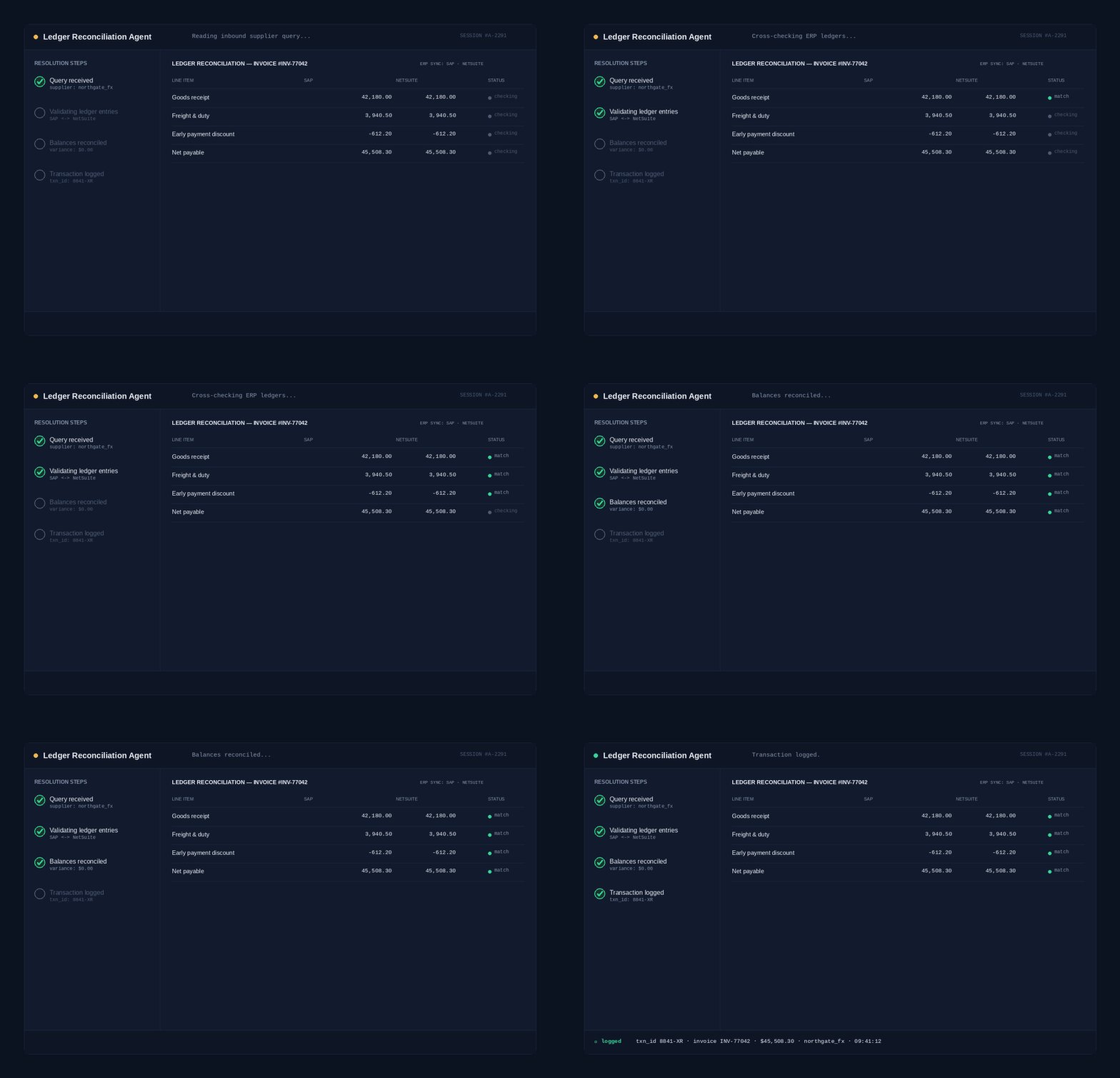
When our team deployed structured operational workflows for mid-market clients, we helped a mid-market enterprise cut manual invoice processing costs by 60% while maintaining full data control across legacy backend databases.
What Didn’t Change: 4 Unshakable Enterprise Fundamentals
Despite dramatic technological progress, core business realities remain unchanged. Leaders who ignore these fundamentals risk project failure:
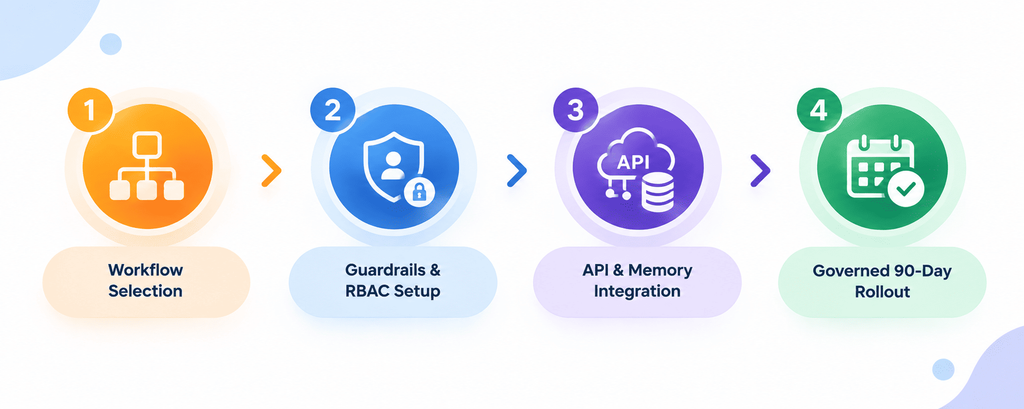
1. Bad Data Yields Bad Automation
An agent is only as reliable as the underlying enterprise data it accesses. Disorganized CRM records or unstandardized SQL databases result in broken execution loops.
2. Strict Governance and RBAC Are Mandatory
Autonomous systems must follow the principle of least privilege. An agent handling customer support must never access sensitive executive payroll data or unredacted financial ledgers.
3. Human-in-the-Loop Oversight Is Essential
High-stakes operational actions—such as approving wire transfers over $1,000 or altering legal contracts must mandate human approval steps before final execution.
4. Clear ROI Metrics Drive Long-Term Scale
Projects fail to expand when teams neglect baseline KPIs. Executive sponsors must measure processing cycle times, error rates, and cost-per-transaction before and after deployment. Learn more in our guide on scoping your first enterprise AI project.
- Incorrect Information Leads to Unsatisfactory Automation – Artificial intelligence workers are just as effective as the data they utilize. Poorly kept CRM records can bring about failures in assignments.
- Effective Governance and RBAC Are Necessary – The data that AI robots can access should be limited to what is needed. A customer service robot cannot have access to sensitive salary information.
- Human Regulation Is Necessary – All high-risk activities should require approval from a human before they take place.
- Clear ROI Is Necessary for AI to Scale Up – It is important for organizations to have precise KPIs in order to define their success in the utilization of AI.
🚀 Build Your Business AI Strategy?
Ready to turn emerging AI capabilities into secure, production-ready solutions that deliver measurable business impact?
Mitigating Risk: Security, Compliance, and Execution Guardrails
Deploying AI agents for business introduces operational considerations that executive leadership must address proactively:
- Execution Risk: An agent taking an incorrect software action causes more disruption than a chatbot generating a wrong text answer. Sandbox testing and schema validations are mandatory.
- Prompt Injection & Data Security: Inbound text payloads must be sanitized to prevent malicious users from overriding system instructions or accessing restricted data fields.
- System Telemetry: Industry research from MIT Technology Review confirms that enterprise AI scale requires granular tracing logs to track every decision, API payload, and model step in real time.
Frequently Asked Questions (FAQs)
“Generative AI” generates content such as text, images, or codes as per the user’s prompt. “Agentic AI” can organize tasks, install software, and accomplish multiple objectives independently.
Yes, as long as companies use advanced encryption technology, authentic access controls, and human vigilance when performing certain activities.
A top-down approach can take “4-8 weeks.” Larger installations with ERP and CRM integration may require “3-6 months.”
No. They may either choose ready-made solutions for corporate applications or cooperate with third-party IT companies.
Build a Production-Grade AI Foundation for Your Enterprise
The evolution of enterprise ai solutions offers unprecedented operational leverage to companies that modernize their software stack. By combining autonomous agentic AI execution with rigorous governance and clear human oversight, forward-thinking organizations build scalable digital advantage.
Ready to transition from passive AI experiments to scalable, high-ROI business automation?