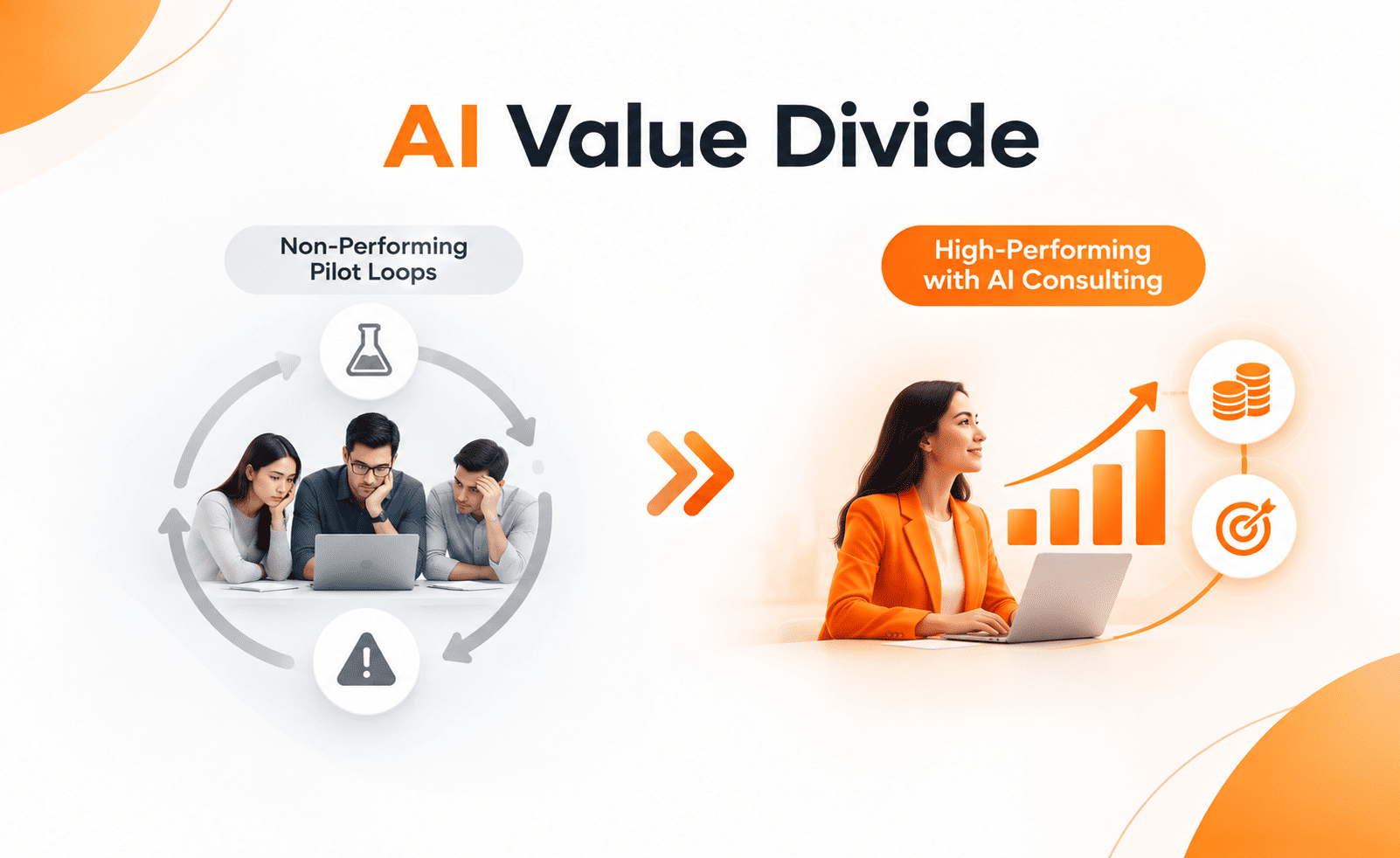
Generative AI has definitely made conversational search and instant content creation available for every company or organization. However, there is something that should be considered, according to PwC’s Global CEO Survey benchmark information, only 12% of the business leaders have managed to increase the revenue through investing in AI while simultaneously decreasing expenses.
According to the study, 88% of companies got stuck in the “pilot purgatory”, investing significant amounts of money into separate instruments that do not help with profit gain.
In order to be able to get out of this situation, the companies need to cooperate with companies that focus on AI consulting and use their helpful advice in order to change from the usage of text-generating chatbots to the application of action-oriented agentic AI systems. These solutions do not just produce text: they affect multiple systems at the same time in order to implement complex business processes. Market specialists say that by the end of 2026 more than 40% of business software applications will have autonomous AI agents for task fulfillment.
Nvidia CEO Jensen Huang highlighted this shift when describing the future makeup of enterprise teams
“Future workforces in enterprise will be a combination of humans and digital humans… Our company’s IT department is going to be the HR department of digital employees of the future.”
This executive guide breaks down why standard software rollouts fall short, how pragmatic AI strategy consulting establishes high-yielding frameworks, and what it takes to navigate AI agent development without getting bogged down in unnecessary technical complexity.
The AI ROI Gap – Chatbots vs. Agentic Transformation
Why do so many enterprise leaders struggle to capture actual financial returns? The root cause often stems from treating advanced technologies like traditional software updates rather than structural operational shifts.
| Capability Layer | Standard GenAI Tools | Internal Knowledge Repositories | Enterprise Agentic AI Systems |
| Logic Basis | Basic prompt-response LLMs | Custom search and retrieval models | Goal-oriented agentic ai loops |
| System Access | Standalone browser interfaces | Internal vector documentation | Reads and writes across CRM, ERP, & APIs |
| User Interaction | One-off manual text prompts | Search and lookup queries | High-level strategic objective inputs |
| Financial Impact | Hard-to-track individual time savings | Indirect research speed gains | Direct cost reduction & revenue expansion |
Unlike conventional conversational models, which depend solely on constant manual input, true agentic artificial intelligence technologies work within an endless feedback loop meant for complicated assignments
- Sense – The agent recognizes an operational trigger, like a customer return that has arrived or an invoicing from a supplier that is 30 days overdue.
- Reason and Plan – It scrutinizes relevant data and compares it to internal compliance rules. Then it breaks the original goal down into smaller tasks.
- Take Action – It implements actions through core infrastructure, including updating ERP data, conducting a range of operations and communicating with suppliers.
- Reflect and Adapt – The mechanism checks the result, makes amends of any basic processing errors, and forwards any cases for human managers to check.
4 Core Pillars of High-ROI AI Strategy Consulting
To succeed like only 12% of the business value makers, company leaders need to ensure that their technological development is in line with business profitability. Efficient ai consulting is based on the following four operational pillars
- Impact-Driven Workflow Selection – Choosing repetitive processes for implementing automation that minimizes administrative costs, while speeding up customer service.
- Integrated Software Installation – Podiuming the use of intelligence engines through their direct streamlining of the enterprise software.
- Data Infrastructure Preparedness – Transforming the pre-existing incomplete outdated databases so that the functioning of the autonomous systems is based on reliable and up-to-date information.
- Controlled Human-in-the-Loop Supervision – Creating the framework of the operational processes that would assign risky processes the ones requiring approval from management for the refund operation exceeding a thousand dollars to human managers.
💡 Is your technical stack prepared for agentic automation?
Avoid spending months on non-performing experiments. Book a Free 15-Minute AI agent with our strategy team to identify your top 3 high-yield operational workflows.
High-Impact Use Cases Driving Balance-Sheet Growth
Reducing LLM costs does not mean reducing output quality. These strategies can help businesses maintain performance while lowering monthly AI costs
1. Logistics & Supply Chain Sector
Autonomous agents track carrier API feeds in real-time and resolve shipping delays by detouring shipments, updating SAP inventory buffers and informing customers immediately.
2. Finance & Accounts Payable Departments
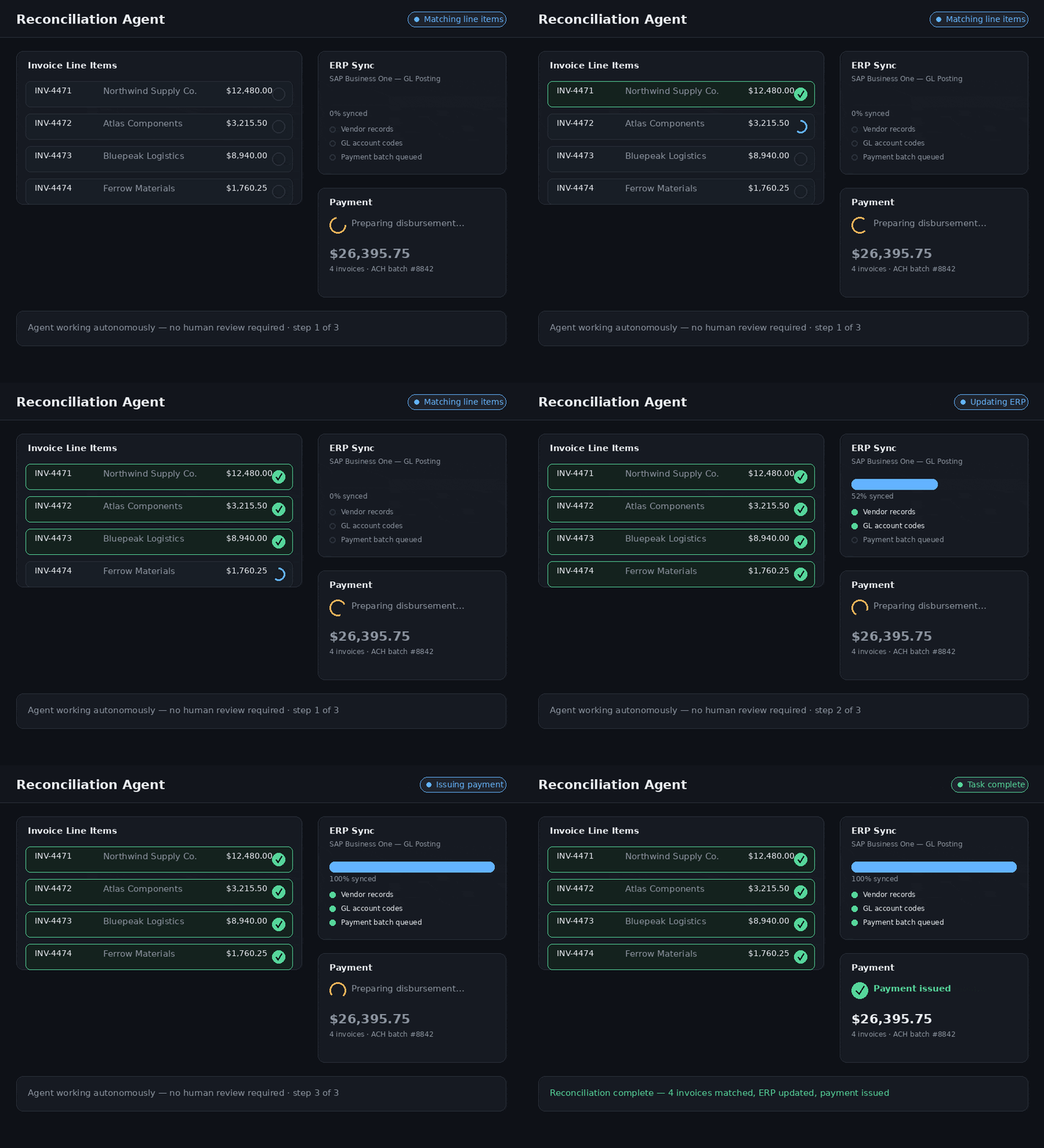
Agents automatically cross-check incoming supplier invoices with related purchase orders and receiving log thus replacing manual data entry. It will raise early detection alerts for discrepancies in prices, prepare clarifications emails, and register authorized outgoing payments.
3. Sales Acceleration
Agents qualify incoming sales inquiries, enrich leads profiles, prepare personalized messages, and schedule introductory meetings without hiring any new staff.
Executive Roadmap for AI Transformation Consulting
From the outset, successful AI transformation consulting initiatives need more than simply coding; they depend on structural processes, basic laws of business, and clearly defined operating principles.
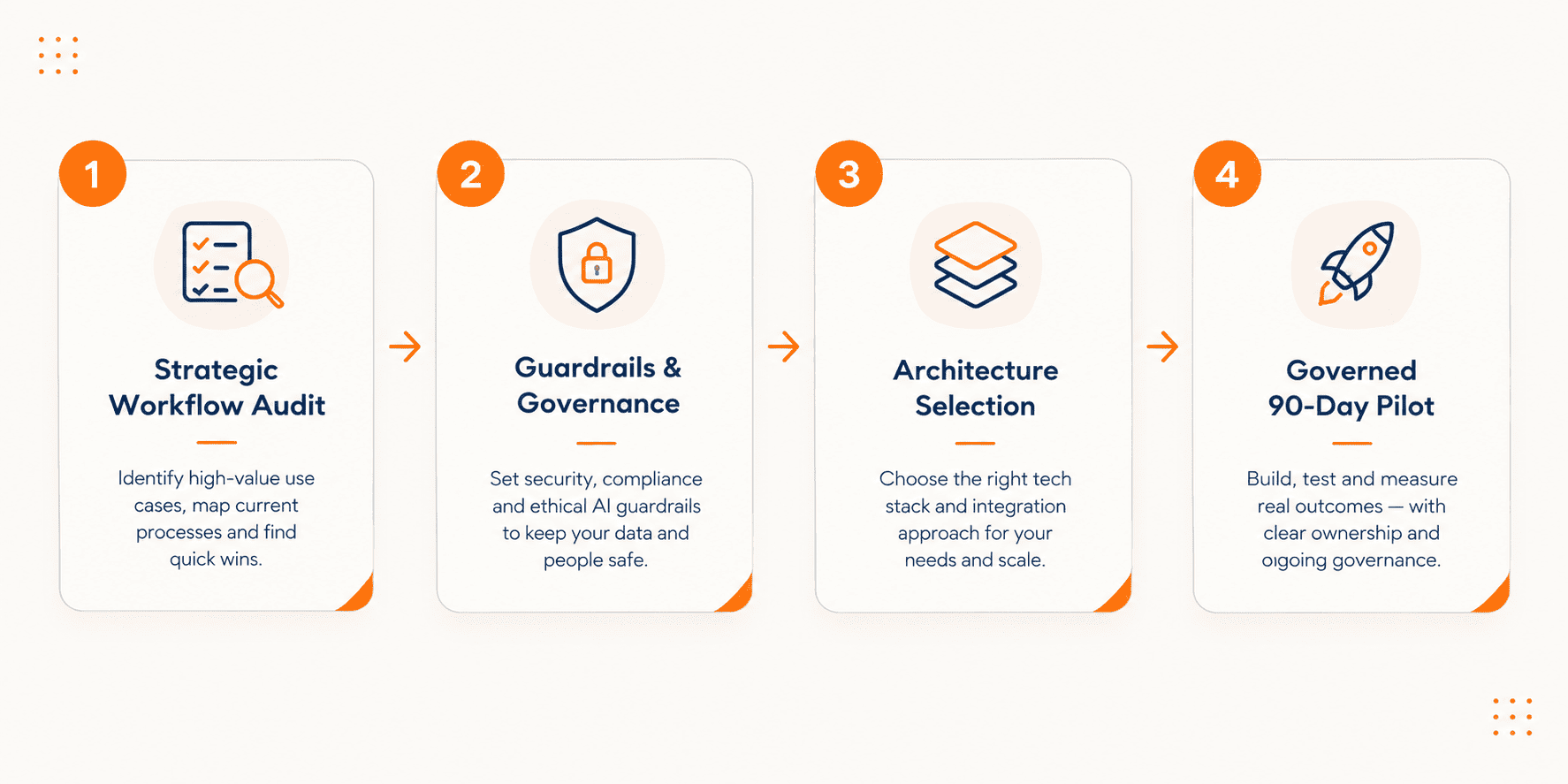
Stage 1- Focus on High-Yield Processes
Steer clear of broad requirements such as “implement AI into customer support.” Instead, identify specific processes that can be automated easily, with specific baseline measures, for example, “automate normal product replacement requests.”
Step 2 – Set up Regulatory Framework
Define clearly the limits of operation. Clearly outline what software and databases the agent will be permitted to process, what data it will be able to handle, and what financial and operational limits require management approval.
Step 3 – Choose the Technical Strategy
- Platform-Integrated Agents: Readily available automation solutions integrated into such systems as Salesforce or HubSpot. They are easy to deploy but limited to one ecosystem only.
- Tailored Agent Development: Customized agentic solutions created according to your individual legacy software systems and safety policies that allow to gain a better competitive edge.
Step 4 – Organize a Governed 90-Day Experiment
Implement agents together with present workers. Assess the processing speed, number of errors made, and cost savings before granting them full independence.
🚀 Accelerate Your Automation Strategy
Ready to build and deploy scalable, high-impact enterprise workflows?
Reducing Risks and Optimizing Returns
In order to successfully scale systems of autonomous operations, companies need to be aware of crucial risks and execute them well
- Risk of How Something Is Done – An autonomous doing something erroneous on your software solutions leads to much greater disruption than a chatbot answering incorrectly. Every deployment needs to go through rigorous testing in a sandbox and validation stages.
- Data Protection – Systems must apply strict RBAC in order to assure that the agent is accessed only by those who require it for doing their jobs.
- Monitoring Financial KPIs – Research from Harvard Business Review and Gartner Research proves that transformation processes come to failure due to the absence of basic operational data monitoring. It is important to track processing cycles and costs before and after the deployment in order to see the change in the P&L impact.
Frequently Asked Questions (FAQs)
The vast majority of enterprises are implementing various technology tools in segregated units without modifying workflows, ameliorating business processes, or linking their tools with databases.
Top-tier AI consulting firms help in resolving operational issues, creating unique data channels, constructing secure automation systems, and managing changes to ensure financial returns.
The first experiments with one-task agents take between four and eight weeks while the entire business will usually need between three and six months to fully launch systems.
It is not necessary. Enterprises can work with user-friendly management software or work with consulting providers for the deployment of the AI systems.
📞 Transform Your Enterprise Operations
Stop running non-performing pilot programs. Start driving bottom-line profitability.
Schedule an executive strategy session with our technical team to see live enterprise automation in action.