Investing in an AI consulting firm is significant; however, the first month does not have to be filled with abstract theories and unfulfilled commitments. If your executive team is having a hard time distinguishing between the hype about AI and actual profits at the end of the quarter, the first month is essential for fundamental groundwork of the current state of your data.
In contrast with the traditional software companies that can offer lengthy discovery stages, the top AI consulting companies specialize in quick deployment, feasibility checks and risk management. They analyze your existing issues in the daily operation, understand whether actual data are fit for your available tools and find any feasible business applications before you start investing in product development.
As Microsoft CEO Satya Nadella noted when describing the shift toward practical enterprise deployment
“For AI to have societal permission, it must have real-world-level impact. The industry is leaving behind an era defined by model releases and entering one where the central challenge is applying AI in ways that deliver measurable outcomes.”
This guide breaks down the exact deliverables top AI consulting firms should provide in their first month, how they structure technical milestones, and how to evaluate their output without getting bogged down in jargon.
Traditional IT Vendors vs. Elite AI Consulting Firms: What Is the Difference?
To understand what a specialized AI consulting company delivers, you first need to distinguish them from general software contractors.
| Capability Layer | Traditional IT Contractors | Standard Software Vendors | Modern AI Consulting Firms |
| Logic Basis | Rigid specifications & hourly tasks | Fixed product licenses | ROI-driven AI architecture & strategy |
| Data Evaluation | Basic database mapping | Standard data import tools | Pipeline health, schema & vector readiness |
| Validation Method | Theoretical project plans | Generic demo environments | Custom Proof-of-Concept (PoC) on real data |
| Governance Focus | General security policies | Standard user permissions | Model risk, compliance, & IP safeguards |
Contrary to traditional contractors who only concentrate on coding hours, elite AI consulting firms function according to a fast feedback cycle of validation step
- Discover – They evaluate your operational data pipelines and detect high-cost manual bottlenecks.
- Assess & Rank – They pass possible cases through the Impact Vs Complexity matrix to find any quick victories.
- Test – They check actual model performance against part of your real company data.
- Plan – They create a data governance authority and a 12-month implementation plan that includes presentation-ready business proposals.
3 Core Phases of the First 30 Days
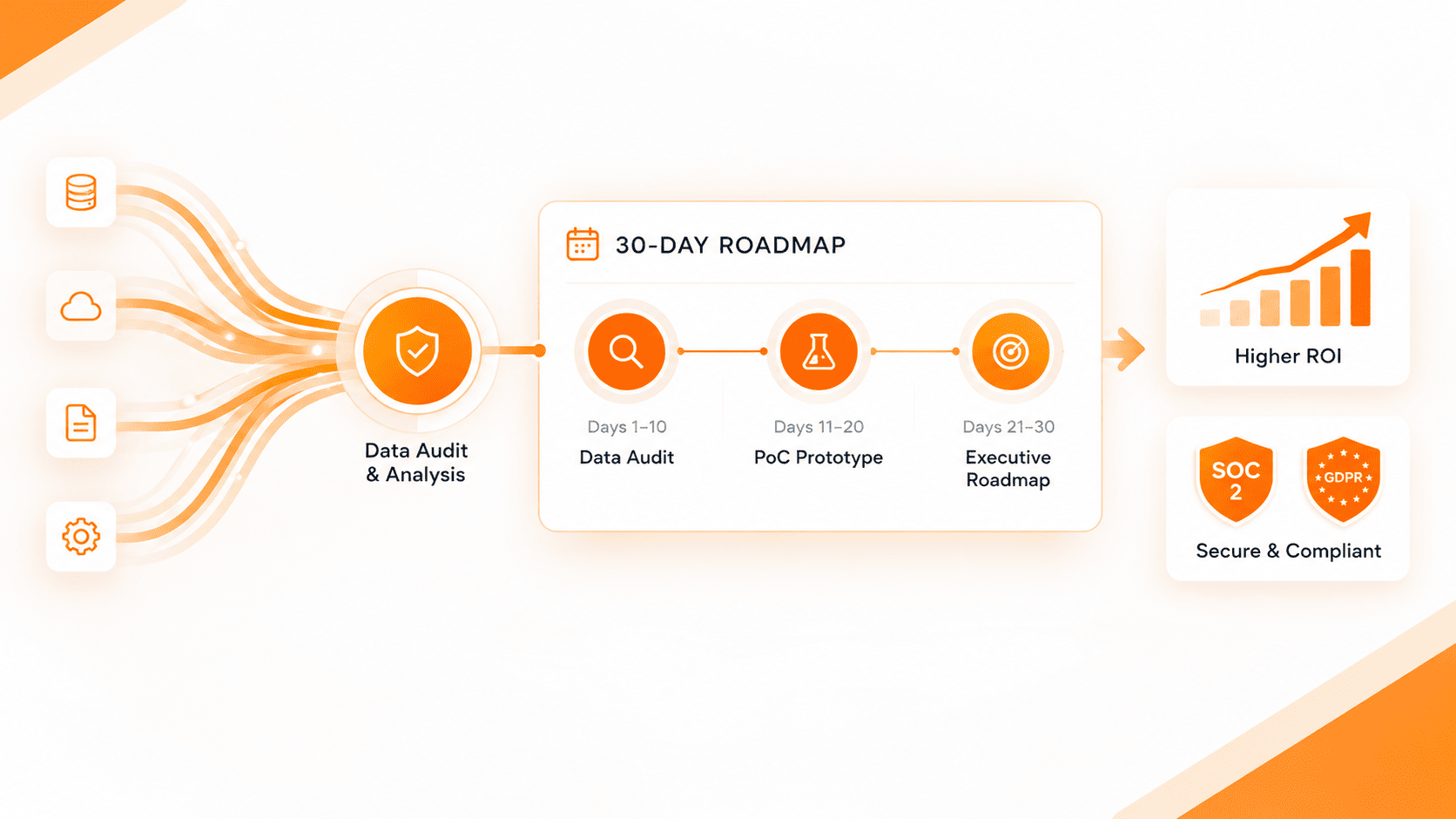
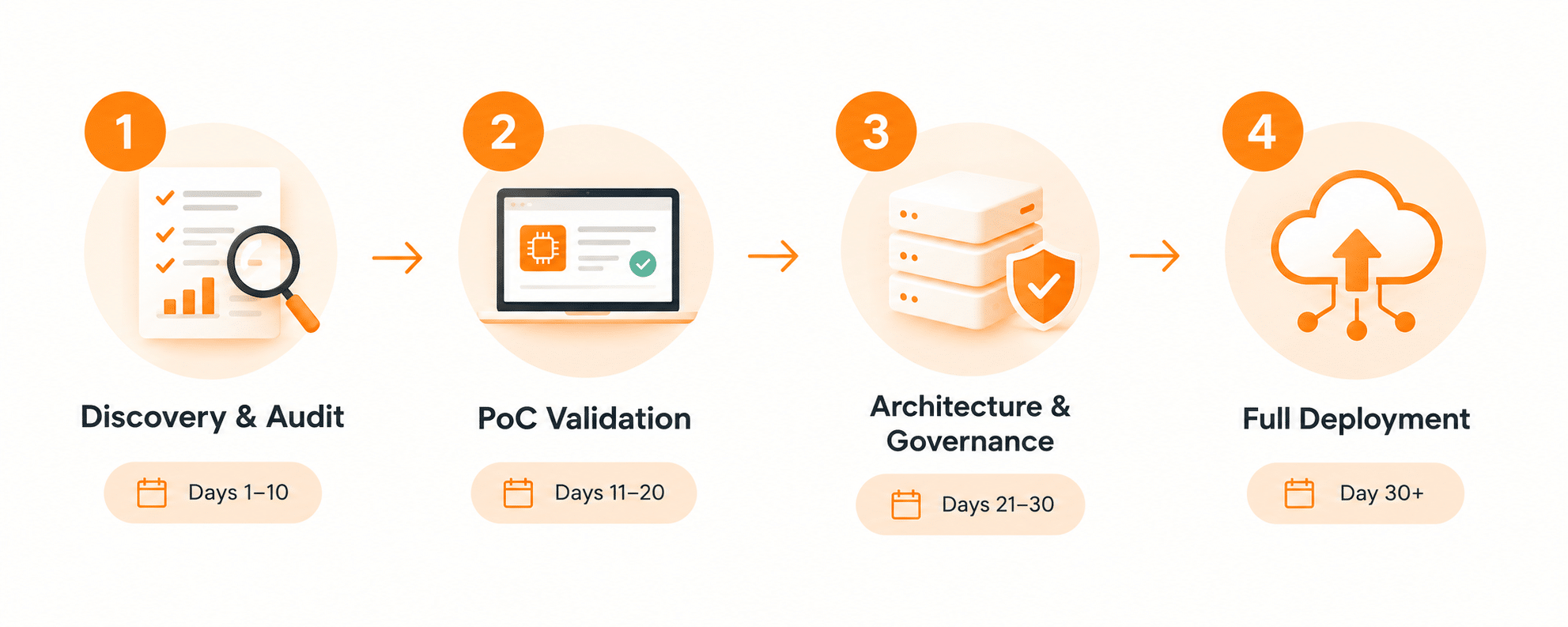
To ensure your investment yields tangible results, expect your AI consulting company to execute across three distinct 10-day sprints:
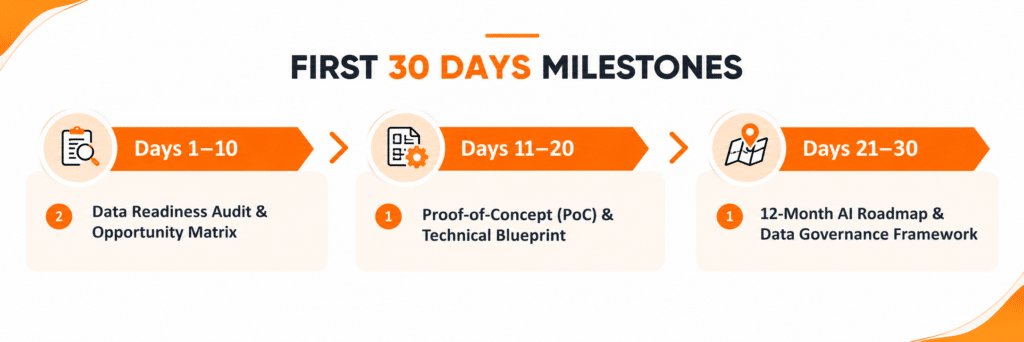
1. First ten days: Evaluation of Data Readiness & Discovery of Opportunities
Leading AI consulting firms would not implement any predetermined framework right from day one. They first assess the challenges within your processes before performing a thorough data health inspection.
- Data Health Assessment & Pipeline Audit – This refers to the assessment of data structure, cleanliness, accessibility, as well as security compliance.
- High-Impact Use Cases Matrix – It refers to the list of possible AI projects ranked according to their expected financial outcomes as well as the level of required technical experience.
- Basic Financial Modelling – Identifying the basic parameters related to savings of time, error reduction, and increase of revenue.
2. From days eleven to twenty: Evaluation of Feasibility & Development of Architecture Design
During the second sprint AI consulting companies move from abstract concepts to practical validation.
- Proof of Concept Framework (PoC) – This idea involves establishment of a prototype for checking whether the idea and implementation work.
- System Architecture Roadmap – This refers to the plan for the cloud architecture, API integration and vector database.
- Selection of Vendors and Tools – This means giving important advice with regards to the application of already existing LLM APIs and open-source models.
3. Days 21-30: Roadmap and Governance Framework
The last sprint converts technical discoveries into an action plan ready for executives and establishing clear compliance capabilities.
- 12-Month Scalable AI Roadmap – Determining specific phases of deployment and necessary internal resources as well as KPIs.
- AI Governance Policy – Defining requirements for privacy laws, regulation standards (GDPR, CCPA, EU AI Act), and IP protection.
- Executive Alignment Brief – Making effective pitches to the board of directors and important stakeholders of the company.
💡 Is your data stack ready for custom AI deployment?
Don’t spend months experimenting without clear ROI. Book a Free AI Audit with our strategy team to evaluate your data readiness and identify your top high-impact workflows.
Prominent Examples of Applications for Businesses
Companies that reap favorable returns on investments in the market place much emphasis on specific actions where artificial intelligence consulting plays significant roles in minimizing the manual contributions needed
1. Retail and E-commerce Activities
Automated processes consist of tracking of customer orders, approving requests for future supply of goods, and managing a customer service department. When collaborating with a retail internet seller we introduced processes aimed at managing data related to the company’s operations allowing the store to cut its number of returned orders up to 30%.
2. Finance and Operations
One of the recent implementations made by financial specialists gives evidence of the enormous possibilities for companies using automated systems for extracting information from invoices, orders, and bank statements and marking discrepancies for employees to pay attention to.
3. Sales Operations
By connecting smart agents to the CRM systems it became possible to identify the character of inquiries, build customer profiles, and prepare proposals for customers without human involvement.
4. Supply Chain Management
For example, the development of transportation processes was made possible by integrating carrier API systems into the organization’s system knowledge base and notifying account managers about unfortunate events that may have occurred.

For a deeper dive into modern strategy frameworks, review our comprehensive Enterprise AI Strategy Guide or learn more about our hands-on Custom AI Development Services.
The Non-Technical Leader’s Guide to 30-Day Delivery
Executing a successful consulting engagement doesn’t require technical expertise—it requires defining business outcomes, establishing governance, and maintaining clear oversight.
As NVIDIA CEO Jensen Huang emphasized during a recent global leadership address:
“It’s very clear that AI is going to impact every industry. Every nation and enterprise needs to make sure that applying AI effectively becomes a core part of their strategy.”
First Step – Focus on Certain Workflows
Instead of trying to accomplish a general objective like “implementing AI in the customer support field,” it is better to zero in on one specific and well-defined workflow that will yield predictable and quantifiable results, such as “automating the detection of invoice mismatches.”
Second Step – Set Up Operational Boundaries
Be specific about what systems can be used. Determine what software databases the consultants’ team has access to, what systems they are allowed to modify, and what operational levels require signing off manually.
Third Step – Pick the Way of Deployment
- Pre-Packaged Integrations: It is the quickest way to get systems implemented within native software suites but has fewer possibilities in real customization and long-term sustainability.
- Tailored AI Solutions – Customized systems built on the basis of your own data and security specifications that provide better scalability and independence from the technical side of the issue.
Fourth Step – Test with a Managed Pilot
Trial early prototypes together with your operational team. Evaluate efficiency, speed of execution, error rates, and frequency of human intervention before making a full-scale deployment decision
🚀 Accelerate Your AI Strategy
Ready to move from idea to execution with a proven partner?
Explore our Enterprise Machine Learning Services to see how we help market leaders build scalable, secure AI systems.
Mitigating Risk: Security, Governance, and Compliance
When working with an AI consulting firm, it is important to prioritize these operations to secure your sensitive information
- Data Protection & Privacy – You have to assess your partner’s ability to employ the needed Controls Based on Role (RBAC) and operate in accordance with the SOC 2.
- Regulations – You have to make sure that your anticipated infrastructure abides by the rules represented in the NIST AI Risk Management Framework Documentation and other regulations.
- Accurate ROI – Research by McKinsey & Company Tech Insights states that it is critical for any initiative to set KPIs beforehand to guarantee that the project is successful. As a result, it is important to measure the times for processing cycles, the cost of each transaction, and the error rate for the first 30 days after the implementation.
Checklist for Deliverables to Clients in 30 Days
Employ this checklist in order for your AI consultancy firm to complete all the work in the first month of cooperation with you
☑ Start of executive engagement and project discovery.
☑ Start of executive engagement and project discovery.
☑ Hierarchized AI use case matrix (Impact vs Complexity).
☑ Results of a proof-of-concept (PoC) trial.
☑ Technical plan of integration and architecture.
☑ Security, privacy, and regulatory compliance system.
☑ Approved timeline of implementation within 12 months with measurable KPIs.
Frequently Asked Questions (FAQs)
During the first month, an AI consulting firm will provide a data health report, an impact vs. effort use case matrix, a functional proof of concept (POC), technical architecture, and a one-year executive implementation plan.
Well known AI consultancies require companies to sign an NDA prior to reviewing their access, implement role-based access control systems (RBAC), test in a sandboxed environment, and follow such regulations as SOC 2, GDPR, and CCPA completely.
Although it takes 3-6 months for an enterprise to be fully deployed, the strategic vision and validation of the project is ensured during the first month. The companies usually start delivering first working models by the endpoint of the second month or in the beginning of the third month.
Not at all. Good AI consulting companies work with executives, founders and managers who are responsible for relevant data management, data architecture, and integration.
Transform Your Business Operations
Stop experimenting without a roadmap. Start scaling with clear technical validation.
Schedule a tailored 30-minute session with our principal architects to review your data stack and map your 30-day delivery plan.