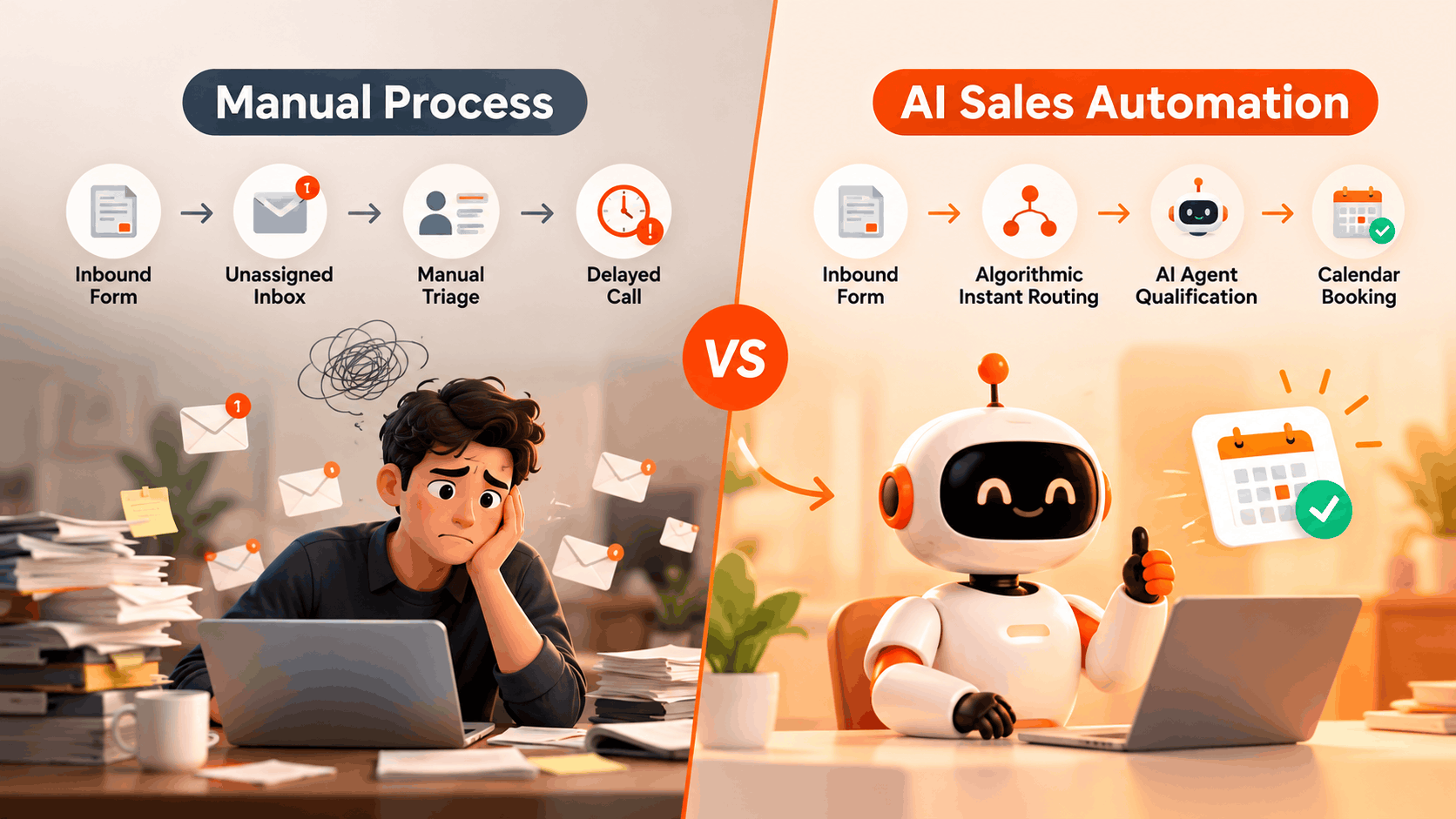
If your sales force is spending hours arranging leads, transferring information from one platform to another, and trying to contact leads that never answer, then your growth is physically capped. In the current competitive marketplace, new customers expect instant communication. The moment a possible client fills out a request form on your website, even a delay of five minutes can cause you to lose them to a competitor that provides a quicker response.
But fortunately, AI sales automation is revolutionizing the way modern companies are managing the speed of sales. With the help of replacement of the boring manual work by the use of artificial intelligence solutions, the companies can capture, identify, direct and grow the leads easily, once the work is fully automated.
In this informative and practical guide, we explain how artificial intelligence sales automation works through all stages of the sales funnel and how the usage of the special ai solution and ai services could help your company to increase the revenue at the lower costs.
As Salesforce CEO Marc Benioff noted when discussing the evolution of modern enterprise productivity and autonomous workflows
“The next generation of CRM isn’t just about recording what happened; it’s about intelligent agents acting autonomously to drive customer success and revenue acceleration across every single touchpoint.”
Research Insight – According to benchmark research highlighted in the Harvard Business Review Study on Lead Response Management, companies that contact inbound prospects within the first 5 minutes are 21 times more likely to qualify that lead compared to waiting just 30 minutes. Furthermore, separate data shows that 78% of buyers purchase from the first business to respond, making automated speed-to-lead execution an absolute necessity for revenue teams.
The Hidden Drag of Manual Pipeline Management
Let’s face it, traditional sales work involves a ton of redundant tasks that take up a lot of time. Because of this, sales reps spend a lot more time doing activities that don’t generate revenue than they do communicating with customers. As a result, problems arise that hurt the company’s ability to grow. Here are a few examples of this
- Leads that come in don’t get assigned immediately, which means that they go cold.
- Leads that would have converted do not because they spend too long waiting for a sales rep to qualify them.
- Email campaigns get bogged down because an employee forgets to send them.
- Great customer information gets stuck in different systems (spreadsheets, email inboxes, etc.).
When an automated workflow is set in place, these problems cease to exist. Technology does the boring work, ensuring that every lead gets the attention it deserves.
Wondering where your pipeline is losing momentum? Book a Free 15-Minute Automation Audit with our strategy team to uncover your top revenue bottlenecks.
Step 1 – Fast Capture of Leads and Intelligent Routing
The essence of a successful revenue engine is speedy lead response. Research on customer behavior shows that responding to the inquiry in 5 minutes greatly increases the likelihood of closing the business deal . Using an internal information system may decrease closing chances significantly, even every minute of delay causes savings in the sales process.
How Does Automated Routing Function
A fast automated lead routing system does not just distribute incoming clientele into the general list. It utilizes predefined business rules to collect the information and processes data in a fraction of a second
- Geographical Distribution – Lead originating from another country is routed to the correct representative, considering active time zones and language competencies of the regional salesperson.
- Business Size and Revenue Segments – Identify if it is a huge company or a small business to redirect inquiries to the right sales department.
- Lead Behavior Analysis – It allows matters to unify correspondence of the clients downloading technical papers, white papers, or price lists to the person responsible for the specific product field.
When studying how to conduct automated routing, it is important to know how to divide the leads according to clear criteria.
Step 2 – Filtering Leads with Smart AI Sales Agent
Once the lead has been processed and is on the right path, the main challenge becomes filtering. Not every query has the authority or budget to buy right now. Putting expensive sales representatives to manually examine all low-intent leads puts lots of pressure on the team and wastes hours of productive time every quarter.
This is when the ai sales assistant changes the approach in your work. Unlike the traditional chatbots that only ever use “if/then” scenarios, modern conversational agents rely on advanced natural processing and provide users with dialogues in web chat, e-mail, or SMS.
What the AI Agent Can Do
- Asks the Right Qualification Questions – The agent dynamically figures out the prospect’s exact pain, budget limits and purchasing timelines without sounding like an interrogator.
- Handles Difficult Objections – The agent provides correct information and instant answers about the security of the products, integrations, etc.
- Schedules Visits – The moment the prospect meets the desired profile, the agent checks your team’s calendar and schedules the discovery call.
For a closer look at real-world implementation, see how our e-commerce client doubled their conversion rate using automated qualification workflows.
Ready to see how an autonomous agent handles your inbound leads? Explore our interactive agent demos and test a live conversation yourself.
Step 3 – Cultivating Leads Through Multi-Channel Follow-Up Sequences
The majority of B2B and e-commerce transactions don’t take place at the first interaction. They require thoughtful and value-driven nurturing over a timeframe of several days or weeks. Unfortunately, a lot of the time follow-ups break down due to the fact that sales reps become bogged down dealing with active deals and managing their pipeline.
With the help of automated follow-ups, no lead ever misses out on a great offer. Good nurturing relies on hyper-personalization and behavioral triggers, not on generic automated spam messages.
Tips for Effective Sequences for Conversion
- Using Various Channels – Use timed LinkedIn connection messages and SMS reminders in conjunction with automated email follow-up sequences in order to maximize engagement and avoid annoying the buyer.
- Value-Driven Messaging – Provide useful information and integrate it into each message instead of asking simple follow-up questions like “How are things?”
- Behavior-Based Triggers – If a lead visits your pricing page twice after a demo, automatically send them a targeted email with relevant case studies or custom ROI calculators.
Step 4 – Expanding with Specialized AI Automation Service Providers
Creating an efficient and effective sales machine goes beyond simply activating some software tools. In order to successfully connect your CRM system, email marketing platform, lead scoring method, and chat platform, you need to lay out a plan, perform extensive testing, and continuously improve data.
This is why some successful companies choose to engage the services of specialized expert organizations that provide AI automation. Such AI implementation expeditors help businesses with the following tasks
- Examine the existing sales technology stack to determine whether there are any gaps in integration or any potential data leaks.
- Create custom webhooks and API links that connect your website, databases, and communication platforms.
- Provide directions to your staff on how to properly operate the automated systems while keeping business processes intact.
When architectured correctly, these systems run continuously in the background, driving predictable revenue while your team focuses exclusively on closing deals and building relationships.
Frequently Asked Questions (FAQs)
This is not a correct assumption, since the current technology uses sophisticated natural language models and dynamic data fields to guarantee that each interaction is personalized and meaningful.
Simple email nurturing processes may be set up in a few days, while creating a fully integrated infrastructure including synchronization of CRM systems, intelligent routing of leads, and AI agents may take from 2 to 4 weeks depending on how complicated your technology is.
No. Most modern automation systems have user-friendly visual design interfaces that make it easy for sales managers to modify rules, tags, and sequences without any programming skills.
A number of companies have demonstrated significant reduction in lead response time from several hours to a few seconds, which has led to better conversion rates and overall improvement in the efficiency of their sales processes.
Ready to Transform Your Sales Pipeline?
Stop letting manual administrative work and slow response times stunt your company’s growth. Implementing intelligent lead routing and automated follow-up sequences is the fastest path to scaling revenue predictably.
Request a Custom Live Demo Today to discover how we can build a high-performing sales engine for your business.