Artificial intelligence is no longer reserved for large enterprises. Today, small and medium-sized businesses (SMBs), SaaS companies, and eCommerce businesses are using AI to automate operations, improve customer experiences, optimize workflows, and drive sustainable growth. Yet many organizations struggle to achieve measurable results—not because AI lacks potential, but because they adopt it without a clear business strategy.
This is where an AI consultant creates real value.
An AI consultant does far more than recommend AI tools or build chatbots. They evaluate business challenges, identify high-impact AI opportunities, and develop a roadmap that aligns technology AI investments with business goals. Rather than focusing only on AI tools, they help organizations make strategic decisions that maximize ROI while reducing implementation risks.
Table of Contents
Why Are AI Consultants Becoming Essential for SMBs, SaaS, and eCommerce Businesses?
The rapid growth of platforms like OpenAI, Anthropic, Google Gemini, and open-source AI models has made artificial intelligence more accessible than ever. However, implementing AI successfully is no longer the biggest challenge. The real challenge is knowing where, when, and how to apply AI to create measurable business value.
Many small and medium-sized businesses (SMBs), SaaS companies, and eCommerce businesses struggle with:
- Disconnected data across CRM, ERP, eCommerce, product, and customer support systems
- Manual workflows that are difficult to automate efficiently
- AI initiatives without clearly defined business objectives or measurable ROI
- Security, privacy, and regulatory compliance concerns
- Multiple AI tools with overlapping capabilities and unclear use cases
- Complex integrations with existing applications and business processes
A common mistake is adopting AI technology before defining the underlying business problem. Successful AI adoption starts with understanding operational bottlenecks, business priorities, data readiness, and opportunities for automation. AI consultants provide this strategic foundation, helping organizations prioritize high-impact AI initiatives that deliver measurable business outcomes instead of chasing the latest AI trends.
What Does an AI Consultant Actually Do?
An AI consultant helps businesses transform operational challenges into practical AI solutions that deliver measurable business value. Rather than focusing solely on AI models or technology, they work across business strategy, operations, data, and technology to ensure AI investments align with organizational goals and solve real business problems.
Their responsibilities typically include:
- Assessing AI readiness across people, processes, data, and technology
- Identifying workflow automation and process improvement opportunities
- Prioritizing high-impact AI use cases based on business objectives and ROI
- Developing AI implementation roadmaps with clear milestones
- Recommending the most suitable AI tools, platforms, and technology stack
- Supporting AI adoption across teams and business functions
- Establishing KPIs and measuring business outcomes after implementation
Whether working with small and medium-sized businesses (SMBs), SaaS companies, or eCommerce businesses, the goal isn’t simply to deploy AI. It’s to improve operational efficiency, enhance customer experiences, reduce costs, and create sustainable business growth through a well-defined AI strategy.
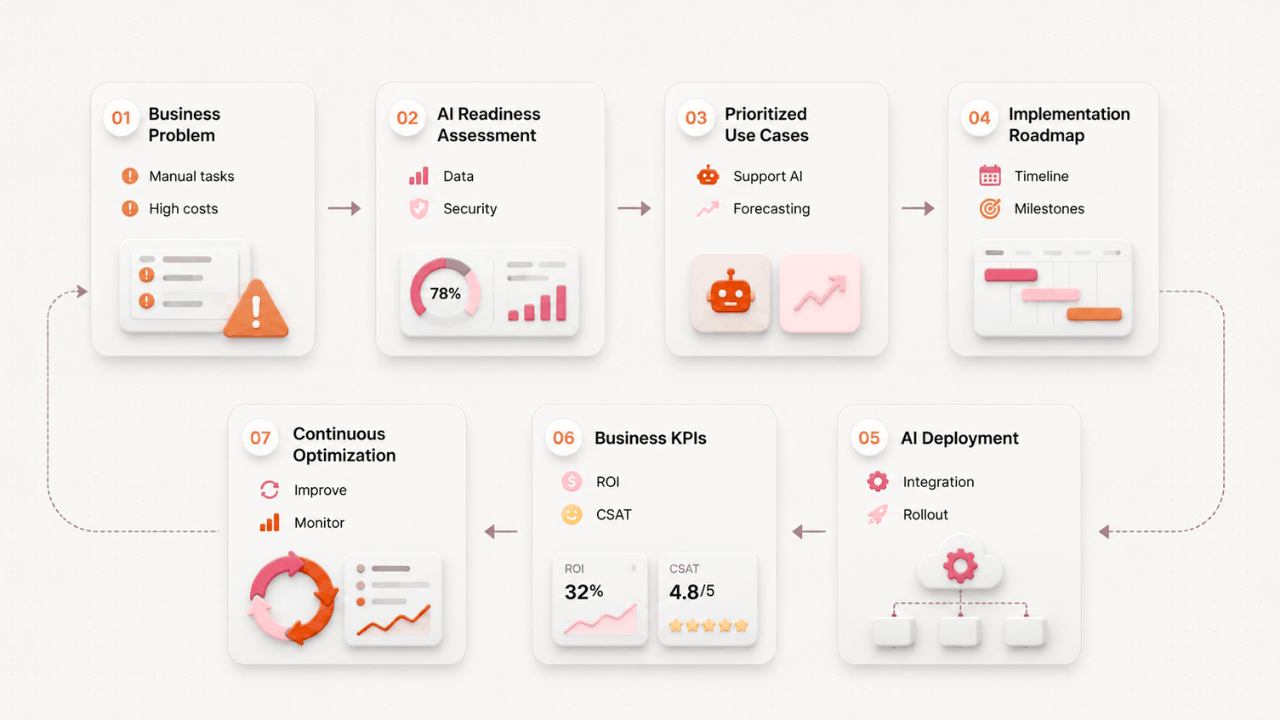
The Gigaflop AI Consulting Framework
At Gigaflop, AI adoption follows a structured process rather than isolated technology decisions. The consulting framework focuses on six stages
| Phase | Business Outcome |
| Discover | Understand business goals, workflows, and operational challenges. |
| Assess | Evaluate AI readiness, data quality, infrastructure, and governance. |
| Prioritize | Identify AI use cases based on ROI, feasibility, and implementation effort. |
| Build & Integrate | Implement AI solutions that fit existing systems and workflows. |
| Scale | Expand successful AI initiatives across teams and business functions. |
| Measure | Track KPIs, adoption, operational improvements, and long-term ROI. |
This structured approach ensures every AI initiative aligns with broader business objectives instead of becoming a standalone technology project.
Gigaflop’s AI Consulting Framework

🧭 Not sure where to start with AI?
Every successful AI initiative begins with a clear roadmap not with choosing a model.
✔ Identify high-impact AI opportunities
✔ Assess your data readiness
✔ Prioritize projects based on ROI
What Problems Does an AI Consultant Solve?
AI consultants solve business challenges—not just technical ones.
1. Identifying High-Impact AI Opportunities
Not every repetitive task requires AI. In many cases, process improvement or automation delivers better results than building a custom AI solution.
AI consultants evaluate business workflows and identify opportunities with the highest business impact, such as customer support, sales, inventory management, marketing automation, internal knowledge management, and order processing. Prioritising these use cases helps businesses achieve faster results while reducing implementation risk.
2. Assessing AI Readiness
Many AI initiatives fail because businesses overlook data quality, technology readiness, and operational maturity.
Before recommending any solution, AI consultants assess:
- Data availability and governance
- Existing technology infrastructure
- Security and compliance requirements
- Team capabilities
- Integration complexity
This assessment identifies potential gaps before significant investments are made, reducing project risk and improving implementation success.
3. Building an AI Strategy
Businesses that implement AI without a roadmap often end up with disconnected projects and duplicated effort.
An AI consultant develops a structured strategy covering:
- Business objectives
- AI use cases
- Technology recommendations
- Budget planning
- Implementation timeline
- Success metrics
- Risk management and governance
This roadmap gives decision-makers a clear direction and helps ensure AI initiatives remain aligned with long-term business goals.
What Skills Does an AI Consultant Need?
An effective AI consultant combines business knowledge with technical understanding.
Business Strategy
Technology decisions should always support business outcomes. AI consultants need to understand business models, growth strategies, customer acquisition, operational efficiency, revenue generation, and customer retention across SMBs, SaaS companies, and eCommerce businesses. Whether the goal is improving customer experiences, streamlining operations, or increasing profitability, AI investments should solve real business challenges rather than simply introduce new technology.
AI and Machine Learning Fundamentals
Modern consultants should understand technologies including Large Language Models (LLMs), AI Agents, Retrieval-Augmented Generation (RAG), Model Context Protocol (MCP), NLP, Computer Vision, Recommendation Systems, and Predictive Analytics. Equally important is knowing when these technologies are appropriate and when traditional automation or software solutions are more effective.
Data Engineering and AI Infrastructure
Reliable data is the foundation of successful AI. Consultants should understand data warehousing, ETL/ELT pipelines, vector databases, Snowflake, data governance, API integrations, cloud platforms, and data security to ensure AI solutions are scalable and sustainable.
Communication and Change Management
AI adoption depends on people as much as technology. Consultants work closely with business owners, leadership teams, operations, sales, IT, and customer support teams across SMBs, SaaS companies, and eCommerce businesses, translating complex AI concepts into clear business decisions and helping teams adopt new ways of working.
Where are you in your AI journey?
AI Consultant vs AI Engineer, Understanding the Difference
Although these roles work together, they serve different purposes.
An AI consultant focuses on business strategy by identifying AI opportunities, defining implementation roadmaps, measuring ROI, and aligning AI initiatives with organizational goals.
An AI engineer, on the other hand, focuses on technical execution. They build, deploy, and optimize AI models while working closely with engineering teams.
In successful AI projects, consultants determine what should be built and why, while engineers decide how to build it effectively.
| AI Consultant | AI Engineer |
| Primary Focus- Business strategy and AI transformation | Primary Focus- Designing, building, and deploying AI systems |
| Identifies business problems that AI can solve | Develops AI models, applications, and workflows |
| Conducts AI readiness assessments | Builds and trains machine learning models |
| Prioritizes AI use cases based on ROI | Integrates AI models into products and applications |
| Creates AI implementation roadmaps | Optimizes model performance and inference speed |
| Recommends AI tools, platforms, and architecture | Develops APIs, pipelines, and production infrastructure |
| Defines KPIs and success metrics | Monitors model accuracy, latency, and reliability |
| Works closely with founders, executives, and business teams | Works closely with developers, data scientists, and DevOps teams |
| Focuses on business outcomes such as efficiency, cost savings, and growth | Focuses on technical outcomes such as scalability, accuracy, and performance |
| Measures ROI and adoption after implementation | Monitors deployed models and continuously improves them |
How Do You Measure the Success of an AI Consultant?
The success of an AI consultant isn’t measured by the number of AI models or tools deployed it’s measured by the business outcomes those initiatives deliver. Effective AI consulting helps organizations improve efficiency, reduce operational costs, enhance customer experiences, and accelerate growth.
Key performance indicators (KPIs) commonly used to measure success include
| KPI | Why It Matters |
| AI Adoption Rate | Measures how effectively employees are using AI-powered tools and workflows. |
| Time-to-Value | Tracks how quickly AI initiatives begin generating measurable business results. |
| Process Automation Rate | Evaluates how many repetitive workflows have been automated. |
| Engineering Productivity | Measures improvements in development speed and operational efficiency. |
| Customer Support Resolution Time | Assesses how AI reduces response and issue-resolution times. |
| Customer Satisfaction (CSAT) | Indicates whether AI improves the customer experience. |
| Cost Savings | Quantifies operational efficiencies created through AI implementation. |
| Revenue Influenced by AI | Measures AI’s contribution to customer acquisition, retention, or upselling. |
| AI Model Accuracy | Ensures deployed AI systems provide reliable outputs. |
| Employee Adoption | Evaluates how successfully teams embrace AI-powered workflows. |
The most successful consulting engagements balance technical performance with measurable business impact, ensuring AI investments translate into tangible results rather than isolated technology deployments.
AI Consultant vs AI Strategist vs AI Engineer
As organizations expand their AI capabilities, these three roles often work together but serve different purposes.
An AI Consultant identifies business problems, prioritizes AI opportunities, develops implementation roadmaps, measures ROI, and works closely with business leaders to ensure AI aligns with organizational goals.
An AI Strategist focuses on long-term AI vision, governance, and enterprise-wide planning. They define strategic direction, prioritize transformation initiatives, and help leadership shape AI adoption across the organization.
An AI Engineer is responsible for technical execution. They design AI architectures, develop applications, deploy models, optimize performance, and integrate AI into existing systems.
For many small and medium-sized businesses (SMBs), SaaS companies, and eCommerce businesses, an AI consultant is often the first expert engaged because they determine whether AI is the right solution before implementation resources are committed.
What Does an AI Consultant Deliver?
A successful AI consulting engagement should give businesses a clear, actionable execution plan, not just a list of AI ideas or technology recommendations. The goal is to help organisations move from AI experimentation to practical implementation with measurable business outcomes.
Typical deliverables include:
- AI Readiness Assessment to evaluate current capabilities
- AI Opportunity Matrix to prioritise high-impact use cases
- Business Process Analysis to identify automation opportunities
- Customer Journey and Workflow Assessment for SaaS and eCommerce operations
- AI Implementation Roadmap with phased milestones
- Technology Stack Recommendations based on existing systems and budget
- Data Readiness Assessment to evaluate data quality, accessibility, and governance
- AI Governance and Security Guidelines to support responsible AI adoption
- Risk, Privacy, and Compliance Recommendations for regulated environments
- ROI Forecast and Cost-Benefit Analysis to estimate business impact
- KPI Dashboard for ongoing performance measurement and optimisation
These deliverables help leadership teams make informed decisions, reduce implementation risks, and build a structured AI adoption strategy. For small and medium-sized businesses (SMBs), SaaS companies, and eCommerce businesses, this approach provides a practical roadmap for scaling AI initiatives while maintaining operational efficiency, customer trust, and long-term business growth.
Common AI Adoption Mistakes that Limits Business Growth
Many small and medium-sized businesses (SMBs), SaaS companies, and eCommerce businesses begin their AI journey with high expectations but encounter common challenges that delay implementation and limit business results.
1. Prioritizing AI Technology Over Business Goals
One of the most common mistakes is investing in AI tools before clearly defining the business problem. Successful organizations start by identifying measurable objectives, such as improving customer service, increasing sales, streamlining operations, reducing manual work, or enhancing customer experiences. AI should support business strategy—not drive it.
2. Automating Inefficient Processes
AI can significantly improve productivity, but it cannot fix inefficient workflows. Automating broken processes often leads to faster inefficiencies rather than better outcomes. Before implementing AI, businesses should optimize existing workflows to maximize long-term value and operational efficiency.
3. Overlooking Data Readiness
Effective AI depends on accurate, accessible, and well-governed data. Whether it’s customer information, inventory records, sales data, or operational metrics, disconnected systems and inconsistent data can become major obstacles to successful AI adoption. Building a strong data foundation early improves implementation speed, model performance, and long-term business outcomes.
4. Measuring AI Activity Instead of Business Impact
Deploying an AI chatbot, integrating AI into an eCommerce platform, or automating a business process doesn’t automatically create value. Success should be measured by meaningful business outcomes, such as lower operating costs, faster response times, improved customer satisfaction, increased sales, higher operational efficiency, better inventory management, and stronger customer retention.
The Future of AI Consulting
AI consulting is rapidly evolving beyond standalone machine learning projects toward connected, intelligent business systems.
Several technologies are shaping the future:
- AI Agents capable of performing multi-step tasks with minimal human intervention.
- Retrieval-Augmented Generation (RAG) enables AI systems to retrieve information from trusted knowledge bases before generating responses.
- Model Context Protocol (MCP) improves communication between AI models, business tools, and existing systems.
- AI Governance helps businesses maintain security, compliance, transparency, and responsible AI practices as AI adoption grows.
Consultants increasingly help small and medium-sized businesses (SMBs), SaaS companies, and eCommerce businesses evaluate these technologies and identify where they deliver measurable business value rather than adopting them simply because they are new.
Frequently Asked Questions
AI consulting delivers value across a wide range of industries and business sizes. Small and medium-sized businesses (SMBs), SaaS companies, eCommerce businesses, healthcare providers, financial services, logistics, manufacturing, and professional services can all benefit from AI strategy, workflow automation, data-driven decision-making, and operational efficiency improvements.
Yes. Small and medium-sized businesses often operate with limited budgets and resources, making it important to prioritize AI initiatives that deliver measurable business value. An AI consultant helps identify high-impact opportunities, create an implementation roadmap, and avoid unnecessary investments in AI tools or custom development.
AI consultants help eCommerce businesses identify practical AI use cases such as personalized product recommendations, intelligent customer support, demand forecasting, inventory optimization, marketing automation, and fraud detection. They ensure AI investments align with business goals and deliver measurable improvements in customer experience and operational performance.
AI consulting focuses on business strategy, AI readiness, opportunity assessment, governance, implementation planning, and ROI. AI development focuses on designing, building, integrating, testing, and deploying AI solutions based on the strategic roadmap created during the consulting process.
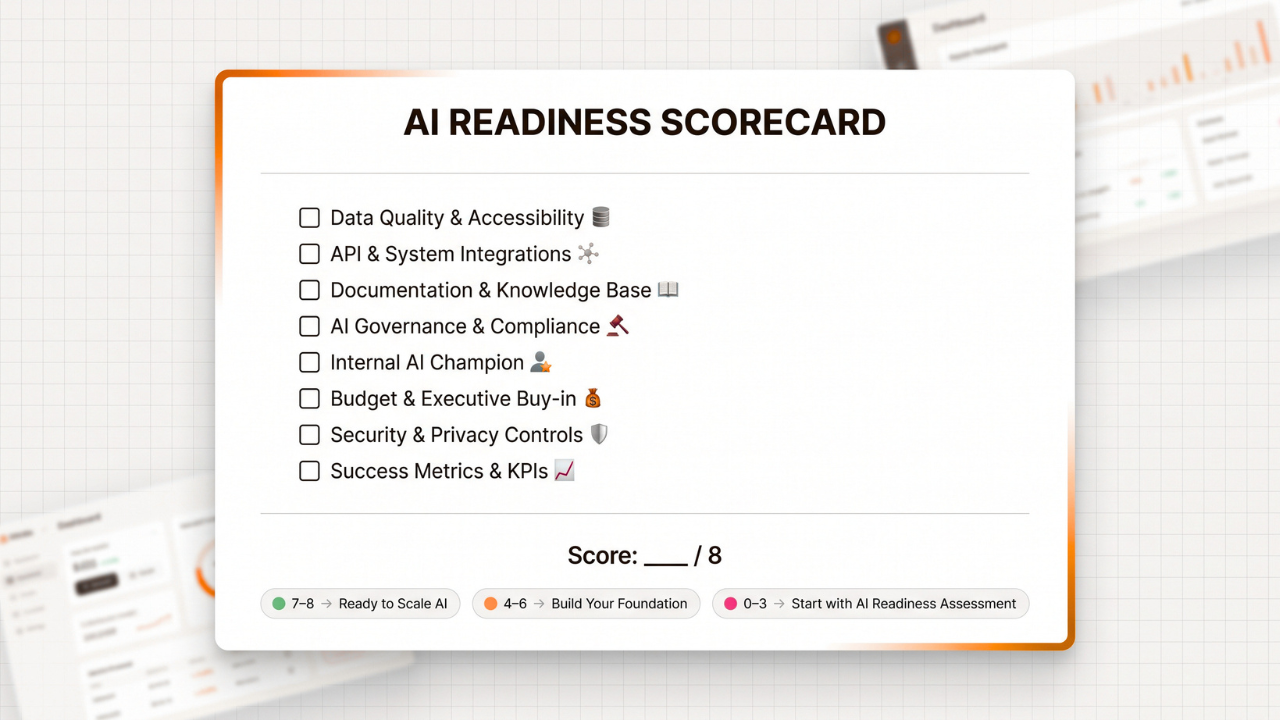
An AI readiness assessment evaluates business objectives, existing workflows, technology infrastructure, data quality, security, governance, and potential AI use cases. The result is a prioritized AI roadmap that helps SMBs, SaaS companies, and eCommerce businesses implement AI with lower risk and greater business impact.
Final Thoughts
Successful AI adoption isn’t measured by how many AI tools or models a business deploys. It’s determined by how effectively those solutions solve real business challenges, improve operational efficiency, and create measurable business value.
An experienced AI consultant bridges the gap between business strategy and technical execution by identifying high-impact AI opportunities, aligning initiatives with organizational goals, reducing implementation risks, and defining measurable KPIs. This structured approach enables organizations to build scalable AI capabilities while maximizing return on investment.
Whether you’re leading a small or medium-sized business (SMB), a SaaS company, or an eCommerce business, the objective isn’t to adopt every new AI innovation. It’s to invest in AI solutions that streamline operations, enhance customer experiences, support data-driven decision-making, and drive sustainable business growth. By following a structured AI Consultant Role Blueprint, organizations can move beyond AI experimentation and transform artificial intelligence into a long-term competitive advantage.
Ready to Turn AI Into Business Growth?
Don’t start with AI tools.
Start with the right strategy.
✔ Discover high-impact AI opportunities
✔ Build a practical implementation roadmap
✔ Align AI investments with measurable business goals
🎯 Free 15-Minute AI Strategy Session