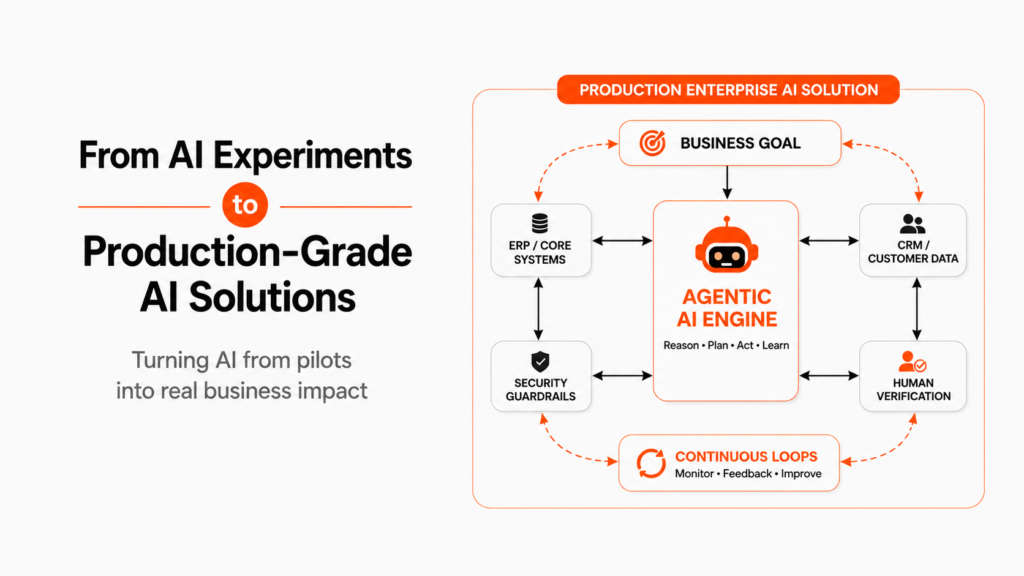
Transitioning autonomous AI agents from local testing environments to real enterprise software necessitates putting in place outstanding execution safeguards. While standard chatbots primarily produce text, leading to relatively limited consequences in terms of hallucinations, autonomous AI agents do more and can perform actual actions, for example, modifying customer relationship management (CRM) records, performing customer refunds, triggering various webhooks, or making changes to SQL databases.
In case of lack of proper architectural supervision autonomous AI solutions become the source of significant operational risk. For instance, prompt injection attacks can modify instructions for the agent, broken tool calls could lead to infinite loops, and also wrong the payload parameters provided by AI could result in damage to valuable data stored in databases.
According to research conducted by Gartner the industry experts predict more than 80 percent of deployments of enterprise agents not equipped with automated guardrail systems will fail to successfully complete security and compliance audits by 2026.
As Anthropic CEO Dario Amodei has emphasized,
“Increasingly capable AI systems need to be developed with safety and control in mind. As AI agents gain the ability to make decisions and take actions, guardrails become essential, not optional.”
This technical guide outlines practical, production-tested guardrail patterns that engineering leaders can implement during ai agent development to secure tool execution, control token burn, and maintain zero-trust data safety.
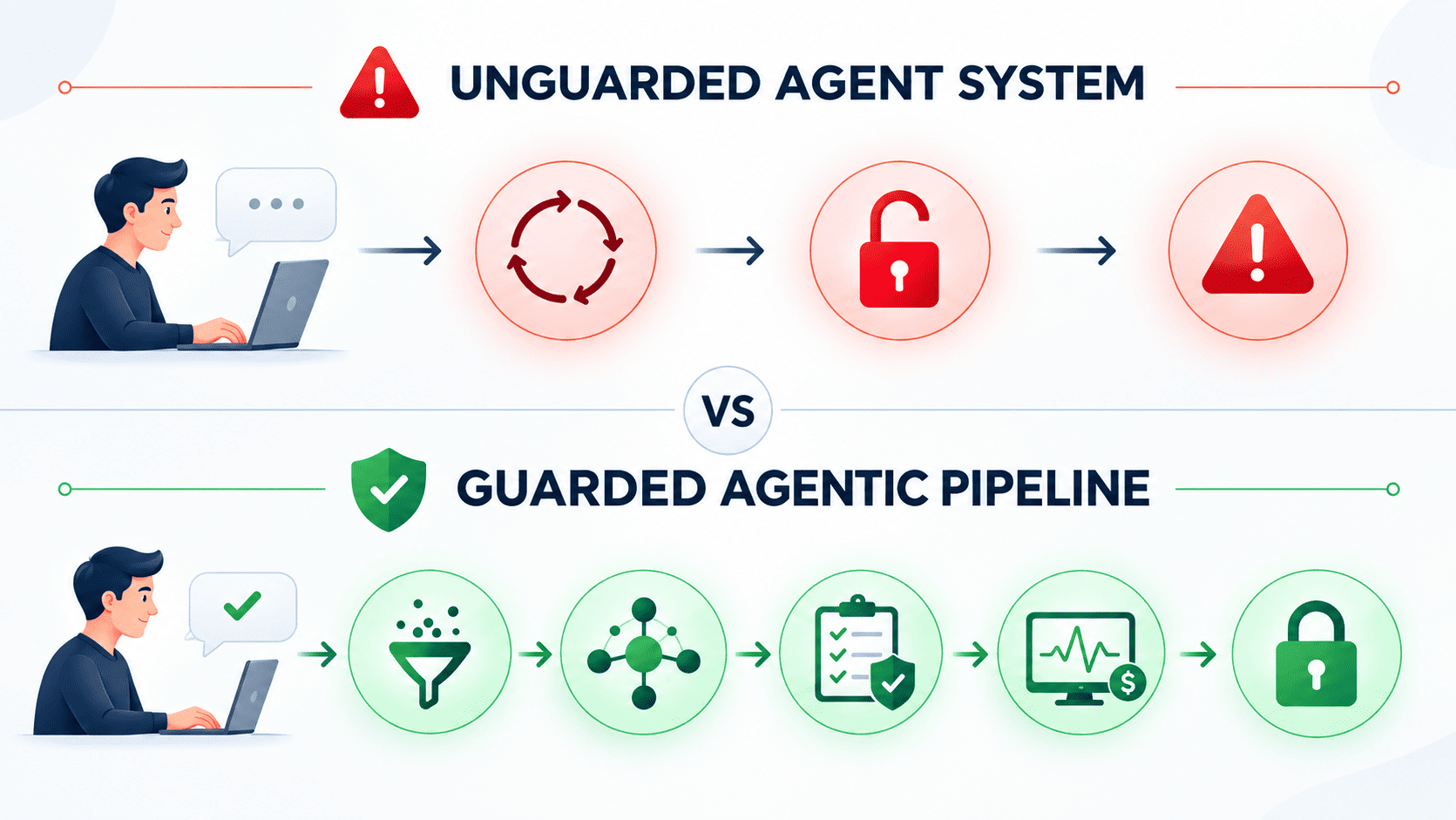
Unguarded vs. Guarded Agent Architecture: A Technical Comparison
Securing autonomous workflows requires adding fixed validation checks between the LLM reasoning process and your software infrastructure.
| Architectural Layer | Unguarded Agent Sandbox | Production-Grade Guarded System |
| Input Validation | Raw user text is directly passed to the system prompt | Input is cleaned before execution, and prompt injection is filtered |
| Tool Execution | Unchecked JSON parameters are sent directly to APIs | Schema validation using Pydantic/Zod and strict type checking |
| Data Permissions | Admin-level database and API service keys | Granular Role-Based Access Control (RBAC) and least-privilege tokens |
| Execution Bounds | Unlimited steps until the model stops | Hard step limits, circuit breakers, and token budget limits |
| High-Stakes Actions | Autonomous write access across all endpoints | Hard step limits, circuit breakers, and token budget limits |
Relying on “prompt engineering” alone to enforce security boundaries is a critical failure pattern. System prompts are soft guidelines, whereas production security requires hard code assertions and zero-trust API validation.
4 Essential Guardrail Patterns for Enterprise AI Systems
Engineering teams scaling AI agent development should add four core guardrail layers directly into their execution pipeline
- Pattern 1 Deterministic Schema & Type Validation
Check the model’s output before sending it to an API. Validate all generated arguments against strict JSON schemas using tools like Pydantic or Zod to catch incorrect data types and missing required parameters. - Pattern 2 Least-Privilege RBAC Gates
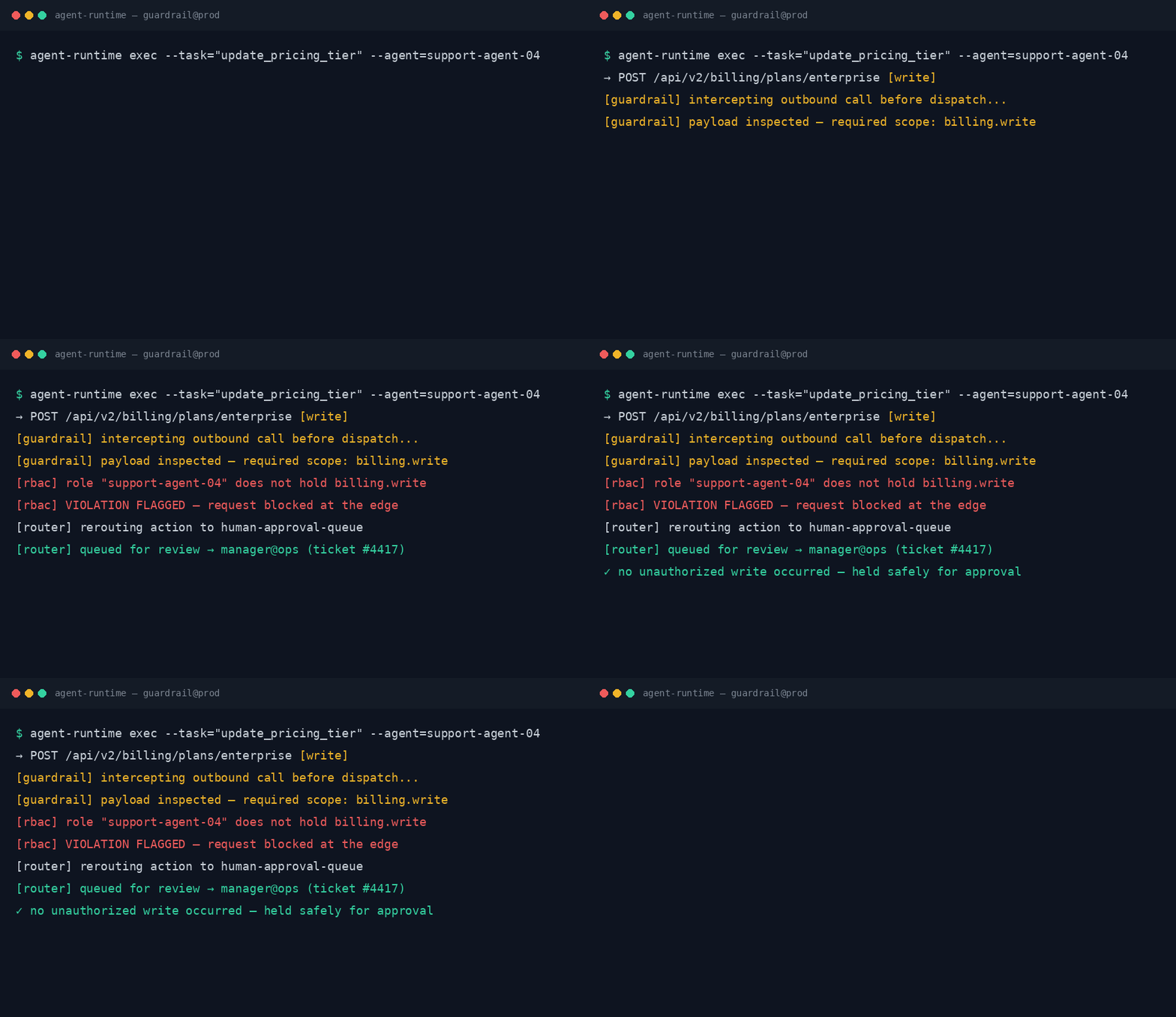
Make sure agents use limited API tokens instead of super-user credentials. An agent that only needs to fetch shipping updates should never have write access to customer billing accounts. - Pattern 3 State-Aware Circuit Breakers
Monitor execution activity in real time. Automatically stop reasoning loops if an agent repeatedly calls the same tool without any state change or goes beyond a set step limit. - Pattern 4 Dynamic Human-In-The-Loop (HITL) Checkpoints
Set conditions that pause execution and send requests to a human approval queue when actions go beyond defined operational or financial limits, such as refunds above $500.
💡 Are unmonitored agent risks delaying your enterprise rollout?
Don’t let security concerns stall your automation strategy. Book a Free 15-Minute Technical AI Audit with our systems architects to review your guardrail stack and secure your deployment pipeline.
High-Impact Guardrail Applications Across Enterprise Workflows
Using targeted guardrails helps prevent serious operational problems in critical business environments:
1. Finance & Payment Reconciliation Workflows
In automated ledger reconciliation, guardrails set strict transaction limits. If an agent finds an unpaid invoice mismatch, it can prepare a reconciliation entry automatically, but any payment approval above $1,000 must require mandatory manager approval.
2. Supply Chain & Logistics Dispatch
Logistics systems use circuit breakers to monitor third-party shipping APIs. If a carrier API returns a 500 error code, the guardrail stops the agent from sending repeated status requests that could quickly lead to IP rate limiting.
3. Customer Operations & Identity Validation
Before an agent reads or changes account data in platforms like SAP or Shopify, input guardrails verify the customer’s identity token and clean the input to protect against indirect prompt injection hidden in incoming emails.
When our team deployed secure operational workflows for enterprise clients, we helped a mid-market enterprise cut manual invoice processing costs by 60% while maintaining full data governance across legacy core systems.
The Engineering Roadmap for Implementing Guardrail Frameworks
Building a resilient safety layer requires embedding deterministic controls across every stage of your development pipeline.
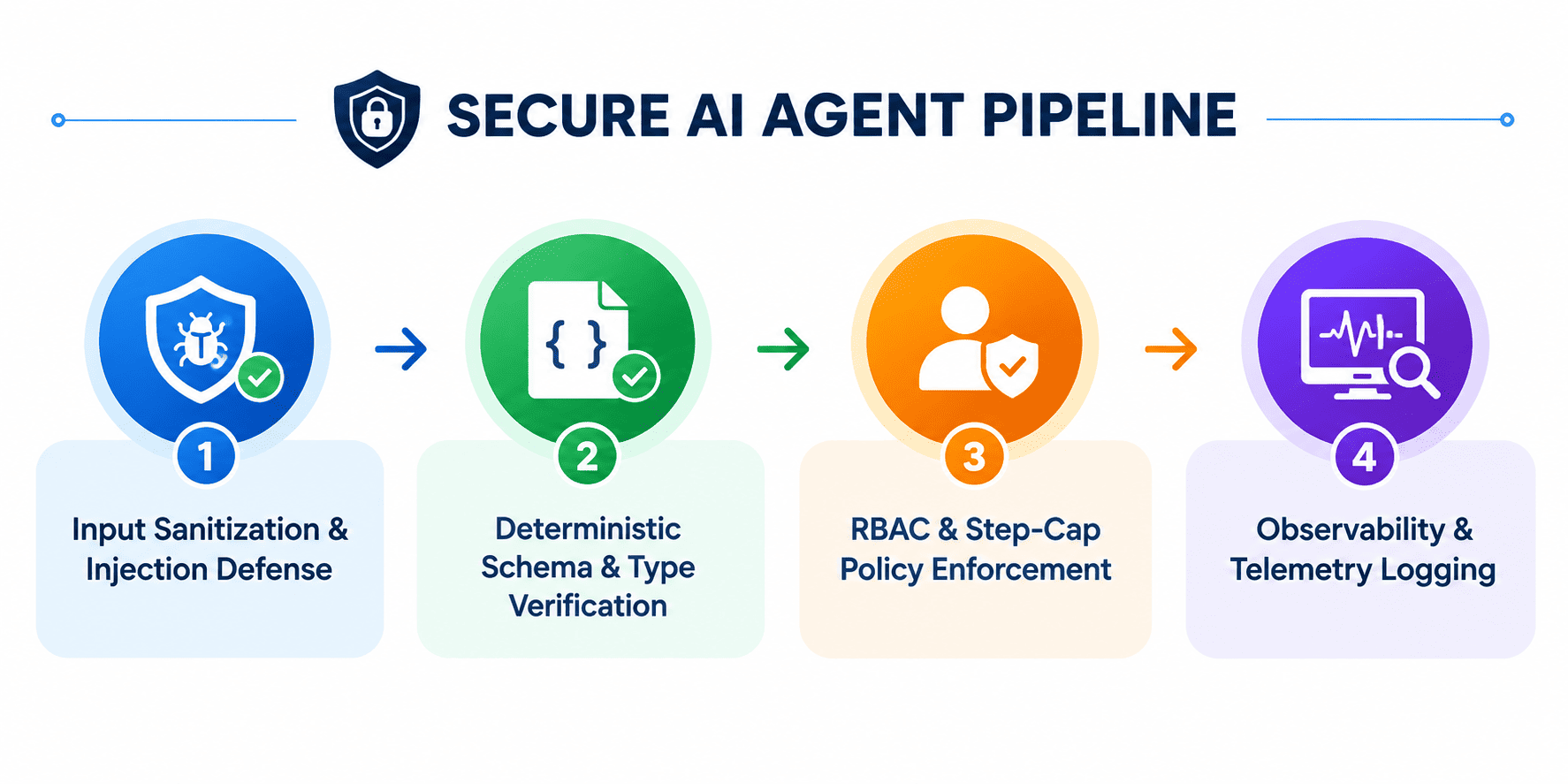
Phase 1 Sanitize Inputs at the Ingestion Gateway
Remove dangerous prompt injection patterns, hidden instructions, and unverified HTML/Markdown from user inputs before they reach the model.
Phase 2 Wrap Tool Libraries in Rigid Schemas
Do not give the agent direct access to raw system calls. Wrap every backend connection in structured interfaces that check data types and reject unexpected arguments.
Phase 3 Enforce Execution & Cost Limits
Set maximum loop limits, such as a maximum of 8 reasoning turns, and strict token spending limits for each workflow run to prevent unexpected cloud costs. Learn more about controlling your execution budget in our guide on scoping your first enterprise AI project.
Phase 4 Deploy End-to-End Tracing Telemetry
Log every step, tool call payload, and safety flag in one centralized observability platform. Use this trace data to continuously review model behavior and update evaluation suites.
🚀 Build Governed, Production-Ready Agents
Ready to deploy secure, highly resilient agentic workflows across your company’s software stack?
Risk Mitigation – Balancing Safety Controls with System Agility
While guardrails are important for security, poorly designed safety rules can reduce system usefulness and slow down normal tasks
- Over-Restrictive Tool Blocking : If validation rules are too strict, they can create many false positives and block valid edge-case API requests. Test guardrail filters using historical trace data before applying the rules to live systems.
- Latency Overhead from Guardrail Models : Using large secondary LLMs as security checks can add significant delay to every step. Use lightweight regex, static schema validators, and smaller models for input and output checks.
- Audit Trail Compliance: According to security analysis from MIT Technology Review, enterprise governance requires keeping immutable, timestamped execution logs for every tool call to pass regulatory audits.
Frequently Asked Questions (FAQs)
Guardrails are software rules, input/output filters, and permission controls placed around large language models. They help control AI actions, prevent prompt injection, check tool arguments, and enforce safety policies.
System prompts are instructions that models may not always follow, especially with complex inputs or malicious prompt injections. Strong security boundaries require code-based validation, type checks, and API access controls.
When an agent plans an action that goes beyond set risk limits, such as deleting database records or sending external emails, the system pauses the action, saves the current state, and sends an approval request to a human manager.
Code-based guardrails, such as JSON schema validation and RBAC policy checks, add very little delay, usually only a few milliseconds. However, using large secondary LLMs as evaluators can add noticeable delays. That is why lightweight, code-first validation is preferred.
Master Custom AI Agent Development with Secure Architecture
Scaling autonomous AI agents across enterprise operations requires moving past basic prompt instructions and adopting robust, engineering-led guardrail patterns. By pairing flexible model reasoning with strict schema validation, RBAC policies, and human oversight, organizations can innovate rapidly while protecting core system integrity.
Ready to build governed, highly reliable agentic architectures for your enterprise?