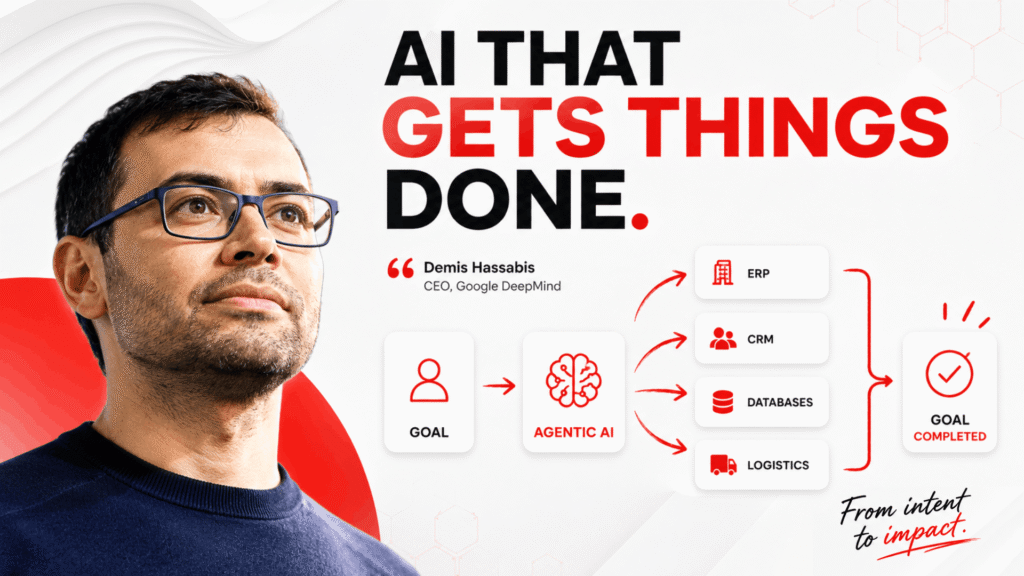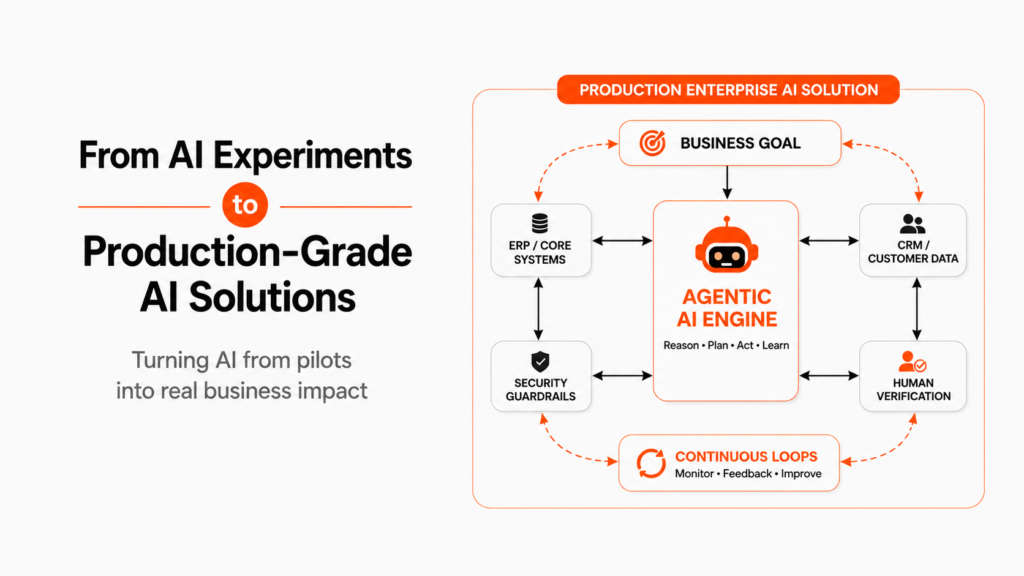
As enterprises scale their AI agents for business into production, API bills can surprise finance leaders. What starts as a predictable $2,000 monthly prototype budget can grow to a $14,000-per-month cost within three quarters, at an effective 7.2x annual compounding growth rate.
This cost increase is not usually caused by query volume alone. Instead, it comes from problems within multi-step agentic workflows, such as large system prompts, sending the same context repeatedly, poorly optimized vector search, and using expensive top-tier models for simple operational tasks.
Recent enterprise software benchmarks from Gartner show that more than 55% of organizations using autonomous workflows will introduce formal LLM FinOps frameworks by the end of 2026 to control rising AI model costs.
As OpenAI CEO Sam Altman has emphasized:
“AI is moving rapidly from experimentation into everyday business use. As organizations deploy more AI-powered applications and agents, the cost of running these systems can become a major operational concern.”
This guide details the technical root causes of token bloat and outlines actionable engineering strategies to reduce API overhead while preserving system performance across your enterprise AI solutions.
Unoptimized vs. Optimized Agent Architecture: Cost Breakdown
Understanding where API budgets burn requires examining how tokens flow through single-turn models versus autonomous agent execution loops.
| Architectural Layer | Unoptimized Agentic System | Optimized Enterprise Stack |
| Model Selection | Uses the same advanced models for every task (e.g., Claude 3.5 Sonnet/GPT-4o) | Uses smaller models for simple tasks and advanced models for complex tasks |
| Context Management | Sends the full system prompt and conversation history every time | Uses shorter context, summaries, and prompt caching |
| Tool Integration | Sends all tool details in every API request | Uses only the tools needed for each task |
| Retrieval Strategy | Searches for many document sections and returns large chunks | Uses better search to return only the most relevant information |
| Caching Layer | Does not cache queries | Uses different types of caching to avoid repeated requests |
When AI agents for business run in unoptimized environments, multi-turn tool loops multiply token consumption exponentially. An agent taking six turns to cross-reference an ERP invoice against a database can easily consume over 80,000 tokens for a single workflow task if context is re-transmitted on every API call.
4 Main Drivers of Enterprise Token Inflation
Engineering teams scaling custom AI agents usually face four main cost problems:
- Context Accumulation in Multi-Turn Loops – As agents plan, act, and review their work, previous step logs stay in the context. This can make later requests cost up to 10x more than the first ones.
- Using Expensive Models for Simple Tasks – Teams may use expensive flagship models for every task, even simple ones like reading JSON or finding dates, instead of using faster, smaller models.
- Schema and Prompt Bloat – Large API schemas and long system instructions are added to every request without being shortened.
- Redundant RAG Retrieval – Raw results from vector databases are added to the model instead of filtering them to include only the most relevant information.
💡 Are rising API invoices stalling your enterprise automation strategy?
Don’t let token overhead erode your automation margins. Book a Free 15-Minute Technical AI Audit with our systems architects to identify token waste and optimize your execution architecture.
4 Engineering Strategies to Reduce LLM Spend by Up to 65%
Reducing LLM costs does not mean reducing output quality. These strategies can help businesses maintain performance while lowering monthly AI costs
1. Implement Dynamic Model Routing
Not every AI task needs an advanced model. Use fast, low-cost models for simple tasks like understanding intent and routing requests. Use advanced models only for complex calculations or code generation.
2. Use Prompt Caching and Prefix Optimization
Modern AI providers support prompt and context caching. Keep system prompts, guidelines, and tool definitions at the start of API requests so they can be cached, reducing input costs by up to 80% for repeated requests.
3. Use Semantic Caching Layers
Add a semantic cache, such as Redis with vector search, before the LLM. When a new request is similar to a previous one, return the saved response instead of making a new API call.
4. Reduce Context with Summarization
Instead of sending full execution logs through long workflows, summarize completed steps. A lightweight model can turn tool outputs into short summaries and remove unnecessary raw data from memory.
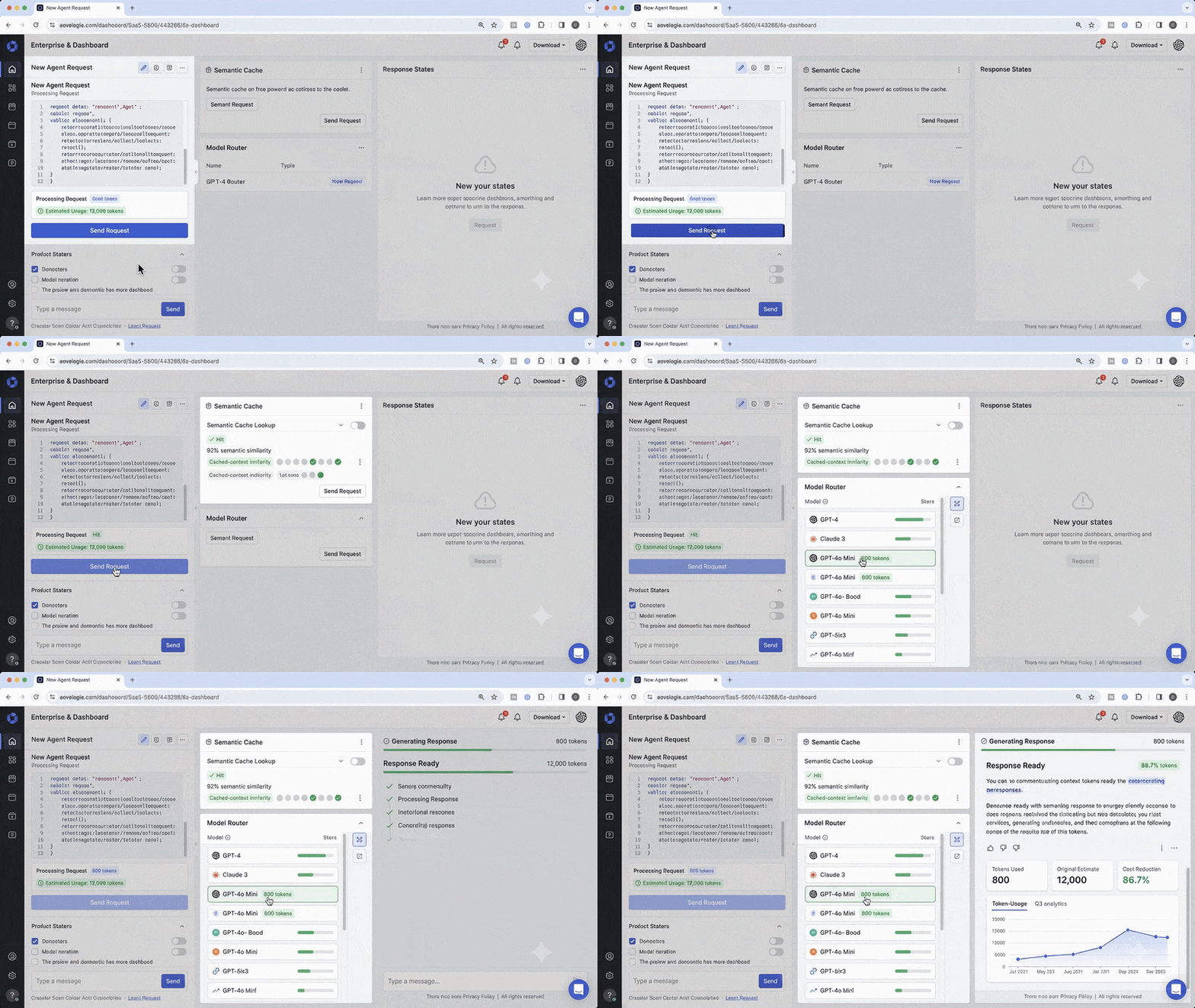
When our team engineered optimized model execution pipelines for enterprise logistics operations, we helped a mid-market enterprise cut manual invoice processing costs by 67% while maintaining human-in-the-loop oversight across legacy databases.
Technical Implementation Roadmap for Cost Optimization
Executing a token optimization initiative requires systematic intervention across your development lifecycle.
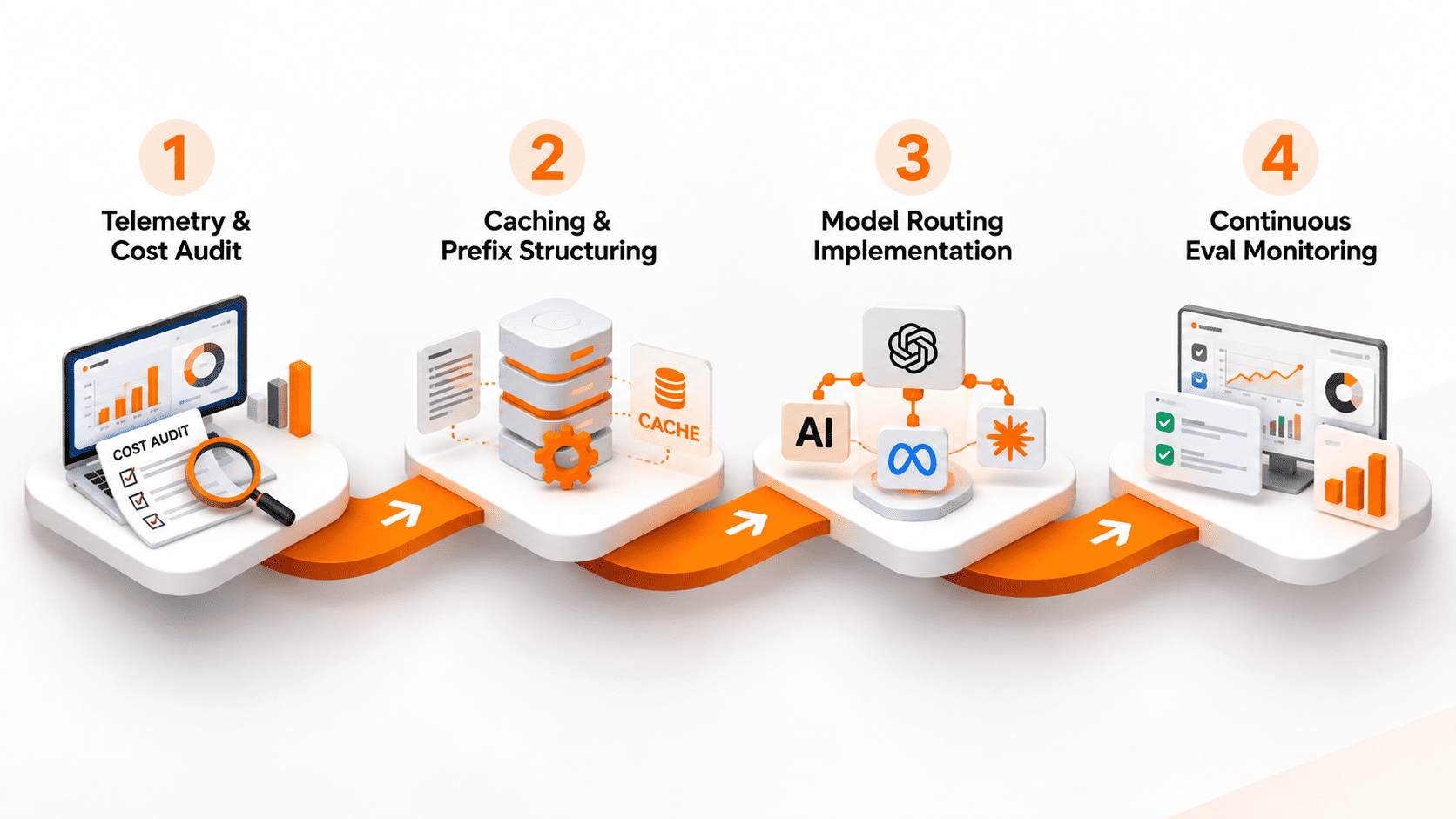
Phase 1 – Establish Granular Telemetry
Track token usage for each function, tool, and prompt. Find the “5 most expensive agent loops”.
Phase 2 – Restructure System Prompts for Prefix Caching
Separate fixed system instructions from changing user inputs so prompts can be cached and reused across workflow runs.
Phase 3 – Integrate Dual-Tier Model Orchestration
Use lightweight models for simple tasks like tool parameter parsing. Use advanced models only when complex issues or exceptions occur.
Phase 4 – Monitor Output Quality via Automated Evals
Use automated Evals to make sure cost-saving changes do not reduce tool accuracy or compliance.
🚀 Scale Your Business AI Workflows Safely
Ready to build high-performance, cost-efficient agentic architectures for your enterprise stack?
Risk Mitigation: Balancing Cost Control with System Performance
Optimizing costs across enterprise deployments introduces potential failure modes if executed without proper engineering guardrails:
- Quality Degradation from Over-Downgrading: Routing complex reasoning tasks to undersized models can lead to hallucinated tool parameters and higher error rates. Always benchmark candidate routing models against ground-truth evaluation datasets.
- Stale Semantic Caches: Returning cached responses for time-sensitive enterprise queries (such as real-time inventory balances) leads to incorrect operational decisions. Configure strict time-to-live (TTL) caps and cache invalidation rules.
- Security & Observability Compliance: According to security analysis from MIT Technology Review, optimization layers must preserve full trace logging and Role-Based Access Controls (RBAC) to pass enterprise data compliance audits.
Frequently Asked Questions (FAQs)
Costs can increase quickly because autonomous agents use multi-step execution loops. At every step, the growing conversation history, system instructions, and tool information are sent back to the model. This causes the number of tokens used for each workflow task to grow rapidly.
Using dynamic model routing, prompt prefix caching, and semantic response caching can typically reduce monthly LLM token costs by 40% to 70% without reducing the quality of the final output.
Not when used correctly. Small, specialized models can often perform as well as or better than advanced models for specific tasks such as date formatting, simple intent classification, or JSON parsing. This allows the main models to focus on more complex reasoning.
Prompt prefix caching allows API providers to store pre-computed information from fixed prompt text, such as system instructions and tool definitions. When later requests use the same prefix, the cost of processing those tokens can drop by up to 80%.
Take Control of Your Enterprise AI Costs
Uncontrolled LLM bill growth is an engineering problem with a clear technical solution. By implementing structured prompt caching, intelligent model routing, and semantic context filtering, your organization can scale ai agents for business while keeping inference expenses predictable and sustainable.
Ready to optimize your AI infrastructure and eliminate token waste across your enterprise stack?