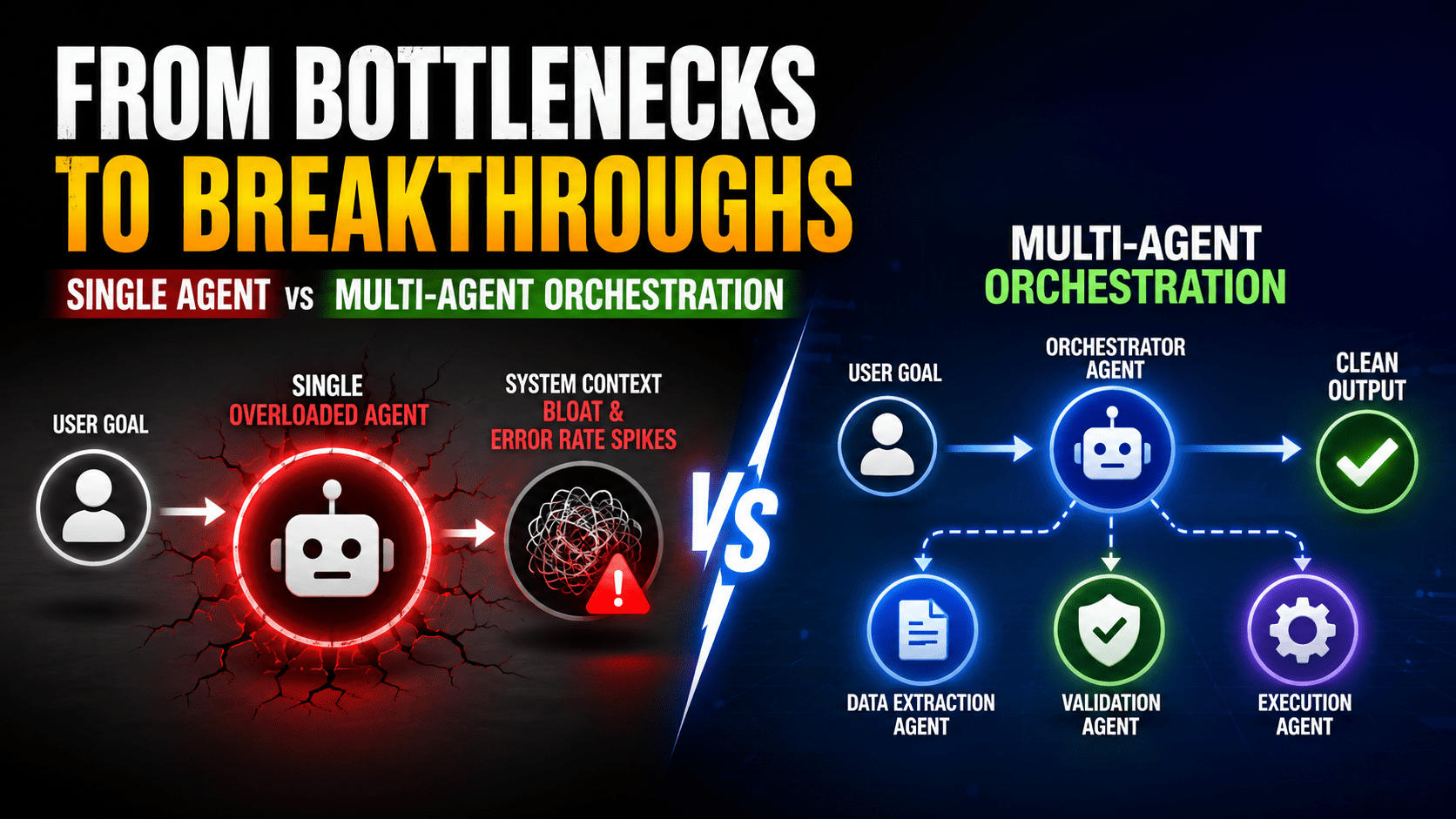
Single-agent systems work well for straightforward tasks, but enterprise workflows quickly break a single agent’s context window. When a single model tries to extract data, validate compliance rules, query APIs, and generate final customer communications simultaneously, accuracy drops and execution errors compound.
Enter multi-agent orchestration. By dividing a complex workflow among specialized autonomous ai agents each with dedicated instructions, tools, and domain permissions enterprises achieve higher accuracy, lower token costs, and strict operational control. Recent benchmark studies published by Gartner reveal that multi-agent architectures reduce task failure rates by up to 45% compared to single-agent setups handling multi-system enterprise operations.
As enterprise technology leaders scale their agentic ai initiatives, moving from single-prompt assistants to orchestrated agent teams is becoming the standard pattern for complex automation.
This guide explores when to transition from single agents to multi-agent networks, how specialized orchestration works, and how to approach AI agent development for multi-agent enterprise systems.
Single Agent vs. Multi-Agent Networks: What Is the Difference?
To scale enterprise automation effectively, leadership must know when a process exceeds the capacity of a single agent.
| Capability Layer | Single-Agent Systems | Multi-Agent Orchestration |
| Architectural Model | Monolithic prompt & tool set | Distributed team of specialized agents |
| Context Management | High risk of prompt clutter and hallucination | Isolated context windows per micro-task |
| System Access & RBAC | Single broad system access credential | Principle of least privilege per agent |
| Error Isolation | Single failure halts entire workflow | Localized error handling and fallback loops |
| Scalability | Limited to low-complexity tasks | High capacity for multi-department workflows |
Unlike single-agent setups where one system attempts every step in sequence, a multi-agent framework splits responsibilities across specialized roles:
- The Orchestrator: Receives the high-level operational objective, plans sub-tasks, assigns work, and evaluates incoming responses.
- The Specialist(s): Executes narrow, domain-specific tasks (such as querying an ERP database, parsing structured JSON, or checking compliance).
- The Validator: Reviews outputs against enterprise business logic before executing live API writes or communicating externally.
3 Telltale Signs You Need Multi-Agent Orchestration
Organizations usually need to upgrade their agentic ai architecture when single-agent deployments hit specific operational walls:
1. High Tool Count and Context Degradation
When an agent requires access to more than 5–7 complex API tools, its reasoning performance degrades. Splitting tasks across focused autonomous ai agents keeps context windows clean and tool selection precise.
2. Conflicting Role Instructions
If an agent must act as an aggressive negotiator while simultaneously enforcing strict compliance rules, prompt confusion occurs. Assigning a dedicated “Analyst Agent” to negotiate and a separate “Compliance Agent” to verify results resolves role conflict.
3. Mixed Security Permissions
Giving a single agent full read/write access across financial ledgers, customer CRMs, and email gateways creates severe security risks. Multi-agent design allows role-based access control (RBAC), ensuring each agent only accesses systems required for its specific task.
Is your AI architecture stalling due to single-agent limitations?
Don’t waste months trying to force complex workflows into a single prompt. Book a Free 15-Minute AI Audit with our strategy team to map your processes to a scalable multi-agent architecture.
Real-World Example: Multi-Agent Supply Chain & Logistics Management
To see multi-agent orchestration in action, consider an enterprise supply chain exception such as a delayed international shipment requiring inventory re-routing.
- Logistics Tracker Agent: Queries carrier APIs to verify real-time package locations and calculates revised arrival estimates.
- Inventory Reconciliation Agent: Checks warehouse inventory levels in SAP to identify backup stock at regional distribution centers.
- Customer Operations Agent: Drafts personalized status updates for affected account managers and queues order adjustment records for human review.
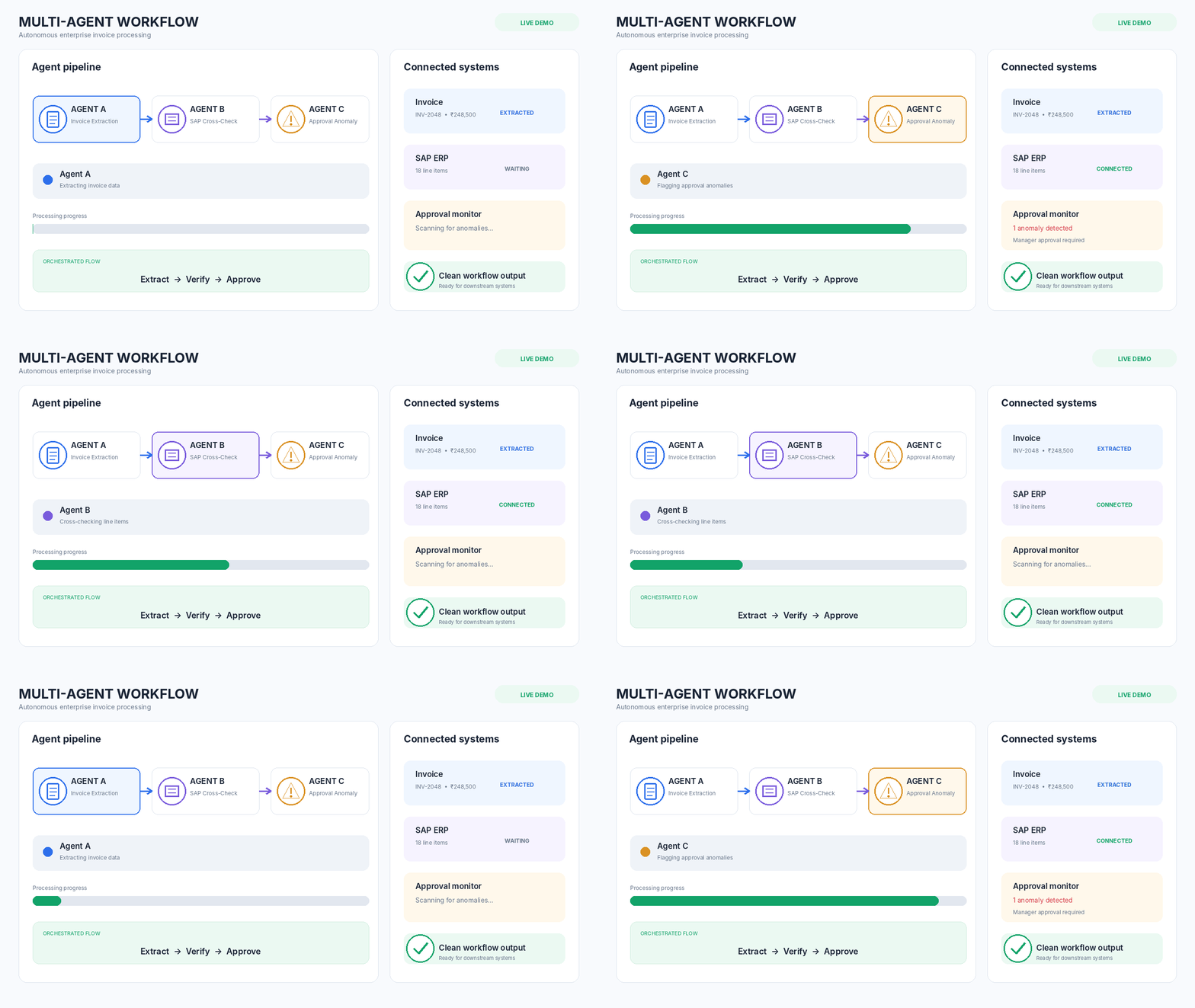
When our team engineered multi-agent orchestration workflows for complex operations, we helped a mid-market enterprise cut manual invoice processing costs by 63% while maintaining enterprise compliance and zero-defect data handling. Explore our AI Automation Case Studies
The Leader’s Guide to Multi-Agent AI Development
Building an effective multi-agent strategy during your AI agent development phase requires clear governance and structured communication protocols.
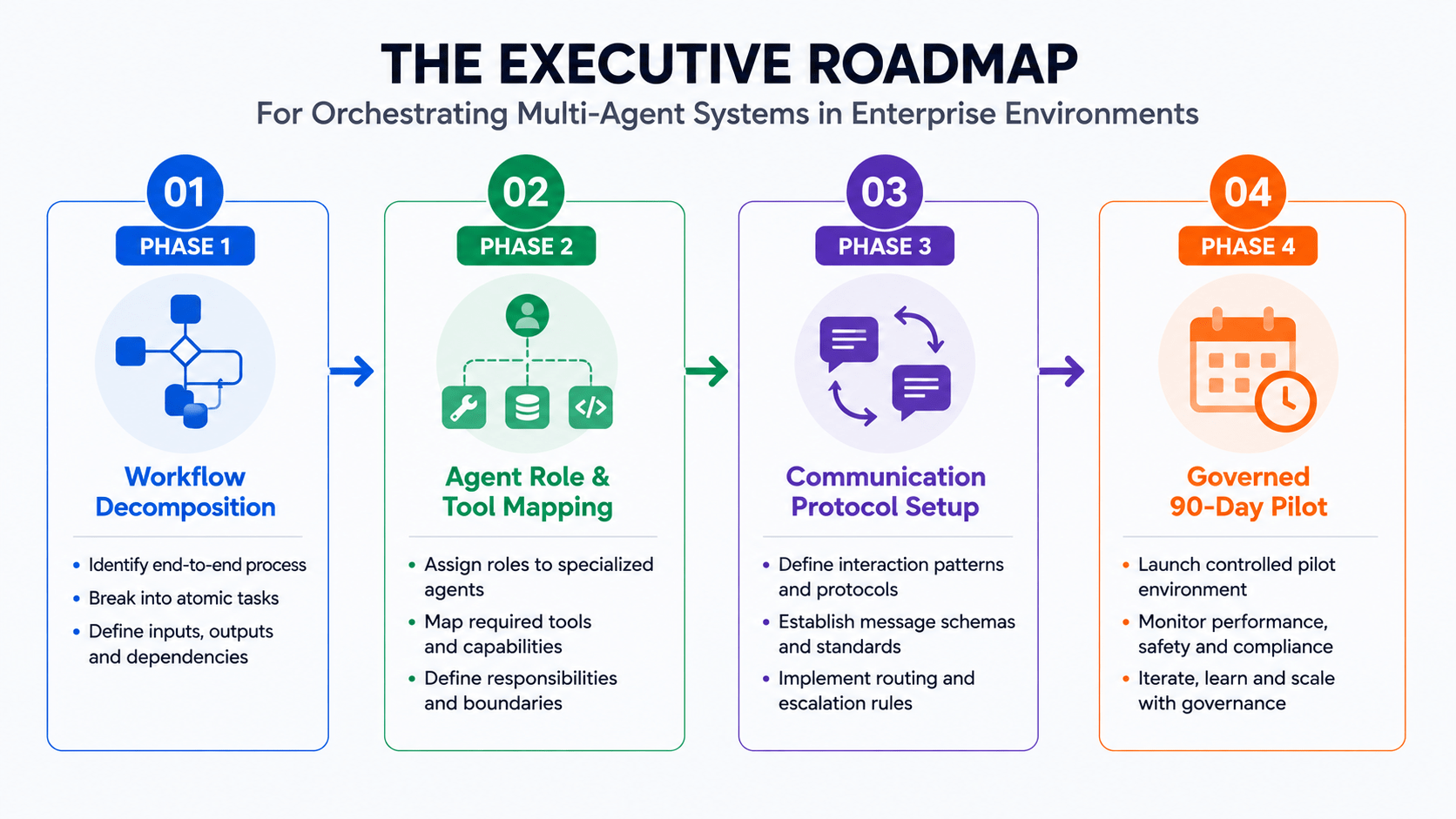
Phase 1: Deconstruct the Master Workflow
Break complex business processes down into discrete, single-purpose sub-tasks. Avoid broad objectives; isolate data fetching, logical processing, and execution steps.
Phase 2: Assign Granular Tools and Permissions
Give each specialized agent the least-privilege credentials required for its scope. Ensure your extraction agent cannot trigger financial payments or delete database records.
Phase 3: Select Your Multi-Agent Framework
- Open-Source Frameworks (LangGraph, CrewAI, AutoGen): Provide deep customization and full control over agent communication state. Ideal for proprietary enterprise setups.
- Pre-Built Enterprise Orchestrators: Quick to launch within platform ecosystems like Salesforce Agentforce or Microsoft Copilot Studio, but limited to native applications. Explore our analysis on custom frameworks versus off-the-shelf platforms to choose the right tech stack.
Phase 4: Run a Governed Sandbox Pilot
Test agent-to-agent communication loops in a sandbox environment. Track hand-off latency, task completion accuracy, token utilization, and human intervention rates before deploying to production.
Accelerate Your Multi-Agent Strategy
Ready to build resilient multi-agent systems for your business?
Mitigating Risk in Multi-Agent Architectures
While multi-agent orchestration solves context issues, leadership must manage unique operational risks:
- Cascading Failures: An error by an upstream extraction agent can propagate through downstream agents. Implement validation checks at every hand-off point.
- Agent Communication Loops: Without explicit iteration limits, agents can get caught in endless correction loops. Set strict execution budgets and step caps.
- Auditability & Traceability: Maintain centralized logging for every prompt, tool call, and state transition across all autonomous ai agents to meet regulatory compliance standards.
Frequently Asked Questions (FAQs)
Multi-agent orchestration is an architectural design where multiple specialized autonomous AI agents collaborate to solve complex workflows. An orchestrator agent divides goals into sub-tasks and delegates them to specialized agents with dedicated tools and context.
Single prompts handling complex tasks suffer from context bloat, higher hallucination rates, and tool selection errors. Multi-agent networks isolate contexts, ensuring higher accuracy and lower computational costs per task.
Initial multi-agent proofs-of-concept for 2–3 specialized agents typically take 6 to 8 weeks. Enterprise-wide orchestration connecting multiple systems generally matures over 3 to 6 months.
While non-technical leaders can monitor outputs using no-code orchestration platforms, custom multi-agent networks benefit from partnership with an experienced AI agent development team to manage API connections, error handling, and state persistence.
Transform Your Operations with Multi-Agent Orchestration
Single agents are great for basic tasks, but multi-agent networks unlock true enterprise-scale automation. By assigning specialized roles to targeted autonomous AI agents, forward-thinking organizations can automate complex, multi-system workflows safely and accurately.
Ready to upgrade your enterprise architecture and deploy resilient multi-agent systems?