Choosing a language model for a business application is not simply about selecting the largest model available.
A powerful model can handle complex reasoning and a wide range of questions. But what if your application performs the same specialised task thousands of times a day? Does it need a large general-purpose model for every request?
Consider an ecommerce company that needs to classify customer complaints, identify return reasons and generate responses in a consistent format. A large model might handle these tasks well, but it could also use more resources than the application actually needs.
This is where custom LLM development and fine-tuning become worth considering.
Fine-tuning adapts an existing language model using examples of the task you want it to perform. When the task is clearly defined and the training data is suitable, a smaller adapted model can sometimes deliver better task-specific results than a larger general-purpose model.
However, fine-tuning is not automatically the better choice. The decision depends on the task, data quality, evaluation results, operating costs and maintenance requirements.
Let’s explore when fine-tuning makes sense, when a larger model is still the better option, and how businesses can make the right decision.
Why Doesn’t a Bigger Language Model Always Deliver Better Results?
Larger language models are generally designed to handle a broad range of instructions, questions and reasoning tasks. That flexibility is useful, but not every business application needs it.
Many business workflows are repetitive and follow defined rules.
For example, an insurance company might use an LLM to:
- Extract information from submitted claims.
- Identify missing documents.
- Classify claims by category.
- Convert unstructured descriptions into structured fields.
- Prepare summaries for human reviewers.
The application does not necessarily need a model that can answer every general knowledge question. It needs a model that performs these specific tasks reliably.
A larger model may still be the better option when inputs are complicated or require multi-step reasoning. But a smaller model adapted to the workflow may be sufficient and potentially more efficient.
A January 2026 study published in Advanced Engineering Informatics provides an interesting example. Researchers developed construction-specialised language models and found that a small model adapted through domain pretraining and fine-tuning achieved a 14.6% higher F1 score and four times the inference speed of larger-scale counterparts on a construction-specific question-answering benchmark.
These findings are specific to that research. They do not establish that smaller fine-tuned models will outperform larger models in every industry. The result demonstrates why model performance should be measured against the actual task rather than judged by model size alone.
What Does Fine-Tuning Actually Change in an LLM?
A pretrained language model already understands language patterns and can respond to many types of instructions. Fine-tuning takes that existing model and trains it further using examples that represent a particular task, domain or expected output.
This process adjusts the model’s parameters so its responses become better aligned with the examples provided during training.
Imagine a financial services company that processes invoices.
A general-purpose model might identify invoice details, but it may not consistently follow the company’s preferred output format or classification rules.
A fine-tuning dataset could contain examples like these:
| Input | Expected output |
| Invoice containing a recurring software subscription | Category: Software Expense |
| Invoice containing office furniture | Category: Office Equipment |
| Invoice containing a cloud hosting charge | Category: Cloud Infrastructure |
With suitable examples, the model can learn to perform the classification task more consistently.
However, fine-tuning does not automatically give a model access to every internal company document, current price or recently updated policy. It also does not guarantee that the model will always return correct information.
If the application needs current business information, an external knowledge source may still be necessary.
This is one reason custom LLM development involves more than training a model. Data preparation, model selection, retrieval, evaluation and deployment all influence the final result.
When Is Fine-Tuning a Better Choice Than Using a Larger Model?
Fine-tuning is worth evaluating when an application has a clear, repeated task and the existing model struggles with consistency, formatting or specialised instructions.
Here are four situations where it may help.
1. Your application performs a repeated specialised task.
Consider an ecommerce business that receives thousands of customer messages.
The application needs to identify whether each message relates to a refund, damaged product, delayed delivery or product exchange.
This is a relatively defined classification task.
A smaller model fine-tuned with representative customer messages and correct classifications may perform the task effectively without relying on a larger model for every request.
The important requirement is that the task can be evaluated using clear success criteria.
2. Your prompts are becoming unnecessarily complicated.
Sometimes a model requires long instructions, multiple examples and repeated formatting rules to produce the desired output.
If the same instructions are used across thousands of requests, maintaining them can become difficult.
Fine-tuning may help the model learn recurring response patterns and output formats.
For example, a document-processing application may need every response to follow a particular JSON structure. Fine-tuning could improve consistency when generating that structure.
It is not a replacement for output validation, however. Applications should still check whether the returned data follows the required schema.
3. Your business needs consistent domain-specific language
Different industries use terms and formats that general-purpose models may not handle consistently.
A legal document application, for example, may need to classify clauses using a defined internal taxonomy. A manufacturing application may need to identify equipment issues using company-specific terminology.
Fine-tuning can help the model learn how these terms are used in the target workflow.
However, when the model needs to retrieve current regulations, contract clauses or technical documentation, connecting it to an updated knowledge source is usually more appropriate than relying on training data alone.
4. You need to optimise inference costs at scale.
A large model can become expensive when an application processes a high volume of requests.
Suppose a business uses an LLM to classify support tickets throughout the day. If a smaller model can achieve the required accuracy after fine-tuning, it may reduce the cost of handling those requests.
But this saving is not guaranteed.
Fine-tuning introduces its own costs, including data preparation, training, evaluation, deployment and ongoing maintenance. The total cost also depends on hosting, inference volume, prompt length and infrastructure requirements.
The right comparison is the total cost of completing a task successfully not simply the price of running one model request.
Fine-Tuning vs. a Bigger Model: What Should You Compare?
Before choosing an approach, compare the models against the same business requirements.
| Factor | Larger general-purpose model | Smaller fine-tuned model |
| General capabilities | Often broader | Usually more limited |
| Specialized tasks | May perform well without customisation | Can improve with suitable training |
| Complex reasoning | May have an advantage | Depends on the model and task. |
| Output consistency | Depends on prompting and model behaviour | May improve for repeated patterns. |
| Inference cost | Can be higher | Maybe lower, depending on deployment |
| Training requirements | May not require customisation | Requires suitable training data |
| Maintenance | Model and prompt updates | Model, adapter, data and evaluation updates |
There is another important distinction: fine-tuning and model size are not competing categories.
You can fine-tune a larger model too. The real decision is which base model and customization approach deliver the required performance at an acceptable cost.
A smaller fine-tuned model is a strong candidate when the task is narrow, repeated and measurable. A larger model may remain the better choice when the application requires broad knowledge, complex reasoning or handling of unpredictable requests.
How Do LoRA and QLoRA Make Fine-Tuning More Efficient?
Traditional full fine-tuning updates all or most of a model’s parameters. For large language models, this can require substantial computing resources and memory.
Parameter-efficient fine-tuning (PEFT) methods reduce that burden by updating a smaller set of additional parameters rather than changing the entire pretrained model.
One widely used method is Low-Rank Adaptation (LoRA).
LoRA keeps the original model weights frozen and introduces smaller trainable matrices that learn task-specific adjustments. This reduces the number of parameters that need to be trained and can lower memory requirements.
QLoRA takes this approach further by combining LoRA with quantisation. In common QLoRA workflows, the base model is loaded in 4-bit precision while the LoRA adapters are trained.
Here is the practical difference:
- Full fine-tuning: Updates the model’s parameters more extensively.
- LoRA: Trains lightweight adapter parameters while keeping the original weights frozen.
- QLoRA: Uses a quantised base model with trainable LoRA adapters to reduce memory requirements.
These approaches can make model customisation more accessible. Hugging Face’s parameter-efficient fine-tuning documentation explains the methods and techniques used to adapt pretrained models with fewer trainable parameters.
However, they do not remove the need for good data, suitable hardware, evaluation or deployment planning.
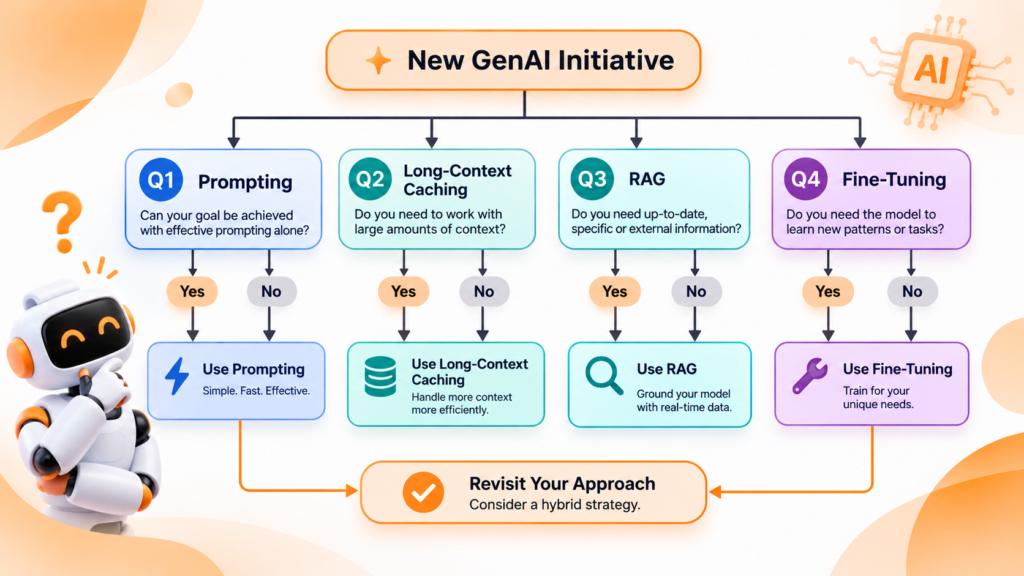
Fine-Tuning vs. RAG: Which Approach Does Your Application Need?
One common mistake in LLM development is using fine-tuning to solve a problem that actually requires better access to information.
Fine-tuning and retrieval-augmented generation (RAG) solve different problems.
RAG connects a language model to an external knowledge source. When a user asks a question, the application retrieves relevant information and provides it to the model as context.
Fine-tuning, on the other hand, changes how the model responds by training it on examples.
| Business requirement | Recommended starting point |
| Answer questions using company documents. | RAG |
| Retrieve frequently updated information. | RAG |
| Follow a consistent response format. | Fine-tuning may help. |
| Perform a repeated specialised task. | Fine-tuning may help. |
| Use current information with specialised response behaviour. | RAG + fine-tuning |
For example, a company may want an AI assistant to answer employee questions using its latest HR policies.
RAG is a suitable starting point because policies can change and the assistant needs access to updated documents.
If the same assistant also needs to produce summaries in a consistent company-approved format, fine-tuning may help with that behaviour.
The two approaches can work together. AWS explains this distinction in its guidance on RAG versus fine-tuning.
Businesses building AI applications around internal documents and existing software systems may also need to consider how information is retrieved, permissions are managed and responses are connected to their workflows. This is an important part of AI integration and implementation.
How Should You Test Whether Fine-Tuning Is Worth It?
Fine-tuning should be treated as an engineering decision supported by evaluation, not an experiment based only on whether the output looks better.
A practical process includes six steps.
Step 1: Define the task
Be specific about what the model needs to do.
For example, instead of saying “improve invoice processing”, define the task as extracting invoice numbers, identifying vendors and classifying expense categories.
Step 2: Prepare representative training data
Collect real or carefully constructed examples that reflect the inputs the application will receive.
Include different formats, edge cases, incomplete information and examples that are easy to confuse.
Remove sensitive information where required and ensure the data can be used appropriately for training.
There is no universal number of examples that guarantees successful fine-tuning. The quality, diversity and relevance of the examples matter more than choosing an arbitrary dataset size.
Step 3: Establish a baseline
Test the existing model before fine-tuning.
Record its accuracy, output consistency, response time and cost. This gives you a reference point for measuring improvement.
Step 4: Fine-tune the model
Choose a suitable base model and training method. Depending on the use case, full fine-tuning or a parameter-efficient method such as LoRA may be appropriate.
Keep a separate holdout dataset for evaluation. Do not use the same examples for both training and final testing.
Step 5: Compare results using the same test cases
Evaluate the original and fine-tuned models against identical test inputs.
Measure the results using relevant metrics:
- Accuracy: How often does the model produce the correct result?
- Precision and recall: How well does it identify the correct items without excessive false positives or missed cases?
- F1 score: How well does it balance precision and recall?
- Latency: How long does the model take to respond?
- Token usage: How much input and output processing does each request require?
- Cost per successful task: What does it cost to complete the task correctly?
The appropriate metrics depend on the application. For example, missing a critical compliance issue may be more serious than incorrectly classifying a low-priority support message.
OpenAI’s guide to optimising LLM accuracy provides additional guidance on evaluating model performance and improving results.
Step 6: Test in a production-like environment
A model that performs well on a test dataset may still struggle with real-world inputs.
Test it with actual workflow conditions, including unexpected formats, high request volumes and incomplete information.
Monitor performance after deployment and review whether the model needs updated training data or changes to its retrieval and validation systems.
Common Mistakes to Avoid During Custom LLM Development
Fine-tuning can improve a specific workflow, but poor decisions during development can waste time and resources.
Avoid these common mistakes:
Fine-tuning before testing prompts: Improve the prompt and establish a baseline first. A customisation project may be unnecessary if better instructions solve the problem.
Using low-quality training data: Incorrect, inconsistent or unrepresentative examples can teach the model the wrong behaviour.
Expecting fine-tuning to provide current information: Training does not replace access to frequently updated documents or databases.
Choosing a model only by parameter count: A larger model is not automatically the best choice for every task.
Ignoring total operating costs: Include data preparation, training, evaluation, infrastructure, inference and maintenance.
Skipping ongoing evaluation: Business workflows and input patterns change. Performance needs to be monitored after deployment.
Final Thoughts: Choose the Model That Solves the Actual Problem
The goal of custom LLM development is not to build the biggest model or fine-tune a model simply because the technology is available.
It is to find the right balance between task performance, reliability, response time, operating cost and maintenance.
A larger general-purpose model may be the right choice for complex and unpredictable tasks. A smaller fine-tuned model may be more practical for repeated, well-defined workflows. RAG may be more suitable when the application needs access to changing business information. In some cases, combining these approaches delivers the best result.
The decision should come from testing real use cases rather than assuming that one approach will work everywhere.
Frequently asked questions
Yes. A smaller fine-tuned model can outperform a larger general-purpose model on a specific task when its training data closely matches that task. However, it may not perform as well on broader or unfamiliar requests.
There is no universal minimum. The requirement depends on the model, task complexity, training method, and quality of examples. Google Cloud’s supervised tuning documentation, for example, recommends at least 100–500 examples for certain supported tuning workflows. More complex applications may need larger and more diverse datasets.
Google Cloud Documentation +1
It can reduce inference costs when a smaller customised model replaces a more expensive model for repeated tasks. However, training, evaluation, deployment, and maintenance costs must also be considered.
Fine-tuning changes a model’s trainable parameters using task-specific examples. RAG retrieves relevant information from external sources and supplies it to the model during inference. Fine-tuning primarily adapts behaviour, while RAG provides access to information.
Not always. LoRA can reduce training resource requirements by updating a smaller set of additional parameters. Full fine-tuning may be appropriate when deeper model adaptation is necessary and the available resources justify it.
A business should consider it when an existing model does not consistently meet its task-specific requirements, and evaluation shows that customisation can improve accuracy, consistency, efficiency, or deployment control.
If you are evaluating a custom LLM, fine-tuning or RAG solution for your business,
Book a free 15-minute call with a senior AI architect at Gigaflop TechLab. Discuss your use case, data requirements and technical challenges, and get a practical recommendation on the next step.