Ask three agencies to quote an AI project right now, and you will get three wildly different numbers: $15,000, $85,000, and $300,000.
If you run a company or lead an engineering team, that spread makes budgeting a nightmare. Why does one vendor charge the price of a used Honda Civic while another asks for the cost of a small house? Because half of them are selling you a thin wrapper over an API, and the other half are quoting an enterprise-grade system that won’t hallucinate, leak customer records, or bankrupt you in token fees six months after launch.
Hiring an LLM development company means paying to connect your messy, private business data to a language model that behaves predictably in production. Here is a transparent look at where the engineering hours actually go and where founders accidentally burn cash.
“The true value of enterprise AI does not come from the underlying foundation model itself; it comes from how securely and seamlessly you connect that intelligence to your proprietary workflows and data.”
Satya Nadella, CEO of Microsoft
The 2026 Reality: What Do LLM Development Services Actually Cost?
First, clear up a common misconception: you are almost certainly not paying someone to train a language model from scratch. Training a foundation model takes millions of dollars in GPU clusters and months of research.
Instead, practical LLM development services take existing frontier models (like GPT-4o, Claude 3.5 Sonnet, or open-source Llama weights) and build the surrounding software pipes that force the model to obey your company’s rules. Depending on how deep those pipes go, budgets break into three realistic tiers:
| Project Tier | Typical Investment | Best Suited For | What’s Actually Built |
| Proof of Concept (PoC) | $15,000 – $35,000 | Testing one internal workflow or validating ROI with leadership | Single-source RAG, basic web interface, sandbox database connection |
| Production RAG & Agents | $40,000 – $120,000 | Ecommerce support, live inventory lookup, automated quoting | Multi-database connectors, permission guardrails, automated test suites |
| Enterprise Multi-Agent Platform | $120,000 – $300,000+ | Cross-department automation, strict compliance, domain fine-tuning | Multi-step reasoning agents, custom orchestration, private cloud hosting |
According to Gartner’s enterprise AI spending forecast, companies scaling generative AI are pulling money out of flashy experimental demos and pouring it into backend integration and governance. That shift matches what we see every week: the demo is cheap; making it safe for real customers is where the real engineering lives.
Not sure which tier fits your current stack?
Book a 15-minute discovery call with our AI architects to get a realistic ballpark estimate before you issue an RFP.
Hiring In-House vs. Hiring an LLM Development Company
When a board asks for an AI roadmap, the first instinct is often to post a job listing for a senior machine learning engineer. Before you do, look at the math.
Recruiting a senior AI engineer in 2026 runs $220,000+ a year in base compensation, plus equity and benefits. Worse, it takes three to five months just to get them through interviews and onboarded. Even then, one ML engineer rarely knows frontend UI, cloud DevOps, and legacy ERP integrations.
Bringing in a specialised LLM development company flips that timeline. You get a data engineer, a backend architect, and a security specialist on day one under a fixed-milestone contract. Once the system is stable in production, they hand over the documentation and train your internal developers to maintain it, leaving you without permanent payroll bloat.
Where Your Money Goes: The 4 Real Cost Drivers
Every custom LLM development proposal splits your budget across four distinct phases. If a vendor leaves one of these out to give you a cheaper quote, you will end up paying for it twice later.
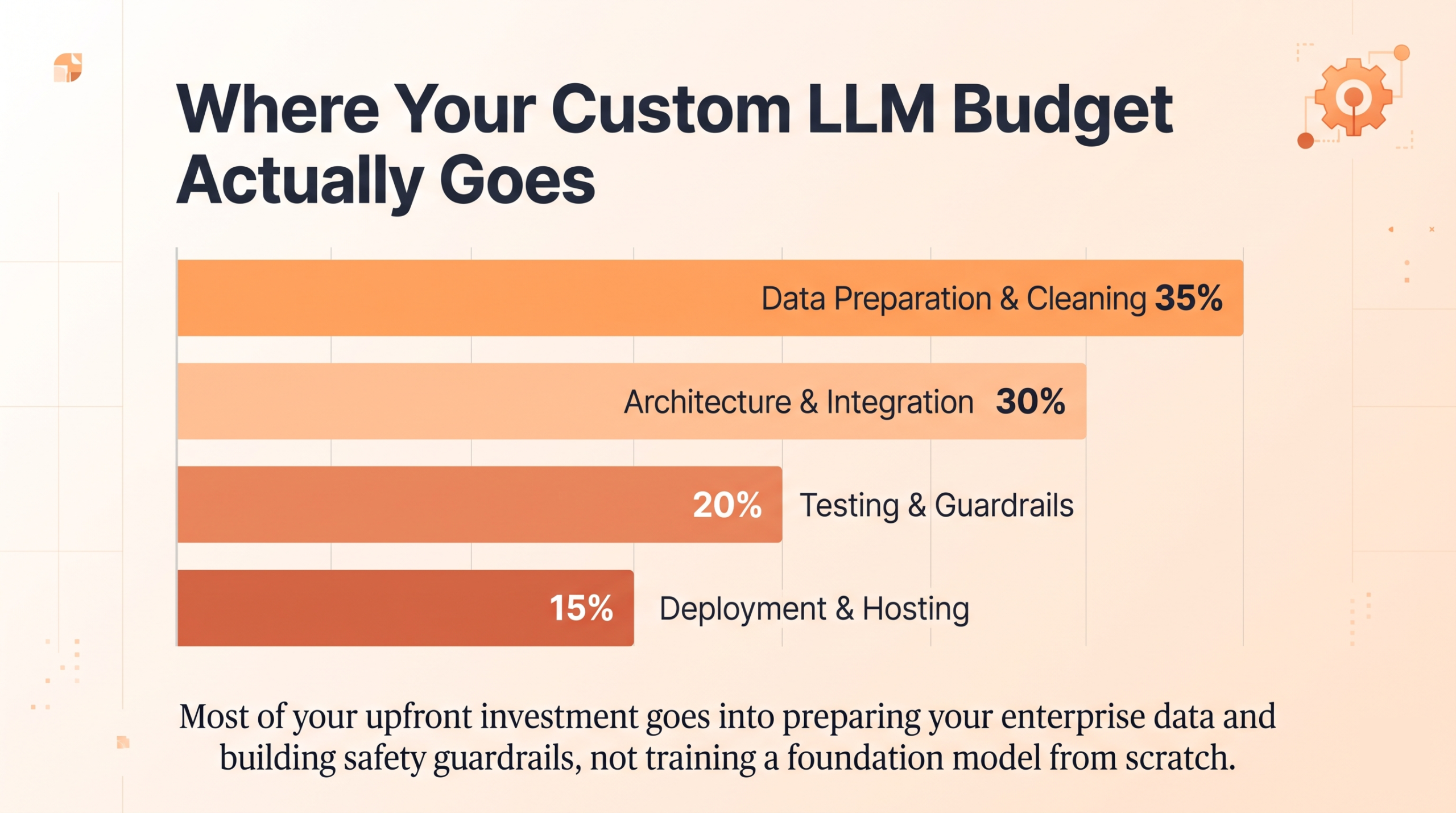
1. Data Prep and Cleanup (Roughly 35% of Budget)
Last year, an ecommerce brand came to us frustrated because their internal prototype kept recommending discontinued winter jackets. The AI wasn’t broken; their product catalogue was a graveyard of duplicate CSVs, outdated PDFs, and scanned supplier spec sheets.
An AI model is only as reliable as the text it retrieves. Before writing a single prompt, engineers have to strip out junk formatting, deduplicate thousands of records, attach metadata tags (like dates, regions, and SKU status), and chunk the files into a vector database. Stanford HAI research on enterprise AI reliability consistently shows that retrieval accuracy, not the size of the model, determines whether an enterprise tool succeeds.
2. RAG Architecture and Tool Calling (Roughly 30% of Budget)
A standalone chat box that answers static FAQ questions won’t pay for itself. Real ROI happens when the model talks directly to your live systems, your Shopify store, NetSuite ERP, Salesforce CRM, or warehouse database.
This requires two things:
- Retrieval-Augmented Generation (RAG): Pulling live facts from your database the exact millisecond a user asks a question.
- Agentic Tool Calling: Giving the AI permission to take controlled actions, like looking up a tracking number, generating a return label, or calculating a custom bulk quote.
3. Guardrails, Security, and Evaluations (Roughly 20% of Budget)
Left unchecked, language models are people-pleasers. If they don’t know your refund policy, they will invent one that sounds polite, and suddenly your support bot is promising free overnight shipping on international orders.
We spend roughly a fifth of every build locking down three failure points:
- Hallucination checks: Forcing the model to cite its source document or say, “I don’t know; let me connect you to a human” when confidence drops below a set threshold.
- Permission boundaries: Making sure a junior sales rep can’t ask the internal bot for executive payroll numbers just because both live in the same company drive.
- Zero-data retention: Configuring enterprise API agreements so providers like OpenAI or Anthropic never log or train on your company’s inputs.
4. Deployment and Observability (Roughly 15% of Budget)
Shipping to production is where the real surprises start. Users type typos, paste entire error logs into chat windows, and try to trick bots into giving discounts. Your budget here pays for cloud deployment, latency tuning (nobody waits 12 seconds for a chat reply), and logging tools like LangSmith or Arize so your team can inspect bad answers and patch them weekly.
Off-the-Shelf AI vs. Custom LLM: When to Buy vs. Build
You do not need custom engineering for every problem. If your marketing team wants help drafting ad copy or summarising Zoom calls, buy $30/month SaaS seats and move on. Build custom only when your competitive advantage depends on private data or live system actions.
| Decision Factor | Off-the-Shelf AI SaaS | Custom LLM Development |
| Ideal Use Case | Drafting emails, meeting notes, basic website FAQ widgets | Live SKU search, automated order actions, complex internal quoting |
| Data Security | Shared multi-tenant servers; limited permission controls | Isolated inside your cloud VPC with role-based access rules |
| Accuracy on Company Rules | Hit-or-miss; guesses when edge cases appear | High; strictly grounded in your live databases via RAG |
| Upfront Investment | $20 – $500 / month | $15,000 – $150,000+ one-time engineering build |
| Ongoing Expense | Predictable per-seat subscription | Pay-per-use API tokens + vector database & cloud hosting |
Want to see how custom integration performs in production?
Read the full case study: How an e-commerce brand cuts support costs by 52% with custom RAG, including exact architecture specs, timeline, and ROI metrics.
3 Hidden Running Costs That Catch Founders Off Guard
A good agency doesn’t just quote the build—they hand you a spreadsheet projecting what the system will cost to run at month six and month twelve. Watch out for these three recurring bills:
- Unchecked Token Burn: We once audited a client’s agentic workflow that was burning $400 a day because an unthrottled reasoning loop kept re-reading a 50-page manual every time a user said “thanks.” Smart architecture uses semantic caching and routes simple queries to cheap, fast models (like GPT-4o-mini or Haiku), cutting monthly API bills by 70% or more.
- Vector Database & GPU Hosting: Storing millions of product embeddings in managed vector databases (Pinecone, Weaviate, or pgvector) adds $200 to $1,500+ a month depending on traffic. If strict healthcare or defense rules require self-hosting an open-source model on dedicated cloud GPUs, budget $2,000 to $6,000+ monthly for compute alone.
- Data Drift: Your business isn’t static. You change prices, sunset SKUs, and update compliance rules every week. If you don’t automate your ingestion pipeline to re-index changes nightly, your AI will slowly drift out of date.
4 Questions to Ask Before Signing an SOW
Before wiring a deposit to any LLM development company, ask these four questions on your technical discovery call:
- “How do you test accuracy before launch?” If they say, “We manually chat with it for a few days,” walk away. Look for automated evaluation pipelines running hundreds of golden test cases.
- “Do we own 100% of the code, prompts, and orchestration?” Never let an agency lock your business logic inside their proprietary closed-source platform. You should own the GitHub repo and cloud infrastructure outright.
- “How do you route queries to keep API costs down?” You want engineers who pair heavy reasoning models with lightweight, low-cost models rather than using a sledgehammer for every query.
- “What happens when our data changes next month?” Make sure automated data-sync pipelines and team handoff documentation are scoped into the original build, not sold back to you as an emergency change order.
Frequently Asked Questions
A focused Proof of Concept (PoC) takes 3 to 5 weeks. A full production system—with live ERP/CRM integrations, security guardrails, and automated testing typically takes 8 to 14 weeks.
For 90% of businesses, commercial APIs (under enterprise zero-data-retention agreements) are far cheaper and faster to ship. Hosting open-source models like Llama or Mistral usually only pays off at massive daily query volumes or under strict air-gapped regulatory requirements.
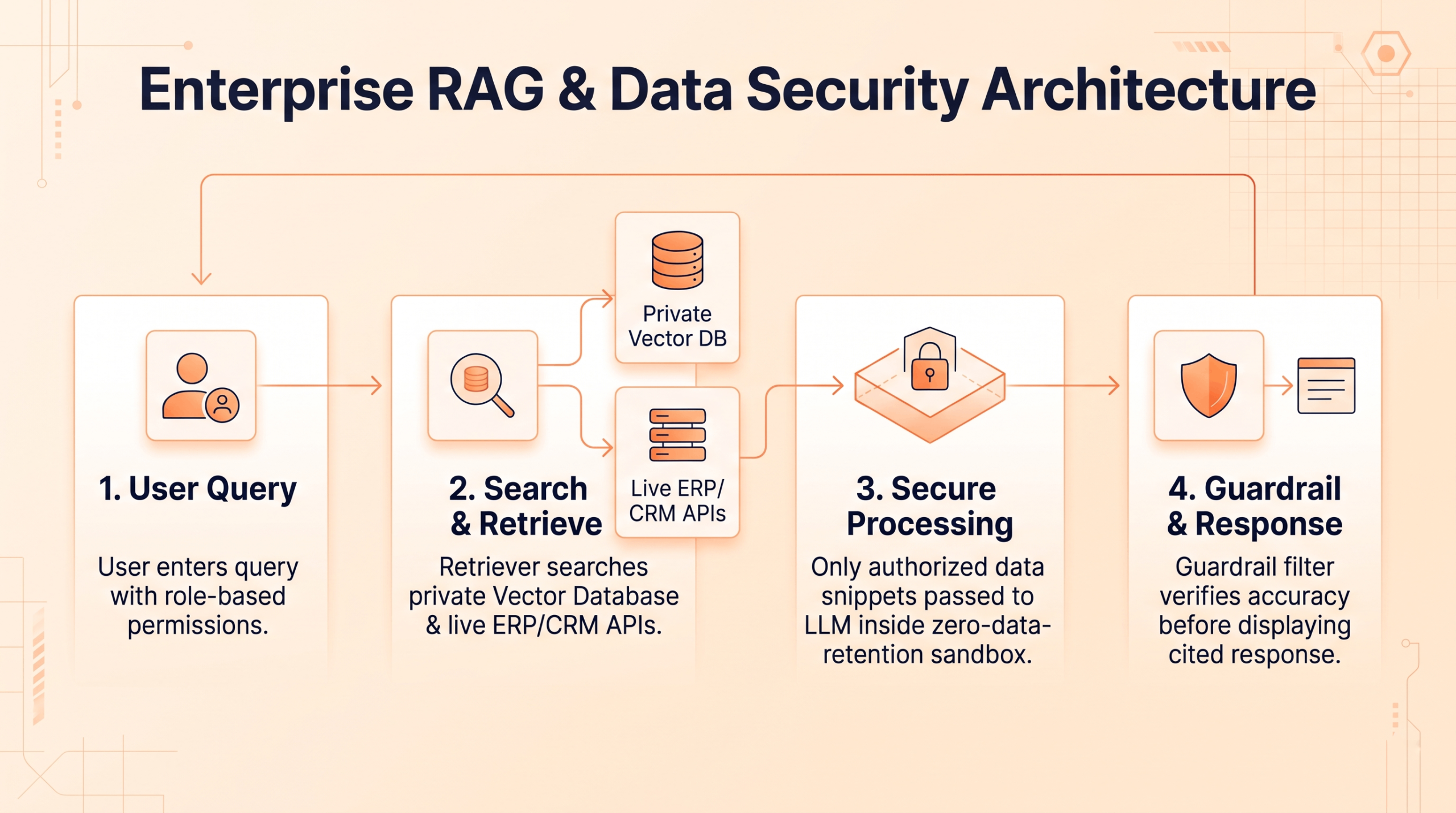
Yes. In a properly built RAG system, the language model never “learns” or memorises your customer database. Your backend code checks who the user is, queries only the records that specific user is allowed to see, and passes just those temporary snippets to the model to format an answer.
Plan on $20,000 to $35,000 for a solid, single-workflow production tool (like an internal policy assistant or support ticket router). Multi-step agents that modify records across several departments usually start around $60,000+.
Ready to Scope Your Custom LLM Project?
Stop guessing what your AI roadmap will cost. Whether you are automating customer support, speeding up internal operations, or building an AI-powered product feature, our engineers will give you a clear, fixed-milestone estimate with zero fluff.