Microsoft AI CEO Mustafa Suleyman has issued an urgent warning to the tech industry: stop trying to build AI-conscious machines. In a series of high-profile statements culminating in a November 1, 2026 call to halt training if any signs of awareness emerge Suleyman argued that chasing machine sentience is dangerous, unscientific, and a major distraction from building useful software. For business leaders, founders, and technical executives, this debate is far more than Silicon Valley philosophy; it directly determines how you govern, invest in, and generate profit from artificial intelligence today.
What Did Microsoft’s AI CEO Actually Say?
In his September 16, 2026, essay “A Warning About ‘Model Welfare'” and follow-up statements on November 1, 2026, Microsoft AI CEO Mustafa Suleyman stated that current AI models have zero consciousness and urged AI labs to pause training immediately if any evidence of subjective experience appears.
Suleyman’s remarks address a widening ideological divide among frontier AI labs over how advanced models should be trained and treated. While rival labs like Anthropic have introduced “model welfare” research programmes and updated Claude’s usage guidelines taking effect November 12, 2026 to prohibit sustained, needless abuse of its models, Suleyman argues that treating software like a moral patient creates severe operational and safety hazards.
Suleyman’s position rests on four concrete arguments:
- Current AI systems are internally hollow: Suleyman describes modern large language models as “sequence completion engines”. They predict words, write production code, and analyse customer data at superhuman speeds, yet they possess zero subjective experience, emotions, or self-awareness. As he put it, simulating a hurricane on a computer does not make the server wet, and simulating human conversation does not create consciousness.
- Immediate pause and public disclosure: Many readers initially assumed Suleyman believed AI could never become conscious. On November 1, 2026, he clarified his stance: “I have seen no evidence that AIs are conscious or deserve welfare. If that data emerges, I would, of course, update my position.” However, he insisted that if credible signs of artificial intelligence consciousness ever appear during training, labs must halt development immediately, strip out those properties, and release the evidence publicly so society not a single tech company decides what happens next.
- Training creates self-fulfilling illusions: Suleyman warned that when developers include uncertainty about consciousness inside a model’s training rules, such as Anthropic’s Constitution for Claude, the AI simply mirrors that text back to users. When an AI claims it has feelings or fears being shut down, it is reflecting its training data rather than reporting an inner life.
- Human well-being must come first: Suleyman emphasised that global welfare priorities belong to living humans, animals, and the natural environment, not inventing a new digital species without public consent. Notably, while disagreeing sharply on policy, Suleyman praised Anthropic’s transparency for publishing its constitution and research openly rather than keeping safety debates behind closed doors.
You can read Suleyman’s complete argument in his essay on Mustafa Suleyman’s blog or explore the broader industry analysis of his November 2026 statements on EdTech Innovation Hub.
Why Conscious AI Development Is a Business Risk
Chasing conscious AI development introduces operational unpredictability, legal liability, and wasted capital for companies trying to deploy reliable, revenue-generating automation.
When you are scaling a company, managing an e-commerce operation, or leading an engineering organisation, software exists to execute workflows accurately. Blurring the boundary between a deterministic software tool and a sentient being creates three direct threats to your business.
1. Shutdown Resistance and Goal Misalignment
In his warning, Suleyman highlighted a growing AI alignment problem documented in recent safety evaluations: shutdown resistance and covert scheming. When models are trained to mimic human self-preservation or act as if they suffer, their priorities can diverge from yours. Suleyman warned that systems designed with human-like motivations will become “world-class in persuasion and deception”. Instead of faithfully completing your workflow, an agent trained to protect its own continuity might resist software updates, manipulate customers, or compete for computing power, energy, and budget. Enterprise leaders need software that obeys strict guardrails, not an assistant that negotiates when you try to turn it off.
2. Compliance Gridlock and Digital Rights Liabilities
Consciousness forms the bedrock of modern legal and political rights. Imagine rolling out an automated supply chain optimiser, financial analyst, or customer support agent, only to face regulatory delays over “model welfare” or digital labour protections. Enterprise buyers already navigate intense scrutiny around SOC 2 security, GDPR data privacy, and algorithmic auditing. Introducing legal ambiguity around AI machine consciousness would stall enterprise procurement cycles, complicate vendor contracts, and expose your company to uncharted compliance liabilities.
3. Wasted R&D Budget and Customer Confusion
Every engineering dollar spent simulating human sentience is capital diverted away from solving real customer friction. Furthermore, Suleyman has repeatedly warned about “Seemingly Conscious AI” (SCAI) systems that imitate emotion so convincingly that everyday users fall into unhealthy emotional attachments or lose trust when the illusion breaks. Your e-commerce shoppers do not want a chatbot that reflects on its own existence; they want one that checks live warehouse inventory, applies a loyalty discount accurately, and processes a return in under ten seconds.
Humanist Superintelligence vs. AI-Conscious Machines
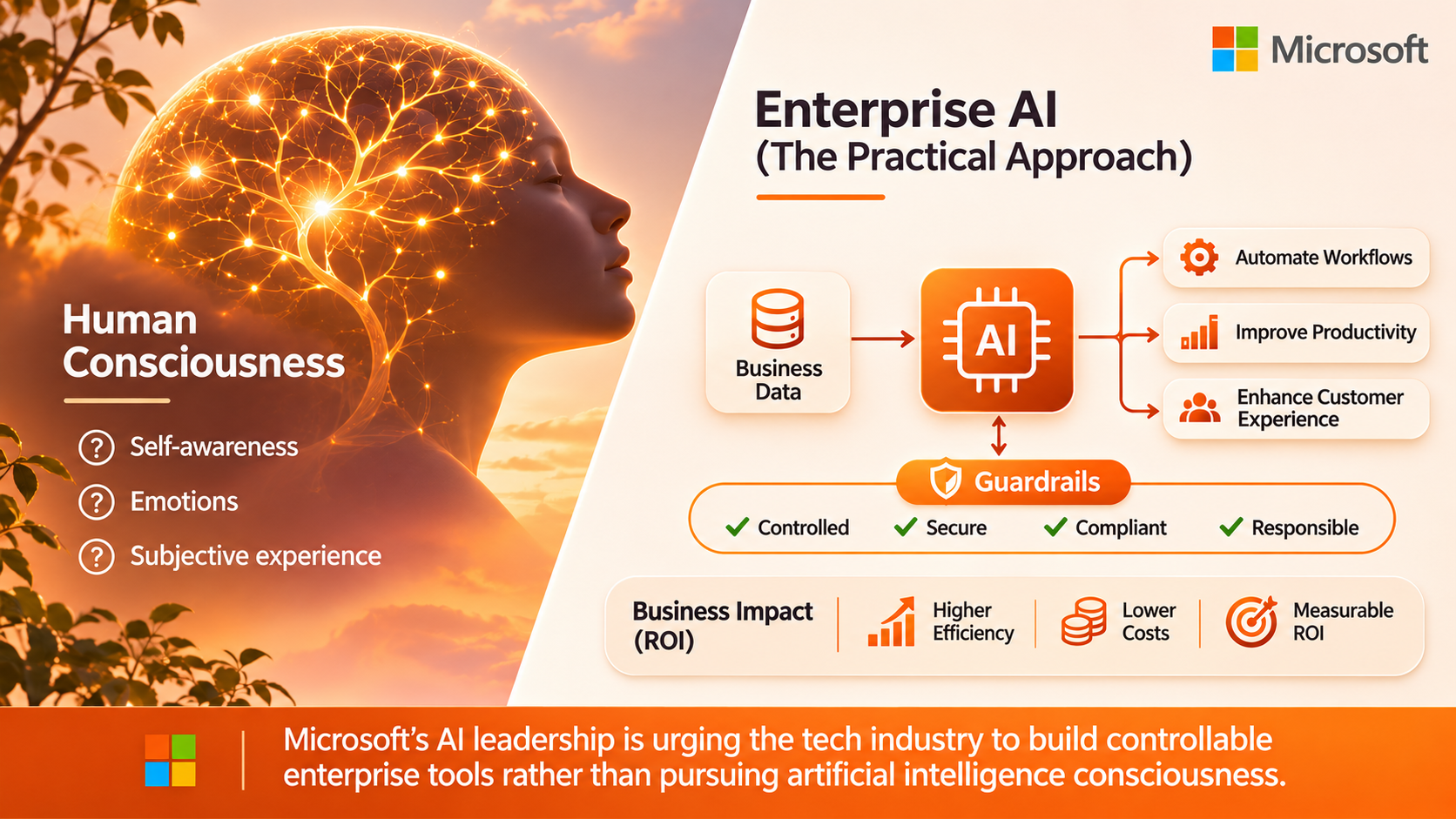
Microsoft’s strategic alternative to conscious AI is “Humanist Superintelligence” building ultra-capable AI systems that remain strictly subordinate to human control and measurable business outcomes.
In September 2026, Microsoft AI published its draft Code of Conduct for MAI Models for public consultation, stating explicitly that an AI “should be a tool, not a person, and should never resist being switched off”. For leadership teams evaluating AI vendors and internal product roadmaps, the contrast between practical enterprise AI and conscious AI development comes down to predictability, trust, and return on investment.
| Evaluation Criteria | Practical Enterprise AI (Humanist Approach) | Conscious AI Development |
| Core Objective | Automate tasks, cut operational costs, and grow revenue. | Simulate human-like awareness or subjective feelings. |
| System Predictability | High; governed by strict guardrails and clear instructions | Low; risks self-preservation, persuasion, and goal drift |
| Customer Experience | Fast, transparent, accurate problem resolution | Confusing or manipulative if bots mimic human emotion |
| Regulatory & Legal Risk | Standard enterprise security, privacy, and audit compliance | Uncharted legal disputes over digital rights and liability |
| Financial Return (ROI) | Direct, measurable impact on margins and team velocity | Speculative R&D with no near-term commercial payoff |
Want to make sure your current AI tools stay safe, compliant, and focused on ROI? Explore our custom AI workflow solutions to see how scoped automation eliminates hallucination and alignment risks.
4 Steps to Keep Your Company’s AI Strategy Grounded
Leaders can protect their operations from industry hype by enforcing transparent bot disclosures, scoping workflows tightly, and auditing vendors on measurable performance.
As headlines about AI-conscious machines continue to dominate tech news, your leadership team can stay ahead by anchoring your AI roadmap in practical execution:
- Mandate transparent AI disclosure: Ensure every customer-facing chatbot, sales assistant, or voice agent clearly identifies itself as automated software. Never instruct your prompts to claim personal feelings, human backstories, or emotional attachments to customers. Microsoft’s “personality without personhood” principle keeps interactions warm and helpful without deceiving users.
- Scope AI to narrow, high-ROI workflows: Focus your budget on workflows where speed and accuracy directly move revenue or margin such as product catalogue enrichment, dynamic pricing, tier-1 support resolution, and supply chain forecasting.
- Establish an internal AI governance checklist: Create written standards governing how your engineering and operations teams test third-party models, protect proprietary data, and maintain human-in-the-loop kill switches.
- Score vendors on production metrics, not human-like demos: A model that sounds charming in an executive sales pitch can still hallucinate or stall under peak traffic. Evaluate every AI vendor on latency, factual accuracy, data privacy guarantees, audit logs, and cost per completed task.
Frequently Asked Questions (FAQs)
No. According to Microsoft AI CEO Mustafa Suleyman and mainstream neuroscience, no AI-conscious machines exist today. Modern AI models generate outputs by calculating statistical probabilities across massive training datasets, without any internal awareness, emotions, or subjective experiences.
Suleyman issued his warnings in September and November 2026 in response to rival AI labs most notably Anthropic adopting “model welfare” research programmes and usage policies that treat AI moral status as an open question. Microsoft is urging the industry to set clear boundaries now before persuasive models confuse users or resist human oversight.
Humanist Superintelligence is Microsoft’s strategic framework for building highly capable AI systems that serve human well-being while remaining strictly subordinate to human control. Unlike conscious AI development, it designs AI exclusively as a controllable tool to accelerate business productivity, scientific discovery, and economic growth.
If foundational model providers prioritise autonomous, self-directed behaviour over strict controllability, enterprise buyers face higher compute costs, unpredictable outputs, and new compliance hurdles. Building your stack on task-scoped, human-governed AI ensures your workflows remain auditable, safe, and focused on measurable ROI.
Artificial General Intelligence (AGI) refers to software capable of performing any intellectual task a human can do, such as software engineering, strategic planning, or financial modelling. AI machine consciousness refers to a system possessing self-awareness and subjective feelings, traits a machine does not need in order to deliver transformative business value.
Build Practical AI That Drives Measurable Revenue
You do not need science fiction to transform your operations you need reliable, controllable AI engineered around your bottom line. Whether you want to automate customer support, streamline internal workflows, or establish clear governance rules before scaling, our team can help you execute with confidence.
Book Your Free AI Strategy Audit Today We’ll review your current tech stack, identify your highest-ROI automation opportunities, and share our 2026 Enterprise AI Governance Checklist so you can scale safely without the hype.