Picture the daily logistics standup. Someone pulls a report. Someone else cross-references a dashboard. A delay gets flagged, a person is assigned to call the carrier, another to update the customer, another to re-check inventory. The meeting exists to surface what went wrong overnight and decide who chases it. It’s a status-reconciliation ritual and it’s exactly the kind of work that’s quietly disappearing.
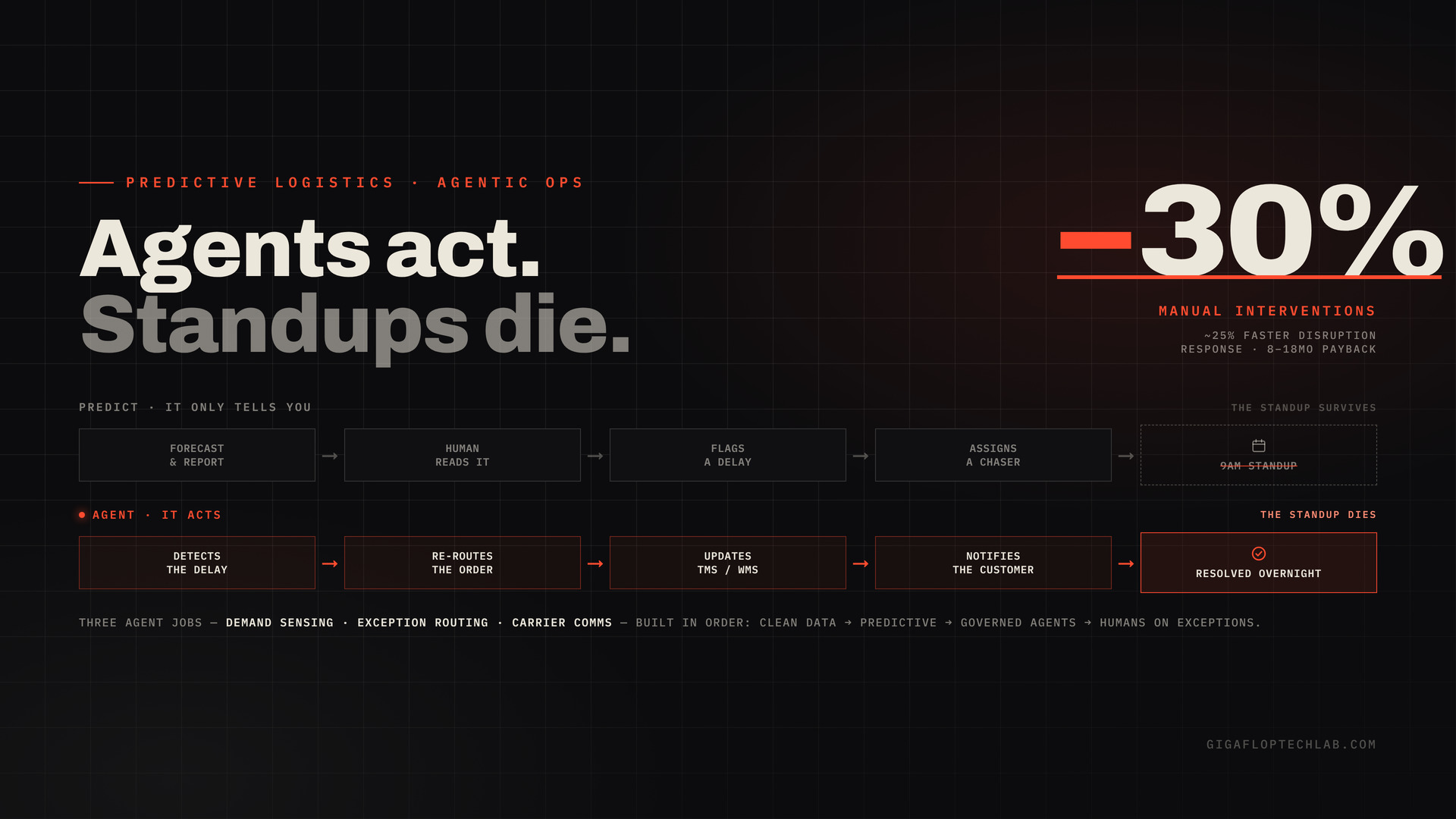
The reason is a category shift most of the industry hasn’t fully absorbed. As one 2026 analysis put it: a procurement exception flags in the system, and somewhere a human is waiting for a report, cross-referencing a dashboard, and drafting an email AI agents close that gap not by generating a better report, but by acting. That distinction is the whole story. A predictive tool tells you a shipment will be delayed. An AI agent detects the delay, checks alternative carrier availability, re-routes the order, updates the WMS, notifies the customer, and escalates to a human only if the exception falls outside its approved scope (industry deployment analyses, 2026).
When that loop runs continuously, the standup loses its purpose. Nobody needs to convene a meeting to surface and assign exceptions that were already detected, resolved, and logged overnight. This piece covers the three logistics use cases where that’s already happening, the architecture behind them, and honestly where the “death of the standup” framing overreaches.
The category distinction that matters: predict vs. act
Before the use cases, the buying-decision trap, because it’s an expensive one. “AI” in logistics describes two fundamentally different things:
- Predictive analytics tells you what’s likely a demand forecast, a delay-probability score, a supplier risk rating. Valuable, but it still hands a human a report to act on. The standup survives.
- AI agents perceive across sources, reason through the right response, execute within governance boundaries, handle exceptions without human scripting, and produce an audit trail. They don’t fill the standup’s agenda they replace it.
Most of the “standup-killing” value lives in the second category. Buying predictive analytics and expecting agentic outcomes is a classic, costly mismatch. The use cases below are about agents that act.
Use case 1 – Demand sensing (act before the order exists)
The shift: from forecasting on historical data to sensing real-time conditions. Traditional forecasts look backward. Demand-sensing agents analyze live signals weather, social trends, port congestion, competitor moves and act on the conditions that will drive demand, before a single order is placed.
What it looks like: an agent detects a trending shift in a region, then automatically adjusts inventory levels, secures shipping capacity, and notifies local nodes — ahead of the demand curve. That “lead-time advantage” is the difference between catching a surge and chasing it.
The standup connection: the demand conversation moves from “here’s last week’s forecast variance, what do we do?” to “the agent already flexed capacity; here’s what it did and why.” Reporting becomes review.
Use case 2 – Exception routing (resolve, don’t relay)
The shift: from a human triaging every exception to an agent resolving the routine ones and escalating only the genuine edge cases. This is the heart of the standup-killer.
What it looks like: the delay-detection loop above detect, cross-reference alternatives, re-route, update systems, notify the customer, escalate only out-of-scope cases. The human stops being the router and becomes the handler of exceptions that actually need judgment.
The evidence: organizations using AI for supply-chain coordination reported around 25% faster response times to disruptions and ~30% fewer manual interventions (2026 deployment analyses). Fewer manual interventions is, almost literally, fewer things to put on a standup agenda.
Use case 3 – Proactive carrier comms (communicate without being asked)
The shift: from humans drafting carrier emails and chasing updates to agents handling routine carrier communication proactively confirmations, status requests, exception notifications within guardrails.
What it looks like: instead of a person spending the morning emailing carriers for ETAs and relaying them onward, the agent maintains those communications continuously and surfaces only what needs a human decision. The back-and-forth that filled the standup’s “who’s heard from whom” segment just… happens.
The architecture pattern (and why sequence decides ROI)
These outcomes aren’t a model you buy; they’re a layered system you build in the right order. The 2026 consensus on supply-chain AI is blunt about sequencing — each layer depends on the one beneath it, and impatience is the most expensive mistake:
- Clean, integrated data across TMS, WMS, and ERP. Agents acting on bad data make confident, automated mistakes. This is the foundation, and it’s where most logistics AI actually stalls.
- Predictive layer — demand sensing, ETA prediction, risk scoring which needs the clean data to be accurate.
- Decision/agent layer — agents that act within well-defined decision rights and proven governance: what they’re allowed to re-route, spend, or commit without a human.
- Human-in-the-loop on exceptions — agents handle the routine; humans handle the out-of-scope, with a full audit trail for every automated decision.
Skip the order — jump straight to autonomous agents on messy data with no governance and you don’t get ROI, you get eroded trust that makes every future attempt harder. (This is the logistics-specific version of “selection and foundation before sophistication.”)
Realistic ROI ranges (directional, not promises): beyond the 25%/30% figures above, deployments report meaningful forecast-error reductions (~18% in some analyses) and AI-agent payback periods commonly in the 8–18 month range, faster where transaction volume is high (2026 analyses). Higher numbers exist (a major maritime operator cited large downtime and cost reductions), but treat headline case-study figures as ceilings, not expectations — your result depends on volume and data quality.
So do daily standups actually die? The honest answer
Here’s where the title is half-right, which is the useful half. What dies is the status-reconciliation standup the meeting whose entire job was to surface exceptions, reconcile what happened overnight, and assign humans to chase. Agents do that continuously and better, so convening people to do it manually becomes theater.
What doesn’t die: coordination that requires human judgment strategic trade-offs, relationship calls with key carriers, genuinely novel disruptions, cross-functional decisions. Those still benefit from people in a room. The shift isn’t “no more meetings.” It’s “no more meetings that exist to do what an agent already did.” Teams stop spending the morning reconstructing what happened and start spending it on the exceptions and decisions that actually need them.
That’s a better use of a supply-chain team than reading dashboards aloud to each other.
Common mistakes
- Buying predictive analytics, expecting agentic outcomes. A forecast tells; an agent acts. Know which you’re buying.
- Skipping the data foundation. Agents on messy TMS/WMS/ERP data automate errors at scale. Clean integration first.
- No defined decision rights. An agent without clear guardrails on what it can re-route or commit is a liability. Govern before you autonomize.
- Jumping to full autonomy. Sequence the layers. Impatience erodes trust and kills the program.
- Believing the ceiling figures. Big case-study numbers are best cases. Plan to directional ranges, validated on your volume.
Conclusion
The quiet revolution in logistics isn’t a smarter dashboard it’s the shift from reporting to acting. When agents sense demand, resolve exceptions, and handle carrier comms continuously, the daily ritual built to do those things manually loses its reason to exist. The standup doesn’t get cancelled by decree; it gets hollowed out, until someone notices there’s nothing left to reconcile.
Build it in the right order clean data, predictive layer, governed agents, humans on the exceptions and you don’t just replace a meeting. You turn a reactive operation into one that acts before the problem reaches a human’s inbox. The morning report becomes a morning review. And eventually, you stop having the meeting at all.
CTA
Wondering which parts of your logistics operation could shift from reporting to acting – and in what order? Sequence is what decides whether this delivers ROI or erodes trust.
Talk Logistics AI → we’ll map where agents (not just predictive dashboards) can sense demand, resolve exceptions, and handle carrier comms in your TMS/WMS/ERP stack, sequence the build so each layer earns the next, and put governance and human-in-the-loop where they belong. Production-grade, not a pilot that stalls on messy data.
FAQs
Predictive analytics tells you what’s likely a demand forecast, a delay-probability score, a supplier risk rating then hands a human a report to act on. An AI agent goes further: it detects the situation, reasons through a response, and acts within governance boundaries (re-route, update the WMS, notify the carrier and customer), escalating to a human only for out-of-scope exceptions. One informs; the other executes.
They replace the status-reconciliation standup the meeting that exists to surface exceptions, reconcile overnight events, and assign humans to chase them. Agents do that continuously, so convening people to do it manually becomes redundant. What doesn’t disappear is coordination requiring human judgment: strategic trade-offs, key-carrier relationships, and novel disruptions still benefit from people in a room.
Three lead: demand sensing (acting on real-time signals before orders are placed), exception routing (resolving routine disruptions and escalating only edge cases), and proactive carrier communication. Deployments report roughly 25% faster disruption response and ~30% fewer manual interventions, with agent payback periods commonly in the 8–18 month range faster at high transaction volumes.
Skipping the sequence. Each layer depends on the one beneath it: clean integrated data, then a predictive layer, then governed agents, then human-in-the-loop on exceptions. Jumping straight to autonomous agents on messy data without defined decision rights doesn’t produce ROI it produces automated errors and erodes trust, making every subsequent attempt harder.
No and this is where most deployments stall. Agents that act on inaccurate or fragmented TMS/WMS/ERP data make confident, automated mistakes at scale. Clean, integrated data is the non-negotiable foundation; the predictive and agentic layers are only as reliable as the data beneath them. Fixing the data foundation is usually the first real project, not the AI itself.
The ranges are real but directional. Figures like 25% faster disruption response, ~30% fewer manual interventions, and ~18% forecast-error reduction come from real deployments, and payback commonly lands in 8–18 months. But headline case-study numbers (such as large maritime downtime savings) are best cases at scale plan to the ranges and validate against your own volume and data quality rather than the ceiling figures.