The agent demo is the most dangerous artifact in AI right now. You give an LLM a goal and some tools, it reasons through a multi-step task live on stage, and the room concludes that autonomous agents are basically a solved drop-in: wire up a model, hand it your tools, done. Then the same setup hits production, takes twenty real actions against messy inputs, and fails in ways nobody saw coming.
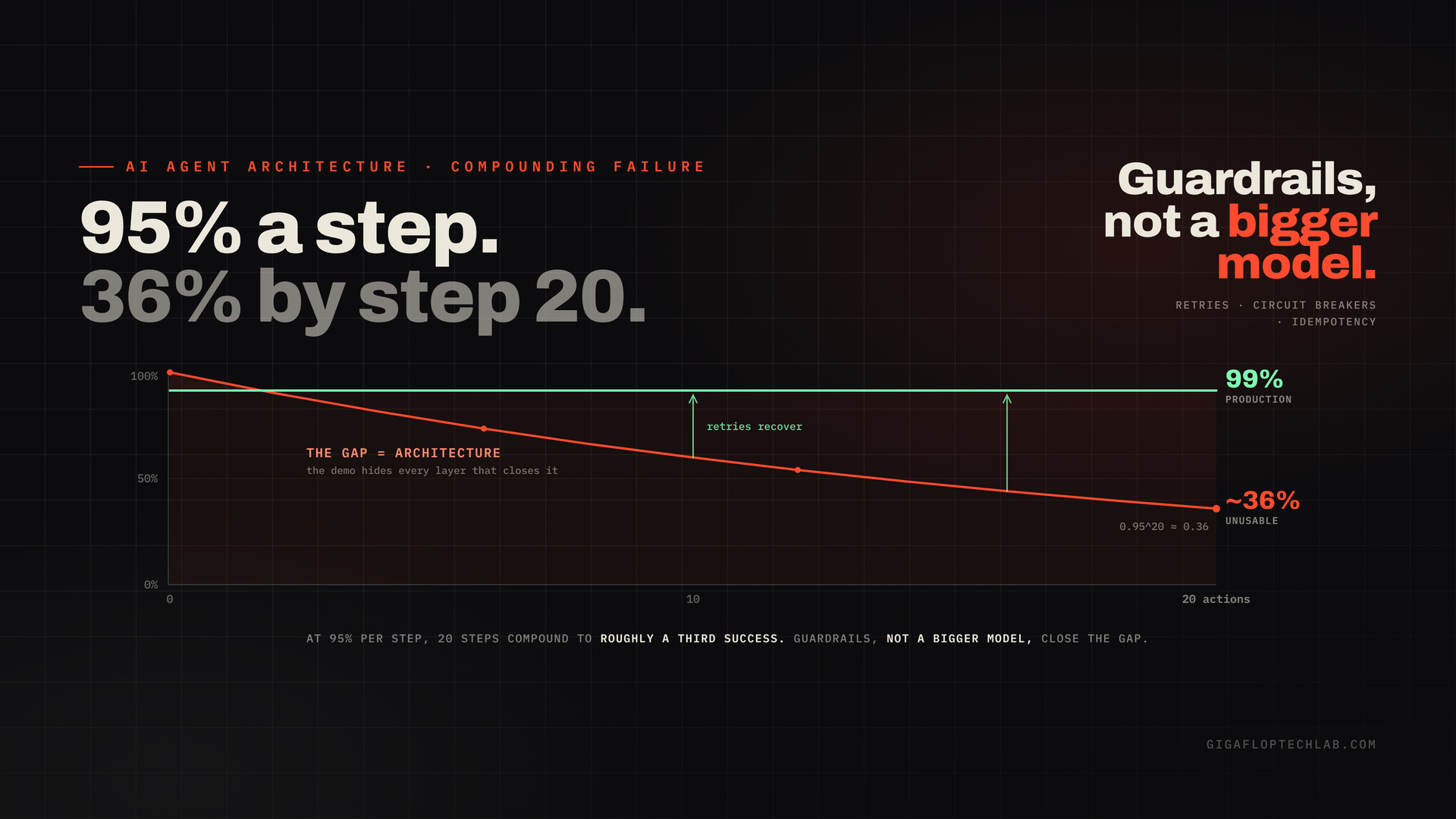
Here’s the gap, quantified. A demo agent running at 80% reliability looks magical. Production needs 99% or better, and the math is unforgiving: at a 5% per-action failure rate, an agent that takes 20 actions fails often enough to be unusable without guardrails, because errors compound across steps. The distance between that impressive demo and a system you can actually run isn’t a better model. It’s AI agent architecture, and it’s exactly the part demos hide.
The mental model that fixes this, from practitioners who ship agents: an agent isn’t a prompt. It’s a distributed system where the LLM happens to be the planner and executor. Once you see it that way, “plug-and-play” becomes obviously wrong, and the real work, the blueprint below, comes into focus.
The core mistake: collapsing everything into one prompt
Before the blueprint, the anti-pattern it exists to prevent, because nearly every failed agent shares it: collapsing all the layers into a single prompt template. Instruction logic, permissions, retrieval behavior, tool selection, and output formatting all tangled into one mega-prompt. It demos fine. Then it breaks, and you can’t reason about why, because every concern is coupled to every other. You can’t fix the permission bug without destabilizing the retrieval behavior.
The discipline that separates production agents from prototypes is separation of concerns: treat the prompt as one control input among many, externalize policy checks, isolate tool adapters, and keep retrieval configurable. That separation lets you fix one failure domain without detonating the rest. The blueprint is, fundamentally, that separation made concrete.
The 2026 agent architecture: six layers
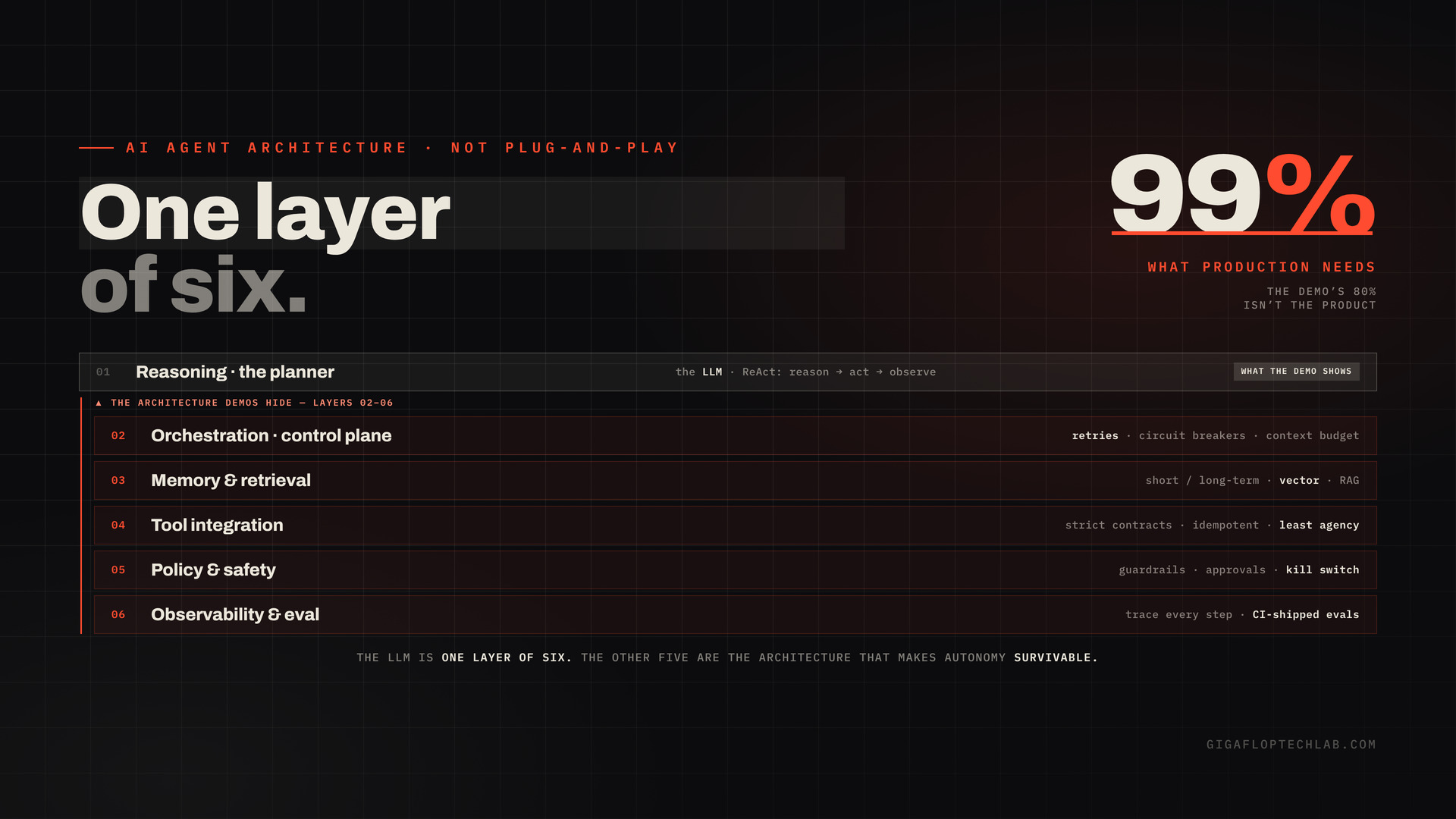
The 2026 consensus converges on roughly six layers. Think of them as the minimum set that keeps an agent from becoming unsafe or unpredictable, not optional sophistication.
1. Reasoning layer (the planner)
The LLM that plans and decides, typically running a pattern like ReAct: reason, act, observe, then repeat, alternating between thinking and taking tool actions, observing each result before the next step. This is the part everyone pictures as “the agent.” It’s one layer of six.
2. Orchestration layer (the control plane)
Where task decomposition, planning loops, routing, and error handling live, and where most reliability is won or lost. The responsibilities here that demos skip entirely:
- Error handling and retries with circuit breakers, so a failed step doesn’t cascade.
- Context management. A subtle, dangerous failure: as the conversation grows, the agent starts ignoring constraints it was following 20 messages ago. No exception is thrown, it just drifts. The fix is recursive summarization when context exceeds a budget (say, ~70% of the window) before the next call.
- Runaway-loop guardrails. An evaluator-optimizer loop whose quality bar can’t be met will retry infinitely, and a single runaway task can burn hundreds of dollars of API budget. Hard limits are mandatory. (This is also the agent-loop cost multiplier, from a budgeting standpoint.)
3. Memory and retrieval layer
Short-term memory for the active session, long-term memory (often vector search) for facts, history, and similar past cases, and RAG for grounding in current knowledge. Not every agent needs heavy vector storage, so match it to the use case, but memory architecture directly determines how intelligent and consistent the agent is. Remember too that this layer is an attack surface: poisoned memory and RAG content is a real threat.
4. Tool integration layer (with strict contracts)
How the agent acts on the world, and the layer where “autonomous” gets dangerous. The non-negotiables:
- Strict tool contracts: validate inputs and outputs, and treat tools as APIs, not magic.
- Idempotent side effects: an agent that retries must not double-charge, double-send, or double-book.
- Least agency: the agent can reach only what the current task legitimately needs. This is the single most important safety control for anything that takes real actions.
5. Policy and safety layer (guardrails)
Externalized, not baked into the prompt: which tools are allowed in which contexts, approval workflows for high-stakes actions (human-in-the-loop on the consequential paths), spending limits for agents with financial access, output filtering, and, critically, fail-safes that prevent irreversible actions plus a tested kill switch that stops the agent from outside its own judgment. This is the layer that makes autonomy survivable.
6. Observability and evaluation layer
You can’t operate what you can’t see. That means trace-level observability of every step (measure retrieval time, inference time, tool-call time, policy-check time, and approval-wait time independently to find bottlenecks), plus an eval pipeline shipped in CI so a change that regresses the agent is caught before it merges. Agentic behavior drifts and emerges, so evaluation is continuous, not a launch gate.
<!– VISUAL 2: GIF or SHORT VIDEO (required). Show, don’t tell. Suggested: a short animated GIF of compounding failure: 20 steps at 95% each, a success meter draining to about 36% by the last step (“80% demo”), then guardrails (retries, circuit breakers, idempotency) snapping it back up toward 99% (“production”). Compress. ALT TEXT: “Animation of compounding failure across 20 agent steps at 95% each, dropping to about a third success, then guardrails restoring reliability” CAPTION: At 95% per step, 20 steps compound to roughly a third success. Guardrails, not a bigger model, close the gap. –>
At 95% per step, 20 steps compound to roughly a third success. Guardrails, not a bigger model, close the gap.
Single agent or multi-agent? Resist the reflex
A quick, money-saving point: for most use cases, a single well-designed agent is enough. Multi-agent architectures (multiple specialized agents coordinating) are justified when a task genuinely exceeds one agent’s context or benefits from parallelism and specialization, and they multiply the cost, the failure surface, and the orchestration complexity, because now you also have inter-agent communication to secure and coordinate. Reach for multi-agent when the problem forces it, not because it sounds advanced. Right-size the topology.
The gap between demo and production
Put the layers together and you can see the actual work. Your agent demos at 80% reliability; production needs 99% or better. That gap is the architecture: circuit breakers, retry logic, context management, idempotent tools, least-privilege access, approval gates, kill switches, trace observability, CI evals, version control. None of it shows up in the demo. All of it determines whether the agent survives contact with real inputs, real volume, and the occasional hostile user.
This is why “autonomous agents are plug-and-play” isn’t just wrong but expensive: it sets the expectation that the demo is the product, so teams budget for the 80% and get blindsided by the cost of the last stretch. The honest version: the model is the easy 80%; the architecture is the hard, valuable part that makes it shippable.
Common mistakes
- Treating the agent as a prompt. It’s a distributed system. Architect it like one.
- One mega-prompt for everything. It couples every concern and makes failures un-debuggable. Separate the layers.
- No least-privilege on tools. Broad access “for flexibility” is the top agent-misuse vector. Least agency, always.
- Non-idempotent side effects. Retries that double-charge or double-send. Make actions idempotent before you let an agent retry them.
- No context budget. The agent silently forgets its constraints as the conversation grows. Summarize at a threshold.
- No loop guardrails. A runaway evaluator loop burning the API budget. Hard limits, mandatory.
- No kill switch or irreversible-action fail-safe. Autonomy without an off switch is a liability, not a feature.
- Reaching for multi-agent by default. More agents, more failure surface. Single well-designed agent first.
The bottom line
Autonomous agents are one of the most genuinely powerful patterns in applied AI, and one of the most over-simplified. The demo makes them look like a drop-in because it hides state, tool contracts, retries, guardrails, and evaluation. Production hides none of it. An agent is a distributed system with an LLM as the planner, and treating it as “a model plus a prompt” is how you ship something that dazzles on stage and fails on Monday.
The blueprint, six layers with separated concerns, strict tool contracts, least agency, real guardrails, a tested kill switch, and continuous eval, is the unglamorous engineering that turns an 80% demo into a 99% system. It’s not plug-and-play. It’s a build. And the teams who treat it as a build are the ones whose agents are still running in production while everyone else’s got quietly cancelled. For a sense of what that pre-production rigor catches, see how a structured audit surfaced 23 critical issues before launch.
Talk to a builder
Have an agent that dazzles in the demo but you’re not sure survives production? The gap between 80% and 99% is architecture, and it’s far cheaper to design in than to discover in an incident.
Talk to a Builder → We’ll architect (or audit) your agent as the distributed system it is: orchestration with retries and context budgets, strict tool contracts, least-privilege access, externalized guardrails and a tested kill switch, and CI-shipped evals. Production-grade autonomy, not a demo that breaks on Monday.
FAQs
Why does my agent forget instructions partway through a task?
Because an agent isn’t “an LLM plus a prompt.” It’s a distributed system where the model is the planner and executor, wrapped in orchestration, memory, tool integration, guardrails, and evaluation. The math is unforgiving: at a 5% per-action failure rate, an agent taking 20 actions fails almost every run because errors compound. A demo at 80% reliability looks magical; production needs 99% or better, and that gap is architecture the demo hides.
Roughly six layers: a reasoning layer (the LLM planner, often using ReAct), an orchestration layer (planning loops, routing, retries, context management), a memory and retrieval layer (short-term, long-term or vector, RAG), a tool integration layer with strict input/output contracts and least-privilege access, a policy and safety layer (guardrails, approval gates, spending limits, kill switch), and an observability and evaluation layer (tracing plus CI-shipped evals).
Collapsing all the layers into one prompt template, tangling instruction logic, permissions, retrieval, tool selection, and output formatting together. It demos fine but breaks in production and is impossible to debug, because every concern is coupled to every other. The fix is separation of concerns: treat the prompt as one control input, externalize policy checks, isolate tool adapters, and keep retrieval configurable.
Layered guardrails: least-privilege tool access (the agent reaches only what the task needs), approval workflows for high-stakes actions, spending limits for financial access, idempotent side effects so retries don’t double-charge, hard limits on retry loops to prevent runaway budget burn, fail-safes that block irreversible actions, and a tested kill switch that stops the agent from outside its own judgment. Guardrails should be externalized, not baked into the prompt.
For most use cases, a single well-designed agent is enough. Multi-agent architectures are justified when a task genuinely exceeds one agent’s context or benefits from parallelism or specialization, but they multiply cost, failure surface, and orchestration complexity, and add inter-agent communication to secure. Reach for multi-agent when the problem forces it, not because it sounds advanced. Right-size the topology to the task.
It’s a context-management failure: as the conversation grows, earlier constraints fall out of effective attention and the agent drifts, with no error thrown. The fix lives in the orchestration layer: monitor context against a budget (for example ~70% of the model’s window) and trigger recursive summarization before the next agent call, so critical constraints persist instead of silently dropping as the task runs long.