The most important shift in enterprise AI this year isn’t making headlines, because it doesn’t look like a product launch. It looks like workflows quietly working differently. The shift: AI stopped being text-in, text-out.
Until recently, “AI” in most enterprises meant a chatbot or a copilot reading and writing text. In 2026, the leading frontier models process text, images, audio, and video natively, in a single call (industry analysis, 2026). That’s not a feature bump it’s a change in what an AI system can perceive, and therefore what kind of work it can take on. The interesting part is how undramatically it’s arriving: not as a demo on stage, but as a support agent that can see the photo you sent, a pipeline that reads the invoice instead of asking you to type it, and a platform that watches several signal streams at once. Let’s separate what’s real from what’s hype, and what it means for you now.
Trend 1 – Perception, not just language
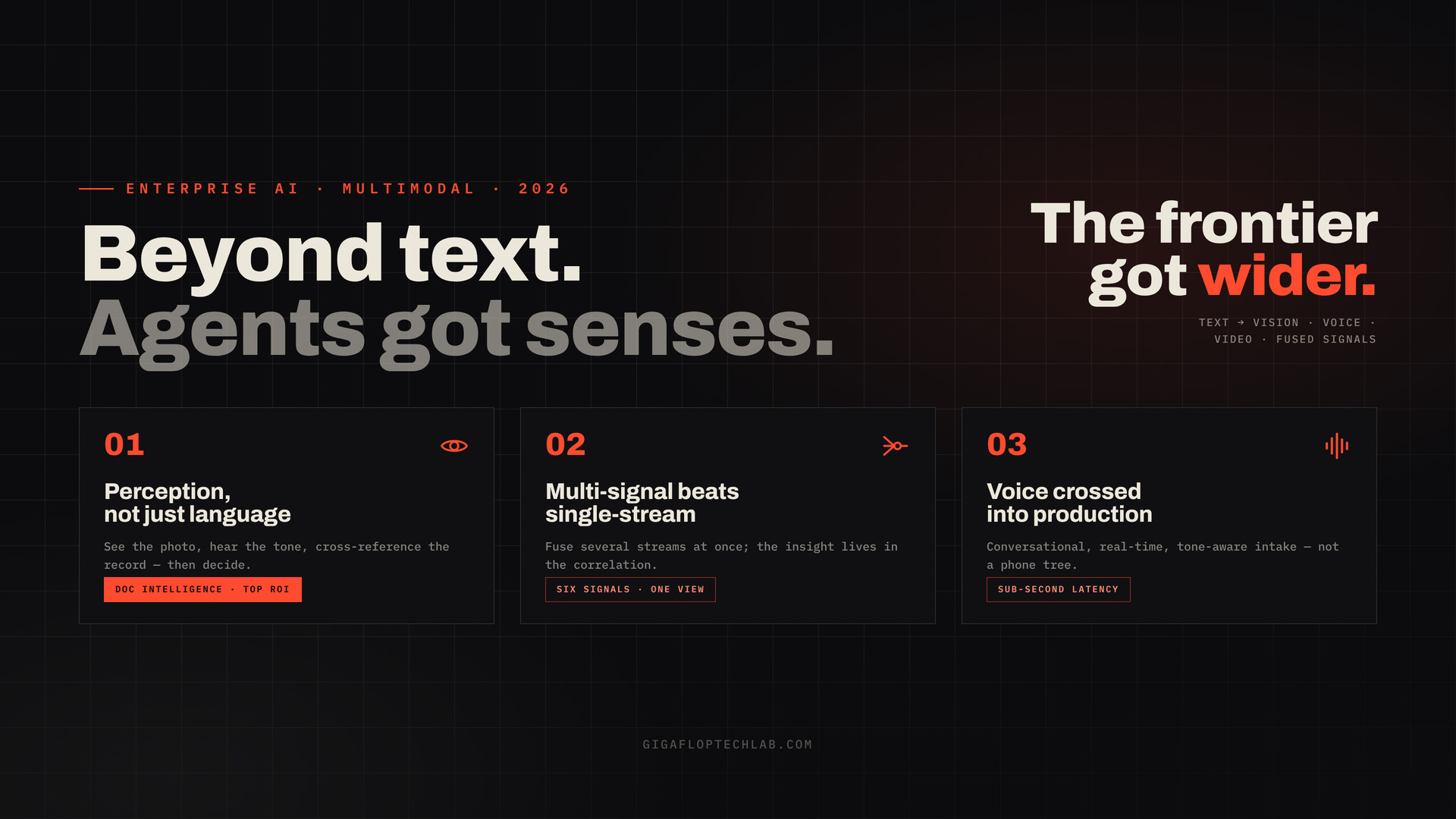
The shift: Agents are gaining senses. A multimodal agent doesn’t just read a complaint it can interpret the product photo attached to it, register the tone in a caller’s voice, and cross-reference the customer’s records, then decide what to do next.
The evidence: This is grounded, not speculative. The multimodal AI market reached several billion dollars in 2026 and is growing at nearly 30% a year (multiple 2026 analyses). About half of consumers now say they prefer multimodal interactions as their primary way to communicate (Voice AI trends, 2026). And the enterprise ROI is concentrated where it’s least glamorous: document intelligence replacing manual data entry from invoices, forms, and contracts at high accuracy and a fraction of the cost is repeatedly cited as the highest-return multimodal application.
The implication: Whole categories of work that required a human because only a human could see or hear the input are now in scope for automation. That’s a different frontier than text automation, and it’s wider than most roadmaps assume.
What to do now: Audit your workflows for the ones currently stuck on “a person has to look at this / listen to this.” Those are your new automation candidates and they were invisible a year ago.
Trend 2 – Multi-signal analysis beats single-stream
The shift: The deeper unlock isn’t any one new modality it’s fusing several at once. One signal tells you a little; several signals together tell you something none of them could alone.
The evidence a real build: We’ve built this. A six-channel behavioral-analysis platform unifies multiple signal streams into one analytical view the same kind of multi-source intelligence layer we’ve written about in healthcare, where conversations, claims, search trends, and research only become insight when read together. [[EDITOR: CS-HEALTHINTEL-reference the six-channel platform at pattern level; confirm specifics + naming approval. This is the SAME build referenced in the Day 9 healthcare post keep consistent.]] The pattern generalizes far beyond healthcare: supply-chain agents that watch text reports, imagery, and audio communications together to flag disruptions before they cascade; support agents that read the message, the image, and the voice tone as one context.
The implication: Competitive insight increasingly lives in the correlation between signals, not in any single stream. Organizations still analyzing one channel at a time are reading one instrument on a dashboard that now has six.
What to do now: Identify decisions where you currently look at sources separately and stitch them mentally. Those are candidates for multi-signal fusion and often the highest-value, least-obvious wins.
Trend 3 – Voice crossed the production line
The shift: Voice agents moved from frustrating phone-tree replacements to genuinely conversational systems that detect tone, urgency, and frustration and act in real time.
The evidence: Production voice frameworks now hit sub-300–800ms latency budgets, the threshold where conversation feels natural rather than stilted (production architecture analyses, 2026). Emotional-signal detection is reducing support escalations measurably. We’ve built in this space too a voice-and-chat concierge agent operating at sub-second response latency. [[EDITOR: CS-CONCIERGE pattern-level reference; confirm sub-1s latency claim + approval.]] The latency barrier that made voice agents feel broken has largely fallen.
The implication: Voice is now a viable primary interface for real workflows intake, qualification, support not just a novelty. The constraint has shifted from “can it respond fast enough?” to “have we designed the workflow and the guardrails well enough?”
What to do now: If you dismissed voice agents on a bad 2023 experience, re-evaluate. The technology that frustrated you has materially changed; the design discipline around it is now the differentiator.
The honest caveats (because this is a trend piece, not a sales pitch)
Multimodality is real, but the production reality has sharp edges worth naming:
- It’s an architecture problem, not a prompt. Production multimodal systems are pipelines with latency budgets, cross-modal fusion logic, and graceful degradation when a camera feed drops or audio is garbled. The demo is easy; the system is not.
- Failure modes multiply. More modalities mean more ways to be confidently wrong. The same human-in-the-loop and eval discipline that governs text agents matters more here, not less.
- ROI still concentrates. Despite the breadth, the clearest returns cluster in a few areas (document intelligence first). Chasing multimodality everywhere is how budgets evaporate. Chase it where a signal you couldn’t process before unlocks a decision you couldn’t make before.
What this means for your roadmap
The strategic read: the set of automatable work just expanded, quietly, and most roadmaps haven’t caught up. For years the boundary was “AI handles text; humans handle everything that requires seeing, hearing, or judging across sources.” That boundary moved. The organizations that notice will find automation candidates their competitors still assume require people and insight in signal combinations their competitors still read one at a time.
This won’t arrive as a single dramatic capability. It’s arriving the way it already is: quietly, workflow by workflow. The advantage goes to whoever looks for it deliberately instead of waiting for it to announce itself.
Conclusion
“Beyond text” sounds like a slogan; in 2026 it’s an operational fact. Agents can now perceive what used to require a person, and fuse signals no single stream could explain. The hype says everything changed overnight. The reality is quieter and more useful: specific workflows document handling, multi-signal analysis, voice intake are being reshaped right now, by teams who treated multimodality as an engineering discipline rather than a demo.
The frontier didn’t get louder. It got wider. The question is whether your roadmap reflects a boundary that has already moved.
CTA
Curious where multimodal could reshape a workflow in your business and where it’d just be expensive novelty? That’s worth a grounded conversation, not a hype reel.
See What Multimodal Can Do → we’ll look at where voice, vision, or multi-signal fusion would genuinely unlock work you currently can’t automate, drawn from real builds. And for the contrarian, production-grade read on where this is heading
FAQs
A multimodal AI agent processes more than one type of input combining text, voice, images, video, and other signals rather than handling each separately. In practice it can read a message, interpret an attached photo, register tone of voice, and cross-reference records together, then decide on an action. It’s perception across modalities, not just language.
They’re in production in 2026. Frontier models process text, images, audio, and video natively, and the multimodal market is growing at nearly 30% a year. The clearest enterprise uses today are document intelligence, voice-plus-vision support, and multi-signal analysis though building them reliably is an engineering discipline, not a quick prompt.
Document intelligence is the most-cited high-return application replacing manual data entry from invoices, forms, and contracts at high accuracy and far lower cost. Beyond that, multi-signal analysis (fusing several data streams into one view) and modern voice agents for intake and support are strong. ROI concentrates in specific workflows rather than spreading everywhere.
The architecture, not the model. Production systems need latency budgets (especially for voice), cross-modal fusion logic, and graceful degradation when an input stream fails. More modalities also mean more ways to be confidently wrong, so eval pipelines and human-in-the-loop oversight matter more, not less.
Not wholesale. Add multimodal where a signal you couldn’t previously process unlocks a decision you couldn’t previously make a photo in support, a voice tone in intake, several streams fused for analysis. Where text alone does the job well, keep it. The goal is matching the modality to the workflow, not maximizing modalities.
Largely yes. Production voice frameworks now hit the sub-second latency budgets where conversation feels natural, and systems can detect tone and urgency in real time. If you wrote off voice agents on a poor earlier experience, the technology has changed materially the differentiator now is workflow and guardrail design, not raw capability.