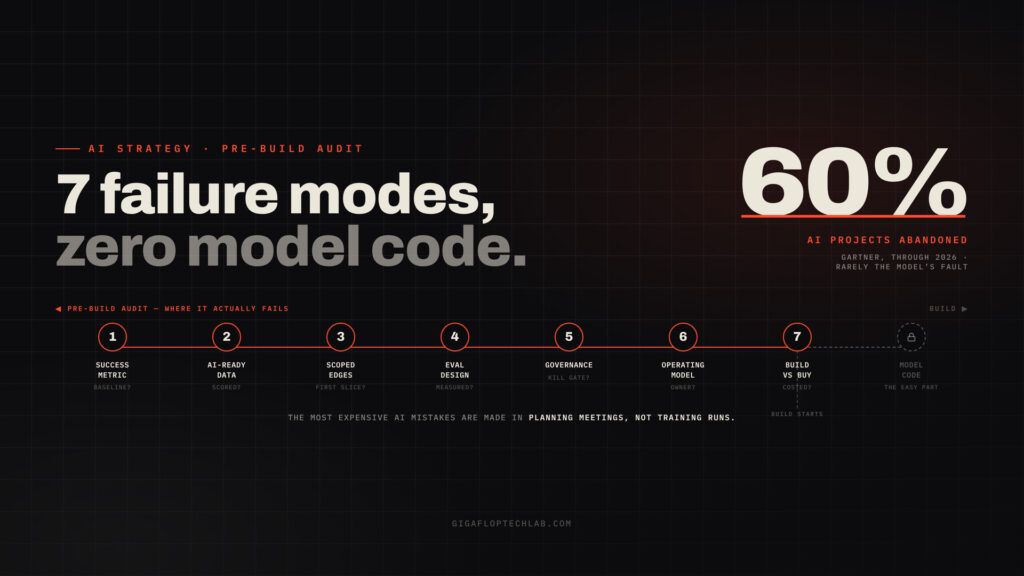
You’ve seen the headline. “95% of AI pilots fail.” “70 to 80% of AI projects don’t deliver.” It gets quoted in board meetings to justify caution, in think-pieces to declare the bubble, and in your own head at 2am when your pilot is wobbling. Right now it’s one of the most-cited statistics in enterprise technology, and it’s also one of the most misread. This post breaks down what that number actually measures, the six things that are really killing pilots, and why every one of them is fixable before you spend the budget.
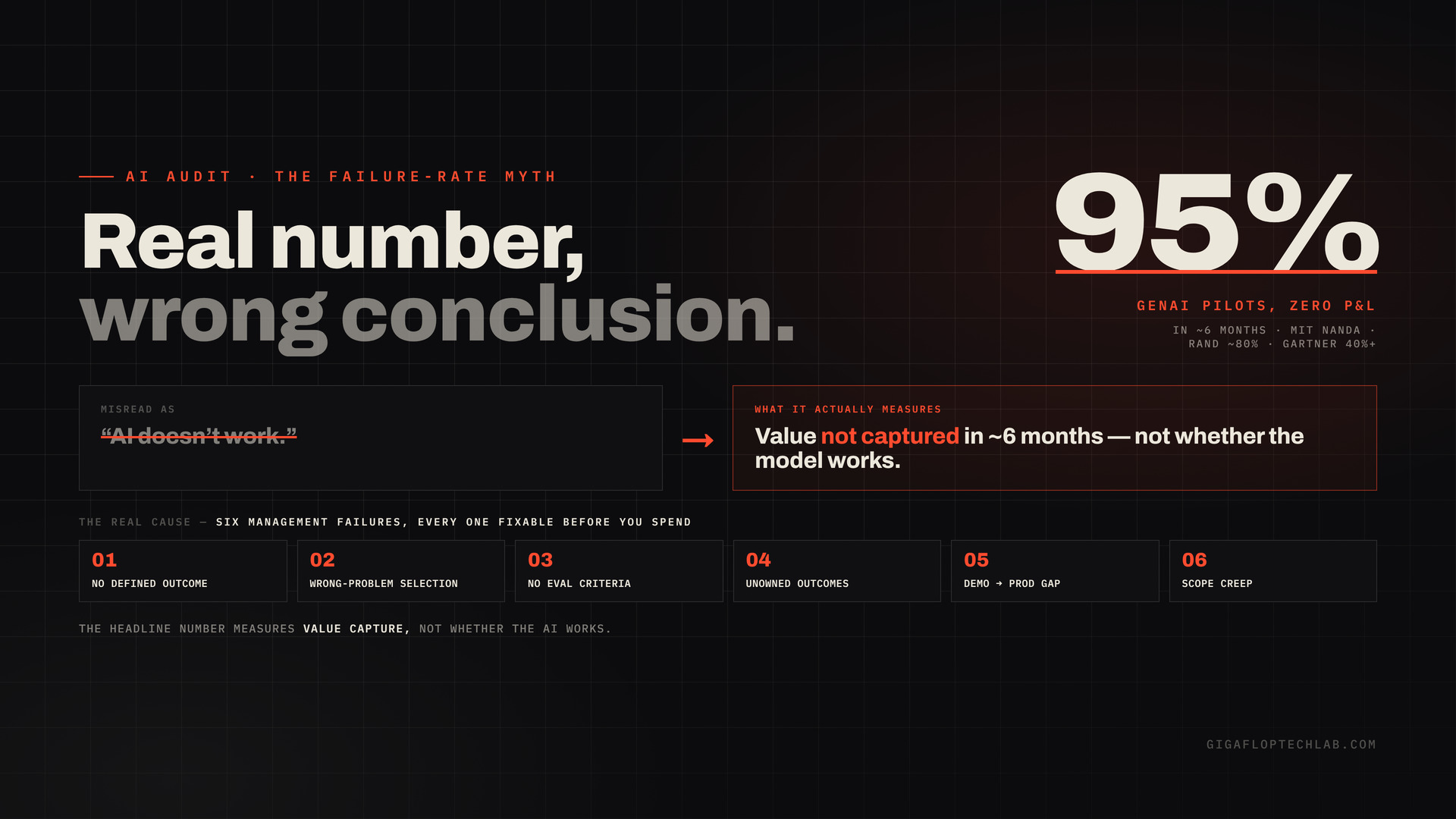
Start with the part nobody disputes: the numbers are real. MIT’s NANDA study found that 95% of GenAI deployments delivered zero measurable P&L impact, RAND put AI project failure around 80%, and Gartner expects more than 40% of agentic projects to be cancelled by 2027. What’s wrong is the conclusion people draw from them: “AI doesn’t work, so be cautious.” That inference is the expensive part, because acting on it means you either pass on a genuinely useful tool or repeat the exact mistakes that produced the statistic.
Here’s the clear-eyed version. That failure rate is real, almost entirely self-inflicted, and almost entirely fixable.
What the AI failure rate statistic actually measures
Read the methodology and the headline stops working as a verdict on the technology. MIT defined “success” as deployment beyond the pilot stage, with measurable KPIs and ROI verified inside roughly six months. By that yardstick the 95% figure measures value realization, and most organizations are realizing none of it.
That narrow definition matters for how you read the number. It captures direct P&L within six months and ignores other genuine value: efficiency gains, cost reduction, lower churn, conversion lift, faster pipeline. A pilot that delivers those but no clean six-month P&L line still gets counted as a failure. In other words, the data conflates “the AI didn’t work” with “we didn’t capture the value.” Critics of the headline have made the same point repeatedly: in the cases studied, the technology itself almost never failed. The way the investment was designed and operationalized did.
The honest summary across MIT, RAND, Gartner, and McKinsey lands in the same place. The technology is rarely the reason a project fails. The capability isn’t overhyped; the assumption that capturing value would be easy is.
So the failure rate isn’t evidence that AI doesn’t work. It’s evidence that most organizations are bad at the management discipline around AI, which is good news, because that discipline is something you control.
What’s actually killing your pilots
Strip away the headline and the real causes are remarkably consistent. Every one of them is a decision, not a technology limitation.
1. No defined outcome before the build. The most common pattern is launching a pilot because AI is exciting, not because someone defined the business outcome first. No baseline, no target, no agreed definition of success. A pilot with no success criterion can’t succeed. It can only continue.
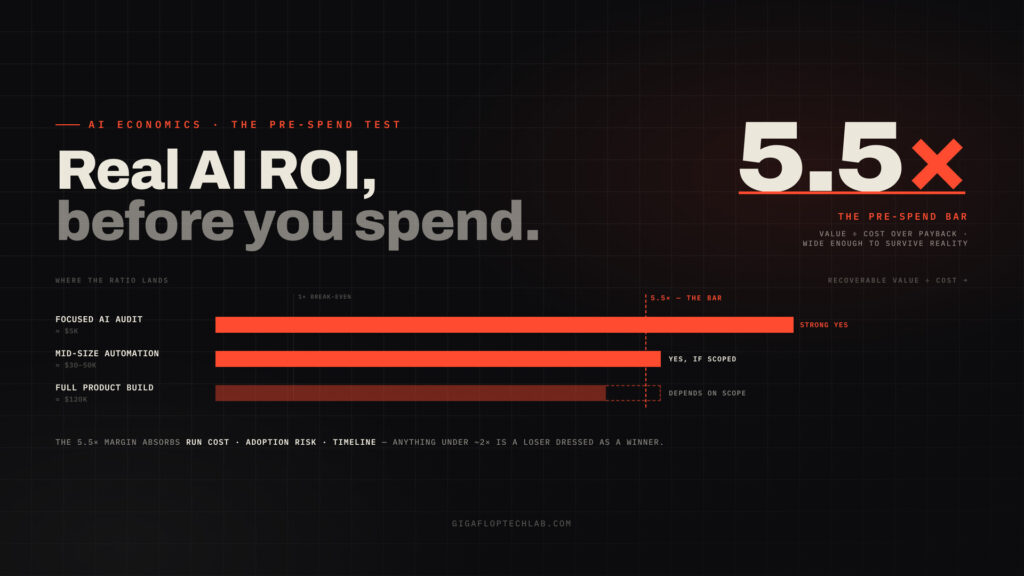
2. Wrong-problem selection. This is the most underrated killer: pointing AI at a problem whose maximum possible upside is too small to ever justify the cost. A 12% improvement on a $500K process will never produce meaningful ROI no matter how good the model is. The math was lost at selection, which is why choosing the right workflow matters far more than model quality. If you want the arithmetic behind that, our breakdown of real AI ROI walks through how the numbers actually pencil out.
3. No eval criteria. Without an eval pipeline and a baseline, a pilot can generate impressive demos and dashboards for 18 months without producing a dollar of value. By the time the gap is obvious, the spend is sunk. With no measurement, you can’t tell a working pilot from a theatrical one until a budget review forces the question.
4. Unowned outcomes. A pilot run by “the innovation team” as a side project, with no accountable business owner on the hook for the result, drifts. When nobody owns the outcome, nobody is responsible for capturing the value, so it doesn’t get captured.
5. The demo-to-production gap. The pilot ran on clean data, friendly users, and no performance pressure. Production is the opposite. Teams confuse a working demo with a production-ready system and underestimate the integration, governance, and reliability work in between. That gap is the entire subject of our production-readiness checklist.
6. Scope creep. A tightly scoped pilot turns into a sprawling “while we’re at it” program, the timeline balloons, and it collapses under its own weight before proving anything. Narrow scope is a feature, not a limitation.
What the 5% do differently
If the failures were a technology problem, the successful minority would simply have better models. They don’t. They have better discipline, and the evidence is specific.
The 5% do the unglamorous work: baselining, holdout groups to prove impact, total cost transparency, portfolio discipline, and real operating-model change. They decide how they’ll capture value before they buy the technology. MIT also found that vendor- or expert-led builds succeed about twice as often as internal ones (roughly 67% versus 33%), largely because outside builders don’t underestimate integration complexity, governance, and the road to production-grade reliability. And smaller, focused efforts convert better than sprawling ones: mid-market firms tend to scale a successful pilot in about 90 days, while large enterprises take closer to nine months. You can see what that discipline looks like in practice in our case studies.
None of that is about a better model. All of it is about how the work is selected, measured, owned, and operationalized.
The bottom line
The 70% AI failure rate is real as a number and a myth as a conclusion. It doesn’t mean AI doesn’t work. It means most organizations launch pilots without a defined outcome, against the wrong problem, with no eval criteria, no clear owner, and no plan to cross the gap between a demo and production. Each of those is a management failure, and each is fixable before the budget is spent.
That reframe is the whole point. A statistic that sounds like “be afraid of AI” actually says “be disciplined about AI.” The companies pulling ahead aren’t the ones with secret models. They’re the ones doing the unglamorous work the headline never mentions. Your pilot isn’t doomed by a failure rate. It’s at risk from six specific, nameable, fixable mistakes, and naming them is the first move out of the statistic.
Get an honest pilot assessment
Worried your pilot is quietly drifting toward that statistic, or want to make sure your next one doesn’t? The failure causes are specific and catchable before the budget is sunk.
Get an Honest Pilot Assessment → We’ll check your pilot against the real failure causes (defined outcome, problem selection, eval criteria, ownership, production-readiness, scope) and tell you plainly whether it’s on track, fixable, or pointed at the wrong problem. The clear-eyed read is a lot cheaper than the post-mortem.
FAQs
The numbers are real but widely misread. MIT’s NANDA study found 95% of GenAI deployments delivered no measurable P&L impact, and RAND put AI project failure around 80%. But these measure value realization against a narrow definition (measurable P&L within roughly six months), not whether the technology works. The myth is inferring “AI doesn’t work.” The data actually shows most organizations fail at the management discipline around AI.
For management reasons, not technology ones. The consistent causes are: no defined business outcome before building, wrong-problem selection (upside too small to justify the cost), no eval criteria or baseline, unowned outcomes, the gap between a demo and a production system, and scope creep. Across MIT, RAND, Gartner, and McKinsey, the technology is rarely the reason a project fails.
It measures whether organizations captured measurable, verified P&L value within about six months of a pilot, not whether the model performed. Critics note this ignores other real value like efficiency gains, cost reduction, and conversion improvements, so a pilot can deliver genuine benefit and still count as a failure under that definition. It’s a value-capture metric, not a technology-capability metric.
They do the unglamorous discipline: baselining and holdout groups to prove impact, total cost transparency, portfolio discipline, clear ownership, and operating-model change, deciding how they’ll capture value before buying technology. Notably, vendor- or expert-led builds succeed roughly twice as often as internal builds (about 67% versus 33%), largely because they don’t underestimate the path to production-grade reliability.
Wrong-problem selection: pointing AI at a problem whose maximum possible upside is too small to justify the build, run, and change-management cost. A modest improvement on a low-value process can never produce meaningful ROI regardless of model quality. The return was lost at the selection stage, which is why choosing the right workflow matters more than model performance.
It should make you disciplined, not cautious. The statistic doesn’t say AI doesn’t work; it says undisciplined AI programs don’t deliver. The right response isn’t to avoid AI, it’s to define the outcome first, select high-value problems, measure with real eval criteria, assign clear ownership, and plan for production. The failure causes are fixable, and the companies applying that discipline are pulling ahead.