There’s a quiet assumption baked into how most teams talk about human-in-the-loop: that it’s a crutch. A temporary concession you make because the AI isn’t quite good enough yet, a cost you’ll engineer away as the models improve. “We still need a human to check it” gets said apologetically, like an admission of failure.
That framing is backward, and it’s costing teams the best structural advantage available in applied AI. Needing a human in the loop doesn’t mean the agent fell short. It’s a design pattern for environments where perfect automation is neither possible nor desirable, and treated that way it becomes a competitive advantage rather than a compromise.
The teams that internalize this don’t bolt a human onto a shaky system and call it safe. They design the human in deliberately, at the right points, and in doing so build something pure-automation competitors can’t match: a system that’s more accurate, that earns trust, and that gets better the more it runs. Here’s the case.
Reframe 1: The accuracy is higher than either alone
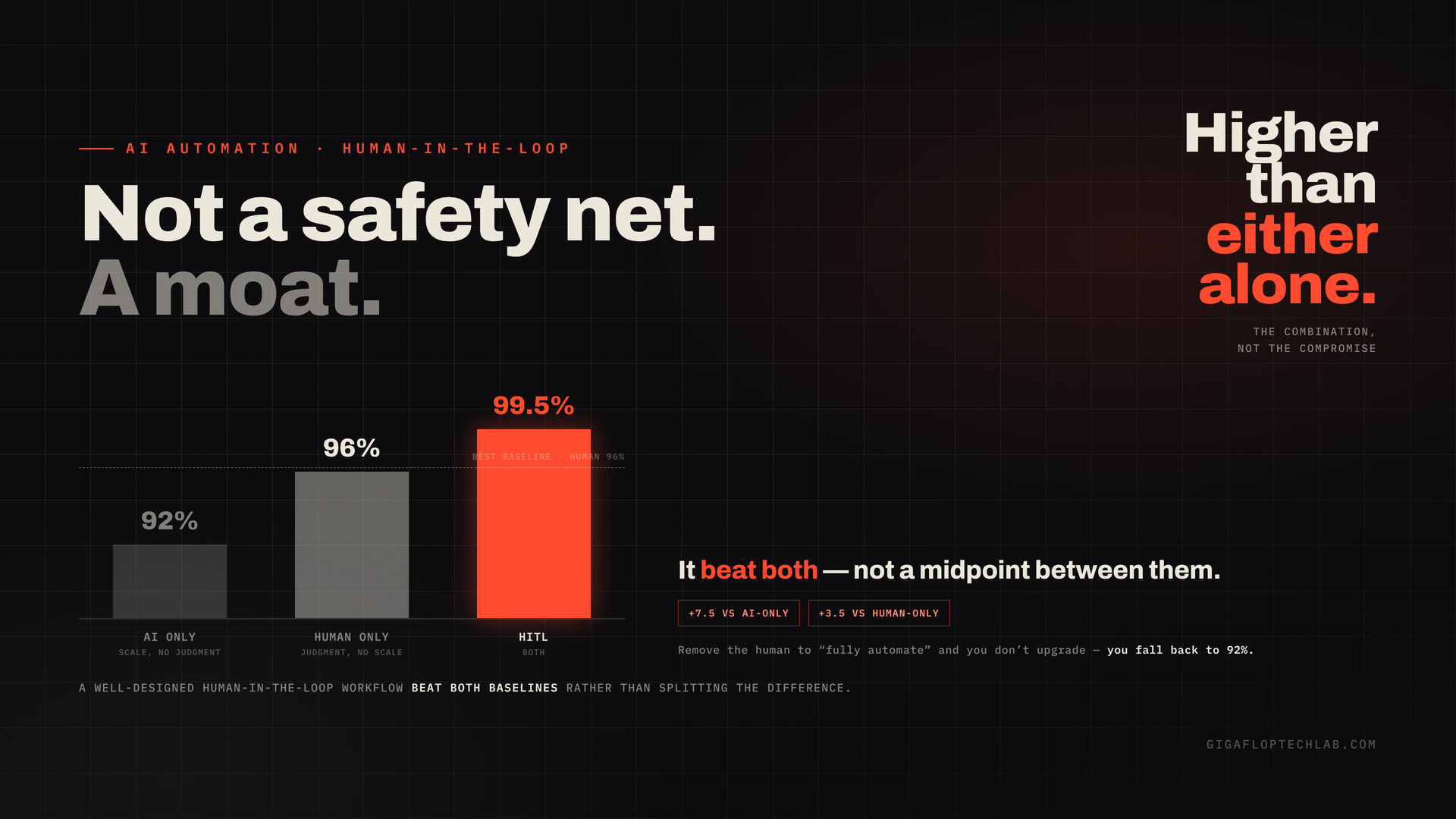
Start with the claim that should end the “HITL is a crutch” argument on the spot. Well-designed human-AI systems outperform both pure-human and pure-AI baselines. In one documented diagnostic deployment, a human-in-the-loop workflow reached about 99.5% accuracy, against roughly 96% for a human-only process and 92% for AI-only.
Read that again. The human-in-the-loop system didn’t land somewhere between the human and AI numbers. It beat both. That’s the whole thesis in one figure. The human isn’t there to drag a 92% AI up to something acceptable; the combination produces something neither could reach alone, because AI contributes scale and pattern recognition while the human contributes judgment on exactly the cases where judgment matters. Removing the human to “fully automate” wouldn’t be an upgrade. It would be a step back down to 92%.
Reframe 2: Confidence-based routing makes the human cheap and high-leverage
The objection to HITL is always cost, because humans don’t scale if you put one on every case. But that’s not the design. The mechanism that turns HITL from a bottleneck into an advantage is confidence-based routing: the AI scores its own certainty on every case, auto-handles the high-confidence routine ones, and sends only the low-confidence or high-risk cases to a person.
That inverts the economics. High-confidence, routine work flows through automatically, at full automation speed where it’s safe. Low-confidence and high-stakes work gets a human, with full judgment where it counts. Human attention goes only where it’s most valuable, so a small team can oversee enormous volume. The results are concrete: some contact-center deployments report around 96% routing accuracy with confidence-based handoffs, sending the cases that need a person to a person.
A clean way to hold the principle: AI handles scale; humans handle irreversibility. Automate the routine and reversible, and reserve people for the consequential and the ambiguous. The goal isn’t more oversight. It’s fewer, higher-value interventions. Picking which work belongs in which lane is the same discipline we cover in automating the right workflows, not the wrong ones.
Reframe 3: The flywheel that makes the system better
This is the reframe that turns HITL from a cost into a compounding asset, and it’s the part pure-automation teams structurally can’t replicate.
In a well-designed HITL system, human review isn’t a dead-end quality check. It’s a data-generation engine. Every time a reviewer corrects, rejects, or modifies an AI output, that decision gets logged with its reasoning and fed back to improve prompts, validators, routing thresholds, evals, and training data. Review becomes an improvement loop, and decisions become signals.
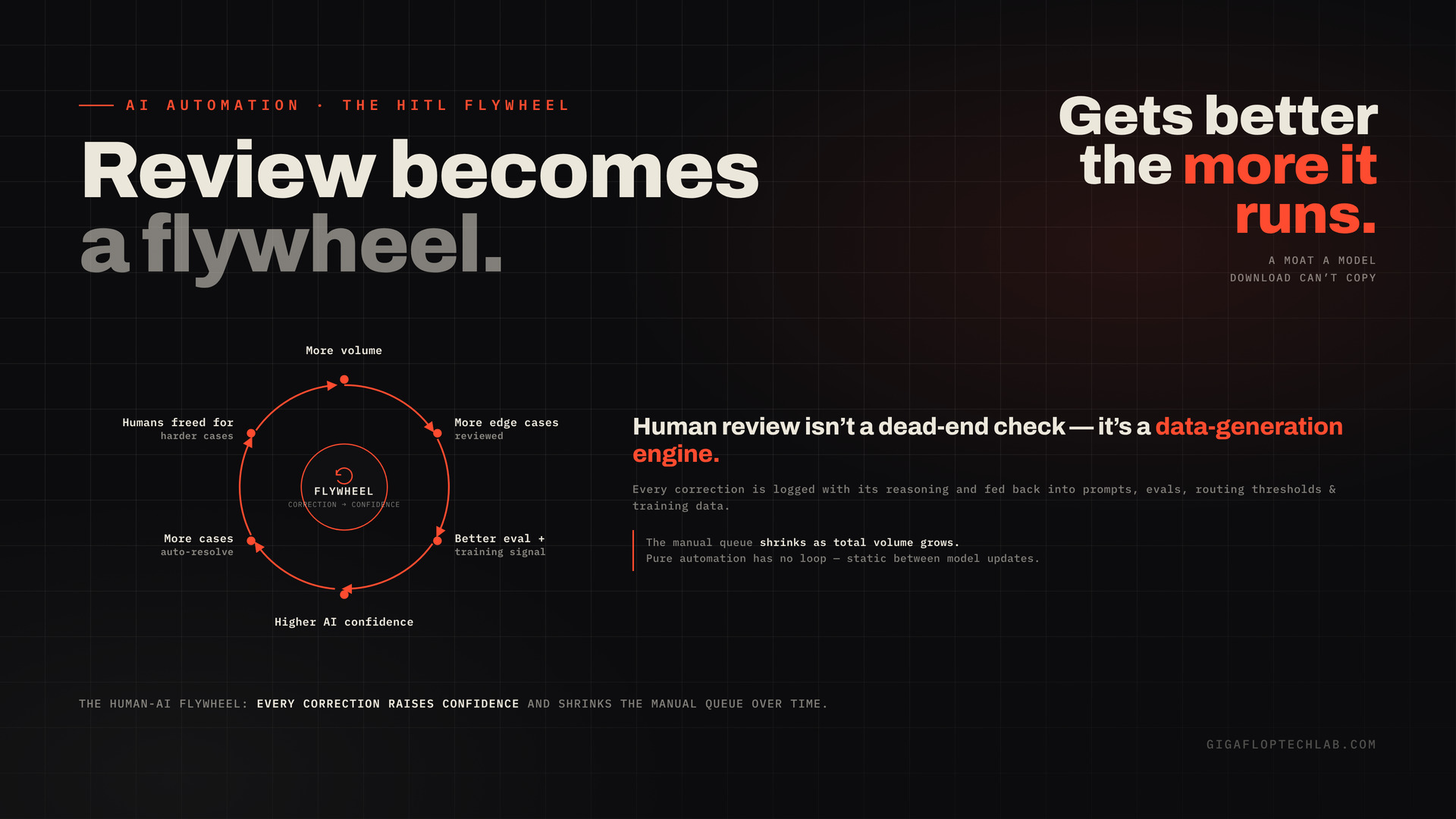
The result is a flywheel. More volume means more human-reviewed edge cases, which means better training and eval signal, which raises AI confidence on those cases, which lets more of them auto-resolve, which frees human time for the next frontier of hard cases. Then it repeats. The manual review burden shrinks over time even as total volume grows, because the system keeps learning from exactly the cases that used to need a person.
A pure-automation system has no such loop. It’s static between model updates. A HITL system is continuously distilling your experts’ judgment into the product, and that accumulated, corrected, domain-specific judgment is a moat. A competitor can copy your model choice in an afternoon. They can’t copy a year of compounded corrections. You can see how we build that loop into delivery in our case studies.
Reframe 4: HITL is what makes trust and governance real
There’s a fourth advantage that matters more every quarter. Human oversight is increasingly how you earn trust and meet obligations, and trust is a competitive asset. Governance expectations are climbing: the EU AI Act‘s broad obligations start applying in August 2026 (with high-risk-system rules phasing in after that), and financial-sector rules like DORA are already in force. Human oversight on consequential decisions is becoming table stakes for regulated buyers. A system with well-designed HITL can be sold into contexts a pure-automation system can’t, because someone is accountable for the decisions that matter. Oversight isn’t only risk reduction. It’s market access.
Designing it well, because bad HITL really is just a cost
The reframe only holds if the HITL is well-designed. Done badly, it becomes the bottleneck the skeptics fear. The principles that separate advantage from drag:
- Route by confidence and risk, not volume. Explicit triggers (low confidence, high stakes, policy flags, validator failures) decide what a human sees. Don’t put humans on everything.
- Close the feedback loop, or you don’t have a flywheel. Log why a reviewer overrode the AI and feed it back into prompts, evals, and training. Review without feedback is pure cost; review with feedback is the moat.
- Prevent rubber-stamping. If reviewers reflexively approve, you have the cost of oversight with none of the benefit. Surface the AI’s reasoning and uncertainty so the human is genuinely deciding, not nodding.
- Sample the auto-approved, too. Even high-confidence outputs need random sampling to measure escape rate and catch drift. This is where HITL meets the production-readiness checklist and your eval pipeline.
- Treat it like an SRE practice. Thresholds, queues, SLAs, and a runbook for spikes and regressions. HITL is operational infrastructure, not a goodwill gesture.
- Aim to shrink human volume over time. The target is fewer, higher-value interventions as the flywheel turns, not a permanent army of reviewers.
Designed this way, oversight stops being a tax and starts behaving like the governance backbone we describe in AI governance without bureaucracy.
The bottom line
The instinct to treat human-in-the-loop as a temporary safety net, something to apologize for and engineer away, gets the strategy exactly wrong. Designed deliberately, HITL produces accuracy neither humans nor AI reach alone, concentrates expensive human judgment only where it pays, compounds into a flywheel that makes the system better and cheaper to run over time, and unlocks the trust and governance that open regulated markets.
That’s not a crutch. That’s a moat. The competitors racing to remove the human entirely are optimizing for a press release. The ones designing the human in are building a system that gets smarter every day it runs, and capturing the judgment of their best people into something a model download can’t replicate. Human-in-the-loop isn’t what you do until the AI is good enough. It’s how you stay ahead once it is.
Design your HITL workflow
Are you treating human oversight as a cost to minimize, or designing it as the loop that makes your AI compound? The difference is whether HITL is your bottleneck or your moat.
Design Your HITL Workflow → We’ll design confidence-based routing, escalation triggers, and the feedback loop that turns every human correction into a system improvement, so your team oversees more volume over time, not less, and your accuracy climbs past what either humans or AI hit alone. Oversight as advantage, by design.
FAQs
Human-in-the-loop is a design pattern where people are deliberately placed at specific points in an AI workflow, typically reviewing low-confidence, high-stakes, or ambiguous cases, rather than checking everything or nothing. Well-designed HITL uses confidence-based routing to auto-handle routine work and escalate only the cases that genuinely need judgment, combining AI’s scale with human accountability.
No, that’s the most common misconception, and it’s backward. HITL isn’t a workaround for immature technology; it’s a design pattern for environments where perfect automation is neither possible nor desirable. Documented HITL workflows have reached about 99.5% accuracy versus roughly 96% human-only and 92% AI-only, so the combination beats both. Removing the human is often a downgrade, not an upgrade.
The AI scores its own certainty on each case. High-confidence, routine cases are handled automatically at full speed, while low-confidence or high-risk cases are routed to a human reviewer. This concentrates expensive human attention only where it adds the most value, letting a small team oversee large volumes. Some contact-center systems report around 96% routing accuracy with this approach.
Through the feedback flywheel. Every human correction is logged with its reasoning and fed back to improve prompts, evals, routing thresholds, and training data, so the AI’s confidence rises, more cases auto-resolve, and manual volume shrinks over time even as total volume grows. A pure-automation system is static between updates; a well-designed HITL system continuously distills your experts’ judgment into a moat competitors can’t quickly copy.
Bad HITL puts humans on everything, has no feedback loop, and lets reviewers rubber-stamp, which is pure cost and a bottleneck. Good HITL routes by confidence and risk, closes the feedback loop so corrections improve the system, surfaces AI reasoning so humans genuinely decide, samples auto-approved outputs to catch drift, and aims to shrink human volume over time. The design is what determines whether HITL is an advantage or a drag.
Human oversight on consequential decisions is increasingly expected rather than optional. The EU AI Act’s broad obligations begin applying in August 2026 (with high-risk-system requirements phasing in afterward), and financial-sector rules like DORA are already in force. Well-designed HITL provides the accountability and review points regulated buyers demand, which means a HITL system can be sold into contexts a pure-automation system can’t. Oversight becomes market access, not just risk reduction.