Predictions are cheap, and most AI predictions are worthless, either breathless (“everything changes tomorrow”) or dismissive (“it’s all hype”). So a ground rule for this one, the last in a 30-part series: every prediction about the future of work in 2030 here is anchored to something already visible in 2026, dated to 2030, and paired at the end with an honest account of what would prove it wrong. Bold, but falsifiable. That’s the only kind of prediction worth your time.
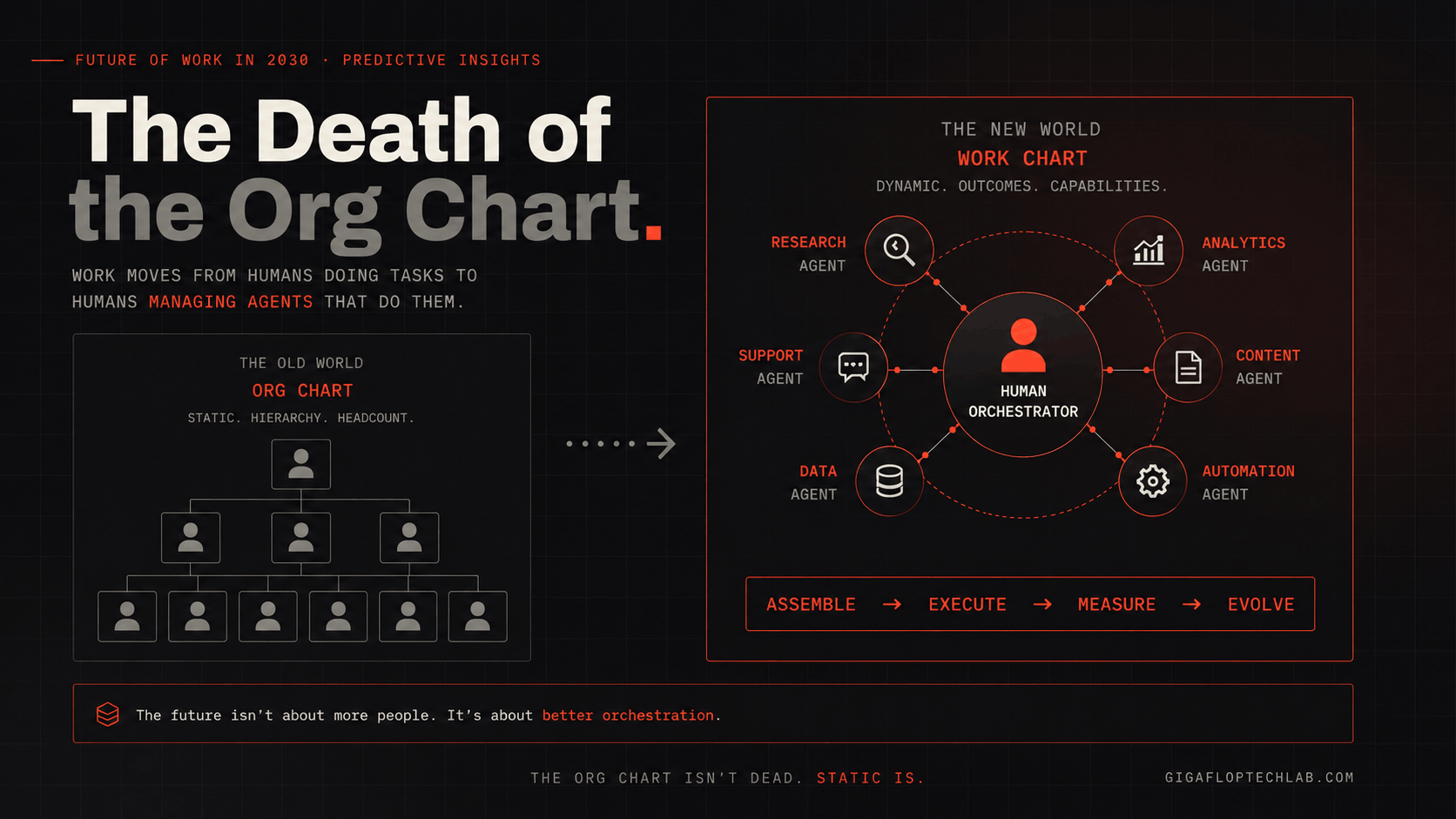
The throughline across all five is a single shift, and once you see it you can’t unsee it: work moves from humans doing tasks to humans managing agents that do them. Everything below is a consequence of that one sentence, including the provocative bit in the title, the org chart. Let’s get to it.
Prediction 1: The org chart becomes a “work chart”
The static hierarchy, boxes of humans, fixed reporting lines, headcount as the unit of capacity, is the first casualty. By 2030, expect it to give way to what some already call a “work chart”: dynamic, outcome-based teams of humans plus agents, assembled from a live skills graph and an agent registry for the work at hand, then re-formed for the next.
This is already starting. Consultancies are predicting a wave of “delayering,” and one AI-native CTO put it plainly: automating basic reporting and data functions “breaks the middle management hierarchy,” letting one person coordinate far more. (UPS, before agents were even in the picture, had already cut 12,000 of 85,000 managers.) As routine multi-step work gets handled by agents, the layers that existed to coordinate and report on that work thin out.
Be honest about what this is and isn’t. The org chart doesn’t vanish into some flat utopia; it gets redrawn around what only humans do. The future chart won’t line humans on one side and machines on the other, it’ll blend them. So “death of the org chart” is precise in one sense (the static, headcount-based, middle-heavy version is dying) and overstated in another (organizations still need structure, accountability, and human leadership, arguably more now that something has to govern the agents).
Prediction 2: Every knowledge worker becomes an orchestrator
If agents do the doing, humans do the directing. By 2030, the dominant knowledge-work skill won’t be executing tasks. It’ll be orchestrating the agents that execute them: designing the playbooks, setting the guardrails, monitoring confidence and impact, and stepping in on the exceptions.
The evidence is in the skill forecasts. The World Economic Forum projects that 39% of today’s core skills will change by 2030, with demand shifting from task execution toward agent management and orchestration. The “agentic workforce manager,” a person who designs, supervises, and continuously coaches a fleet of agents, goes from novel title to ordinary job. It’s the Chief Agent Officer idea pushed all the way down the org: everyone becomes, in part, a manager of machines.
The human residue is the valuable part, and it’s consistent across every credible forecast: humans concentrate on judgment, strategy, relationships, and exception-handling, the work that resists automation. Which is exactly why the displacement story is more “roles restructured” than “roles eliminated.”
Prediction 3: The interface becomes conversation, and the dashboard fades
By 2030, the default way people interact with enterprise systems won’t be navigating dashboards and apps. It’ll be asking. This is the death of the dashboard as the primary destination, generalized across the stack: you query your business in natural language and get an answer, and increasingly an action, rather than hunting through pre-built screens.
This one is well underway. A majority of analytics queries are already shifting to natural language, and conversational AI is on track to be a primary interaction channel by the end of the decade. The deeper change is that the interface dissolves into the work: the agent that answers “why did margin slip in the Northeast?” is the same class of system that can then act on the answer.
Here’s the catch that decides the winners, and the reason this is a data story rather than a UI story: a conversation is only as trustworthy as the governed semantic layer and eval discipline beneath it. The enterprises that win the conversational era are the ones that did the unglamorous data foundation and evaluation work. The ones that bolt a chat box onto ungoverned data just democratize being confidently wrong.
Prediction 4: Almost nobody builds their own model
By 2030, building or training your own foundation model will be a choice reserved for sovereigns and frontier labs. Everyone else orchestrates over commodity frontier models, layering them on proprietary data and workflows, with targeted fine-tuning only where a domain genuinely demands it.
This is the natural endpoint of a trend already visible in 2026: the model is becoming a commodity (a dozen-plus frontier models across a roughly 1,000x price range), so it stops being the differentiator. Competitive advantage migrates down and around the model, to your data, your workflows, your orchestration, and your evaluation. The enterprises pulling ahead won’t be the ones who trained something. They’ll be the ones who assembled something defensible from parts anyone can buy.
Prediction 5: The moat becomes proof
The final and most important prediction, because it’s the one that determines who actually wins: when the model is a commodity and orchestration is table stakes, the durable moat becomes the things that compound and can’t be downloaded. Your proprietary data, your evaluation suite built from your real failures, and the human-in-the-loop flywheel of corrected judgment accumulating into the system over time.
Every credible forecast converges here from a different angle: trust is the bottleneck (only around 28% of firms currently trust AI to make reliable decisions), so the enterprises that can prove their systems are accurate, fair, and governed will win the contracts the others can’t. By 2030, “show me your eval results and your audit trail” becomes a standard procurement question. The companies that treated evaluation as the product and governance as engineering will have a moat; the ones that chased the flashiest demo will have a liability.
What would make these wrong (the honest part)
A prediction you can’t falsify is a horoscope. Here’s what would prove these too aggressive, and the signals are real.
- The trust gap doesn’t close. Only around 28% of firms currently trust AI to make reliable decisions. If that doesn’t improve, agents stay confined to low-stakes tasks and the org-chart transformation stalls at the edges rather than reshaping the core.
- The reliability gap persists. The honest barrier today is pilot-to-production: demos work, scaled systems don’t, reliably. If the 80%-to-99% gap proves harder to close than expected, “humans managing fleets of agents” stays a 2035 story, not a 2030 one. As one researcher put it, we may be much further from AI coworkers than the demos suggest.
- Regulation reshapes the path. High-risk obligations (the EU AI Act, and a thickening web of US state law) could slow agent autonomy in exactly the high-value domains, making the transition more gradual and human-supervised than the boldest version here implies. Though note that this mostly changes the pace and shape, not the direction.
Our honest read: the direction of all five is well-supported; the timing is the uncertain variable. 2030 may prove early for the fullest version, but the enterprises preparing now are buying optionality, not making a bet.
The synthesis: what to actually do about it
Strip the futurism away and the five predictions prescribe the same unglamorous work this whole series has argued for. The 2030 enterprise is won by the teams who, starting now, build a clean, governed data foundation (the moat and the conversational interface both depend on it); treat evaluation and human-in-the-loop as the product, not afterthoughts; orchestrate over commodity models instead of building cathedrals; and automate the right workflows, the high-volume and verifiable ones, while keeping humans on judgment and exceptions.
None of that is exotic. It’s the difference between an enterprise that’s ready for 2030 and one that’s still running pilots when it arrives. You can see the shape of that discipline in our case studies.
The bottom line
The 2030 enterprise won’t be a sci-fi tableau of robots at desks. It’ll be quieter and stranger than that: org charts redrawn into work charts, every knowledge worker quietly managing a fleet of agents, conversations replacing dashboards, commodity models orchestrated rather than built, and competitive advantage flowing to whoever can prove their systems are trustworthy. The single thread tying it together is the shift from humans doing the work to humans governing the work that machines do.
The org chart doesn’t die. It gets redrawn around the one thing that doesn’t automate: human judgment about what’s worth doing, and whether it was done right. The enterprises that win the next five years are the ones building toward that now, not the ones waiting to see if the predictions come true.
That’s the end of this 30-part series, but the questions it raises are just getting interesting.
Keep reading, then build toward it
This is the kind of question we think about constantly: not “what’s the flashiest AI demo,” but what actually holds up, and compounds, over the next five years.
Subscribe to The Gigaflop Brief for a regular, no-hype read on AI, data, and automation for technical and financial decision-makers: what’s real, what’s overhyped, and what to build now so 2030 arrives as an opportunity, not a surprise. And when you’re ready to build toward it, start with an audit.
FAQs
Not obsolete, redrawn. The static, headcount-based hierarchy with heavy middle management is what’s fading; it’s being replaced by a “work chart” of dynamic human-plus-agent teams assembled around outcomes. As agents handle routine multi-step work, the layers that existed to coordinate and report on it thin out (delayering is already underway). But organizations still need structure, accountability, and human leadership, arguably more, because something has to govern the agents.
Orchestration and judgment. With roughly 39% of today’s core skills projected to change by 2030, demand shifts from executing tasks toward managing agents that execute them: designing playbooks, setting guardrails, monitoring confidence, and handling exceptions. The durable human work is judgment, strategy, relationships, and exception-handling, the things that resist automation. The dominant new role is effectively “agentic workforce manager,” pushed down to nearly every knowledge worker.
The evidence points to roles being restructured more than eliminated. Through 2030, agents increasingly handle routine multi-step tasks while humans shift toward supervision, strategy, and exception handling, with the net effect expected to be fewer repetitive roles and more agent-supervision and creative roles, not mass unemployment. The bigger near-term constraint is reliability and trust, not capability: agents have to earn their way into high-stakes work.
The things that compound and can’t be copied: proprietary data, an evaluation suite built from your real failures, and the human-in-the-loop flywheel of corrected judgment accumulating into your systems over time, all wrapped in governance you can prove. When the model is a commodity anyone can rent, advantage migrates to your data, workflows, orchestration, and demonstrable trustworthiness. By 2030, “show me your eval results and audit trail” becomes a standard procurement question.
Mainly timing risks. The trust gap (only around 28% of firms currently trust AI to make reliable decisions) may not close fast enough; the pilot-to-production reliability gap may prove harder than expected, keeping agents in low-stakes roles; and regulation (EU AI Act high-risk rules, expanding US state law) could slow autonomy in high-value domains. These mostly affect the pace and shape of the transition, not its direction. 2030 may simply prove early for the fullest version.
Do the unglamorous foundational work: build a clean, governed data foundation; treat evaluation and human-in-the-loop as core product, not afterthoughts; orchestrate over commodity frontier models rather than building your own; and automate the right workflows (high-volume, verifiable) while keeping humans on judgment and exceptions. Preparing now buys optionality rather than betting on a date, and the readiness compounds regardless of exactly when 2030’s changes land.