A quiet pattern is playing out in enterprise AI budgets right now, and it doesn’t match the headlines. While the public narrative is “everyone’s racing to build AI,” a lot of companies are shutting down internal LLM projects that looked like flagships eighteen months ago. The project that was going to be the company’s proprietary AI advantage is being wound down, folded, or quietly de-funded.
It’s tempting to read that as “AI is overhyped, enterprises are retreating.” That reading is wrong, and acting on it would be a mistake. What’s dying isn’t AI ambition. It’s a specific, identifiable kind of internal LLM project that the 2026 cost-capability landscape made obsolete, and something is very deliberately replacing it. Getting precise about which projects are dying, and which aren’t, is the difference between a useful insight and a misleading headline. So let’s disaggregate.
What’s actually dying (be specific)
“Internal LLM projects” is too broad to be true or false. Three distinct things hide under that phrase, and they have very different fates.
Dying: pretraining your own foundation model
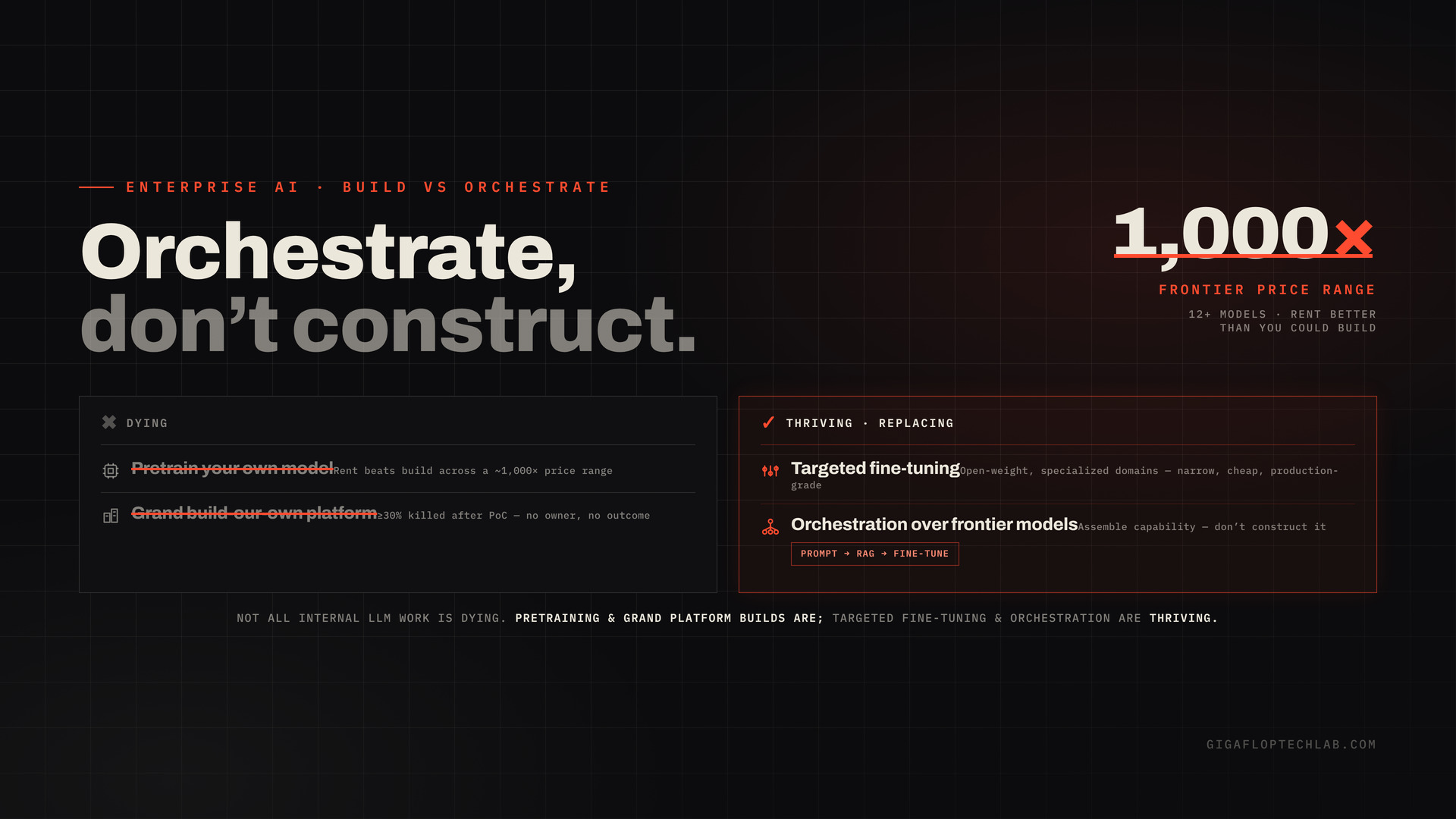
For all but a handful of organizations (sovereign or national efforts, frontier labs), training a model from scratch is over. The reason is simple economics. The frontier-model market now has more than a dozen models competing across a roughly 1,000x price range, and open-weight models keep approaching frontier performance. When you can rent better-than-you-could-build intelligence by the token across a vast price-performance spectrum, spending tens of millions to pretrain your own is a vanity line item, not a strategy. For enterprises, this bet is effectively dead.
Dying: the grand “build our own AI platform from scratch” program
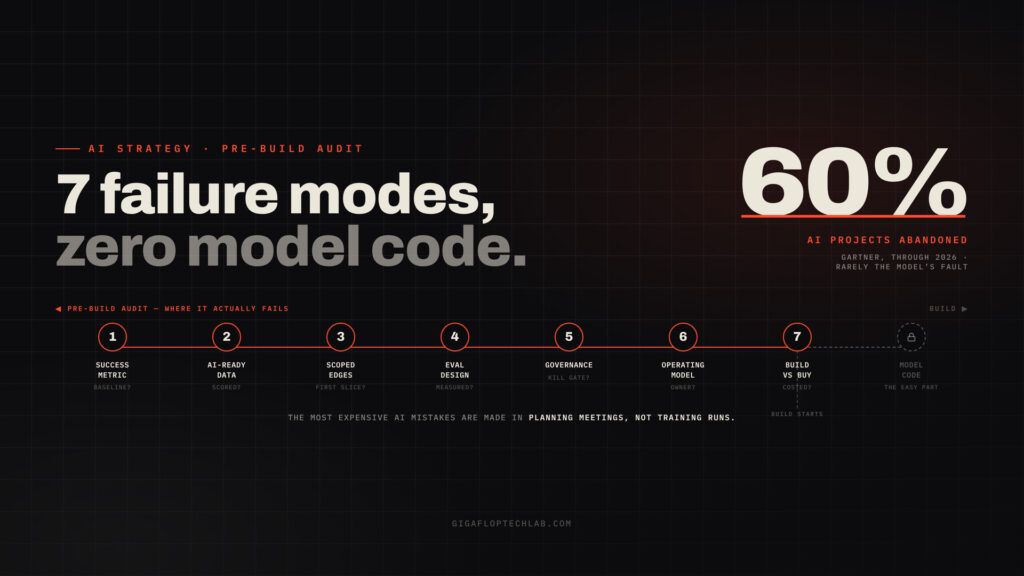
The flagship internal program, a big team, a multi-quarter roadmap, a bespoke end-to-end stack, is the other casualty, and for a more painful reason: most of them didn’t work. Gartner has predicted that at least 30% of GenAI projects are abandoned after the proof-of-concept, driven by weak data quality, inadequate risk controls, escalating costs, and unclear business value, and internal builds succeed at roughly half the rate of expert-led ones. These grand programs collapsed under the same forces behind the so-called AI failure rate: no defined outcome, the demo-to-production gap, unowned results. The budget review came, the value couldn’t be shown, and the flagship got quietly killed.
Not dying: targeted fine-tuning of open-weight models
Here’s where the “killing internal LLM projects” headline overshoots, and honesty requires saying so. Fine-tuning an open-weight model on proprietary domain data is rising, not dying: for specialized domains (legal, medical, financial) with proprietary terminology, for data-sovereignty requirements, and where base-model behavior is inadequate even with RAG. This is a fundamentally different activity from pretraining or building a platform. It’s narrow, cheaper, and often delivers production-grade performance at a fraction of the cost. So “enterprises are killing internal LLM work” is false as a blanket claim. The grand internal projects are dying; targeted internal customization is healthier than ever.
What’s replacing them: orchestration, not construction
The thing replacing the killed flagships isn’t “buy a chatbot and give up.” It’s a genuinely different way enterprises get AI capability, and it’s smarter than what it replaced.
The old framing was binary: build (a huge internal engineering program) or buy (adopt an integrated vendor platform). LLMs introduced a third path that’s now dominant: assemble capability through orchestration. Layer a frontier model on top of existing platforms, connect it to your enterprise data, enforce entitlements and policy controls, and deploy targeted agents into specific workflows. The ownership question stops being “build or buy the model?” and becomes far more granular: which workflows get AI decisioning, where intelligence should live in the architecture, what needs to be differentiated versus standardized, and how accountability is structured when AI influences outcomes.
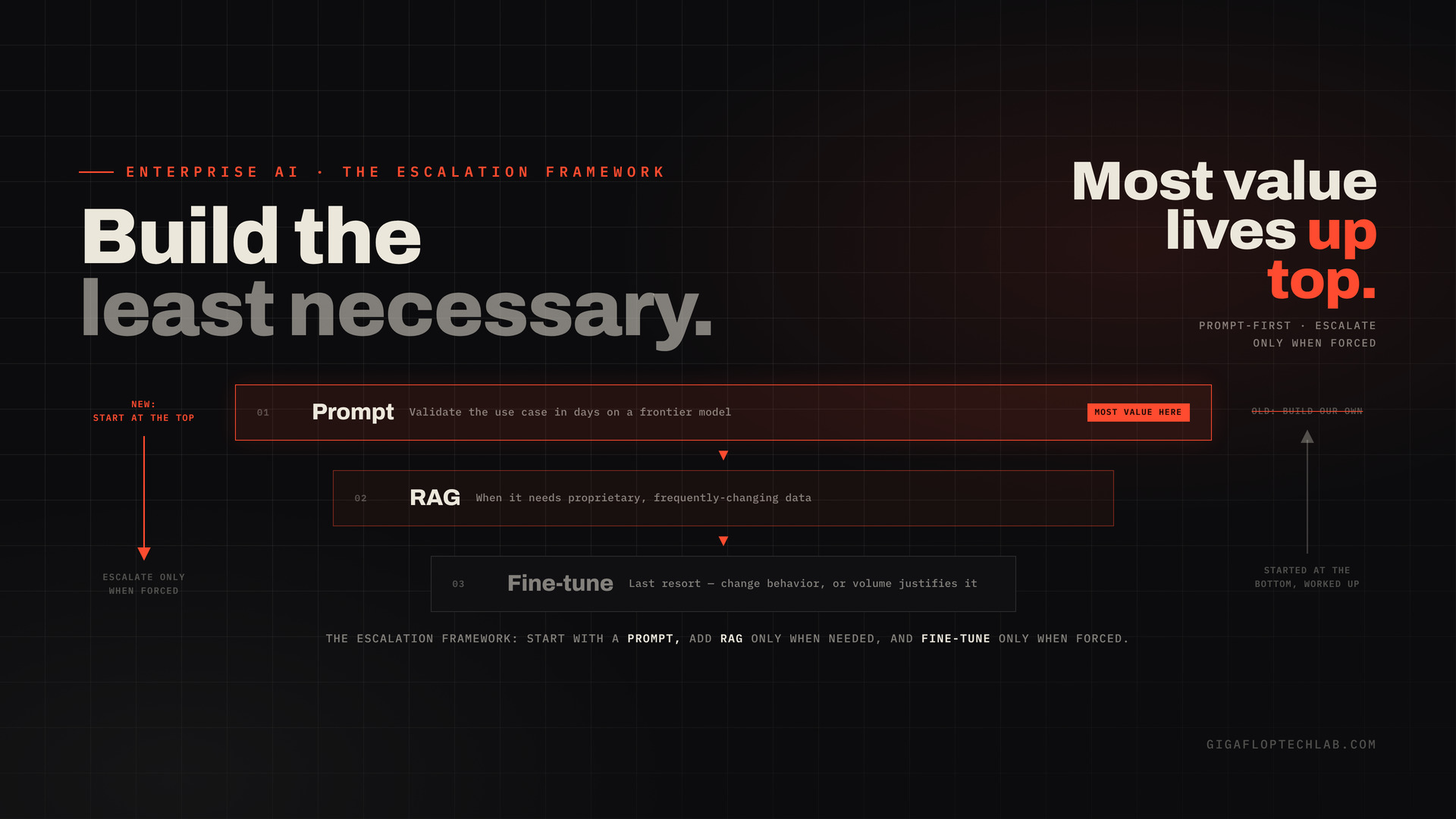
In practice, the replacement follows an escalation framework that successful teams now treat as the default:
- Prompt engineering first. Validate the use case in days on a frontier model. Most of the value lives here.
- RAG next. When the model needs to know proprietary, frequently changing data, retrieve it rather than train it in.
- Fine-tuning as a last resort. Only when you need to change how the model behaves (specialized lingo, brand tone) or when volume justifies training a smaller, cheaper model.
Notice what this inverts. The killed flagship projects started at the bottom of that ladder, “let’s build or train our own,” and worked up. The replacement starts at the top, “what’s the smallest intervention on a frontier model that solves this?”, and escalates only when forced. It’s the least-specialized-tool principle applied to AI capability: don’t build what you can orchestrate, don’t fine-tune what RAG solves, and don’t RAG what a good prompt solves. Deciding which workflows even deserve AI decisioning is half the battle.
<!– VISUAL 2: GIF or SHORT VIDEO (required). Show, don’t tell. Suggested: a short animated GIF of the escalation ladder: start at the top (Prompt), escalate to RAG only if needed, escalate to Fine-tune only if forced, with a “build the least necessary” tagline. Contrast with the old bottom-up “build our own” arrow. Compress. ALT TEXT: “Animated escalation ladder for LLM capability: prompt first, then RAG, then fine-tuning only as a last resort” CAPTION: The escalation framework: start with a prompt, add RAG only when needed, fine-tune only when forced. –>
Why this is maturation, not retreat
Read correctly, this trend is one of the most bullish things happening in enterprise AI, because it’s the market getting good at it.
- Capital moves from infrastructure to outcomes. Money that went into building models nobody could productionize now goes into narrow systems that actually ship. That’s discipline, not retreat.
- Speed goes up. Prompt-then-RAG validates a use case in days; a from-scratch build validated nothing for quarters. Killing the flagship to ship five targeted agents is a better AI program. A 191-CV screening stack that shipped in production is worth more than a platform team that never left the roadmap.
- The differentiation question gets honest. A commercial frontier model is available to your competitors too, so differentiation comes from your data, your workflows, and your orchestration, not from a model you trained. That’s a more durable moat than a model that’s obsolete in a year anyway.
What this means for your roadmap
If you have an internal LLM project right now, the useful question isn’t “should we be worried?” It’s “which kind is it?”
- Pretraining your own model? Unless you’re a sovereign or frontier-lab-scale effort, this is the one to question hardest. The economics have moved under you.
- A grand build-our-own-platform program? Pressure-test it against the failure pattern: is there a defined outcome, an owner, a path past the demo? If not, it may be a flagship heading for the quiet-kill list, and it’s better to refactor it into targeted, orchestrated systems now. Our production-readiness checklist is a good stress test.
- Targeted fine-tuning for a genuinely specialized domain? That may be exactly right. Just make sure you’ve earned it by exhausting prompt engineering and RAG first.
The bottom line
The quiet killing of internal LLM projects isn’t a story about AI failing. It’s a story about enterprises learning the difference between constructing AI and orchestrating it, and reallocating from the first to the second. Pretraining your own model and the grand from-scratch platform are dying because the cost-capability landscape made them irrational. Targeted fine-tuning is thriving. And the dominant replacement is orchestration over frontier models, with an escalation framework that builds the least necessary, not the most.
So if your flagship internal LLM project is wobbling, the lesson isn’t “AI doesn’t work.” It’s that you may have been building when you should have been orchestrating. The enterprises pulling ahead aren’t the ones who trained a model. They’re the ones who shipped ten targeted systems while the others were still hiring for the platform team.
Talk to a builder
Have an internal LLM project you’re not sure about, a flagship to double down on, or a build that should have been an orchestration? That’s a clear-eyed call worth making before the next budget cycle makes it for you.
Talk to a Builder → We’ll pressure-test your internal LLM work against the escalation framework (prompt, then RAG, then fine-tune) and the build-versus-orchestrate question, and tell you honestly what to keep, refactor, or kill. For the broader outlook, subscribe to our newsletter, The Gigaflop Brief.
FAQs
A specific kind, yes, but not AI overall. What’s being wound down is pretraining proprietary models and the grand “build our own AI platform from scratch” programs, because frontier models now span a roughly 1,000x price range and Gartner has estimated at least 30% of GenAI projects are abandoned after the proof-of-concept from unclear value and governance gaps. Targeted fine-tuning of open-weight models for specialized domains is actually rising. It’s a reallocation, not a retreat.
Economics. With more than a dozen frontier models competing across a roughly 1,000x price-performance range and open-weight models approaching frontier quality, you can rent better intelligence than you could build, by the token. Spending tens of millions to pretrain your own model is a vanity line item for all but sovereign or frontier-lab-scale efforts. The cost-capability landscape moved, so the rational build-versus-buy answer moved with it.
Orchestration over frontier models: layering a model on existing platforms, connecting it to enterprise data, enforcing entitlements and policy, and deploying targeted agents into specific workflows, rather than constructing a model from scratch. Most teams now follow an escalation framework: prompt engineering first (validate in days), RAG when the model needs proprietary knowledge, and fine-tuning only as a last resort when behavior must change or volume justifies it.
No, and that’s the nuance the “killing internal LLM projects” headline misses. Fine-tuning open-weight models on proprietary domain data is rising for specialized fields (legal, medical, financial), data-sovereignty needs, and cases where base-model behavior is inadequate even with RAG. What’s dying is pretraining from scratch and grand platform programs. Fine-tuning is a targeted, cost-effective customization, just one you should reach for only after exhausting prompt engineering and RAG.
Use an escalation framework rather than a binary build/buy choice. Start with prompt engineering on a frontier model to validate the use case in days; add RAG when the model needs to know frequently changing proprietary data; fine-tune only when you need to change model behavior or volume justifies a smaller trained model; and reserve building or training for genuinely exceptional cases. The principle is to build the least necessary: orchestrate before you construct.
Usually the opposite. A model you trained is available-grade intelligence your competitors can rent too, and may be obsolete within a year. Durable differentiation comes from your proprietary data, your workflows, and your orchestration, not from the model itself. Reallocating from a stalled build to targeted, orchestrated systems that actually ship typically strengthens your competitive position rather than weakening it.